How to Tell Minecraft: Quick Identification Guide
Learn how to tell Minecraft apart from imitators with clear visual cues, edition notes, and official indicators. This Craft Guide tutorial helps players identify the real game across Java and Bedrock editions.


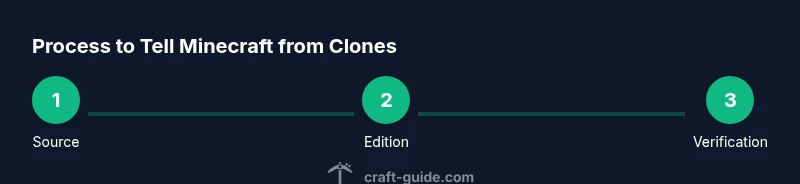
According to Craft Guide, you’ll quickly learn how to tell minecraft apart from imitators by checking official sources, edition indicators, and in-game cues. This quick guide summarizes the key checks: launch from the official launcher, confirm the edition (Java or Bedrock), verify the version number, and inspect the UI for vanilla visuals. These checks help you avoid counterfeit downloads and mislabelled packs.
What counts as Minecraft?
According to Craft Guide, the quickest way to tell minecraft authenticity starts with the launcher, the official site, and clearly published feature lists. This section defines what qualifies as the real game and what features matter when you verify a copy, a mod pack, or a world file. Minecraft is characterized by a blocky, voxel-based world, a specific color palette, and consistently updated edition branding. While many imitators emulate the look, the authentic game is backed by official distribution channels, version strings, and Mojang's licensing.
Visual cues that identify Minecraft
Minecraft has a signature visual language: chunky, block-based blocks; default textures like dirt, stone, and grass; a distinctive font in menus; and the classic crosshair and inventory layouts. This section lists the key cues you can check quickly. Look for the default grass texture and block shapes, the absence of high-fidelity textures typical of modern shooters, and the characteristic sky gradient. If you see hyper-realistic textures or non-blocky lighting, you're likely looking at a modded pack or a clone, not vanilla Minecraft.
Edition and platform indicators
Minecraft exists in several editions: Java Edition, Bedrock Edition, and legacy variants. Each edition uses different launchers, version numbering schemes, and feature sets. Java Edition focuses on PC with a dedicated launcher and universal mod compatibility, while Bedrock runs on consoles, Windows 10, and mobile with cross-platform play supported to some extent. The launcher icon, version string (for example, 1.20.3), and update channel reveal the edition. If you can't identify the edition from the launcher or the main menu, you may be looking at a clone or an unofficial build.
In-game indicators to verify authenticity
Within the game, look for the official menu layout, Mojang Studios logo splash screens, and the absence of unrelated branding in the main menu. Authentication prompts often appear when connecting to multiplayer servers; official servers show recognized domain patterns and the standard login flow. You can also verify the game’s version via the pause menu, or the credits screen, which should reflect the correct edition and latest update.
Red flags and common misconceptions
Beware of shiny, high‑resolution textures that look too modern for vanilla Minecraft; clones often imitate fonts but use non‑standard UI elements. Modded packs may feature their own logos and custom menus, which can be mistaken for official branding. If a site asks you to disable security software or install from an untrusted app store, stop and walk away. Always circle back to the official pages to confirm legitimacy.
How to verify a Minecraft download or mod pack safely
Always download from official sources such as minecraft.net or the Microsoft Store, and use the official launcher to start the game. Verify any provided file hashes or digital signatures when possible, and avoid installers from untrusted sites. For mods, use trusted loaders like Forge or Fabric and ensure compatibility with your edition. Cross-check the mod's publisher and read user reviews to spot fake or outdated content.
Quick self-check list for authenticity
Before launching a world or connecting to a server, run through a brief checklist: confirm the download source is official, verify the edition and launcher, inspect textures and UI against vanilla visuals, check the version string on the main menu, and review any mod or pack name for official indicators.
Tools & Materials
- Official Minecraft launcher(Download from the official site or Microsoft Store)
- Verified internet connection(Stable connection to access official pages)
- Official Minecraft account(Required to authenticate and download)
- Access to official Minecraft website(For source verification and hashes)
- Trusted mod loaders (Forge/Fabric) if modding(Only when using mods from reputable sources)
Steps
Estimated time: 20-30 minutes
- 1
Verify download source
Begin by visiting the official pages (minecraft.net or the Microsoft Store). Check the URL and ensure the connection is secure (https). If you cannot verify the source, do not download or install anything.
Tip: Always start at official sites to avoid counterfeit installers. - 2
Check edition and launcher
Identify the edition you need (Java vs Bedrock) and confirm you are using the correct launcher for your platform. The launcher icon and edition label should match your device.
Tip: Match the edition to your device (PC vs console/mobile) before proceeding. - 3
Inspect visuals in-game
Launch a test world and observe block textures, lighting, and UI. Vanilla Minecraft uses a distinct blocky aesthetic; anomalies often indicate mods or clones.
Tip: If textures look unusually modern, recheck your source. - 4
Verify version numbers
Open the pause menu or main menu and confirm the version string aligns with official release notes. Mismatches can signal an unofficial build or outdated mod.
Tip: Cross-check the version with the official site’s patch notes. - 5
Test with official servers or seeds
Connect to an official server or load a known, legitimate seed to confirm expected behavior. Clones often behave differently or block access to official servers.
Tip: Prefer tested, verified environments for verification. - 6
Assess mods and packs cautiously
If using mods, verify the publishers, compatibility, and mod loader (Forge/Fabric). Avoid any mod packs from untrusted sources and read reviews.
Tip: Only install mods from trusted communities with clear publishers.
People Also Ask
What exactly defines Minecraft authenticity?
Minecraft authenticity is defined by official distribution channels, the block-based visuals, and edition-specific features. Cross-check the launcher, platform, and version numbers with official pages. When in doubt, verify the source and apply common-sense checks.
Authenticity means using official sources and matching the edition, version, and visuals.
Can I tell Minecraft apart from clones by visuals alone?
Visual cues help, but they are not definitive. Clones may imitate textures yet fail on launcher, version strings, or platform features.
Visuals help, but you should also verify the launcher and version.
Are Java and Bedrock editions identified differently?
Yes. Java and Bedrock editions use different launchers, versioning schemes, and feature sets. Check the launcher and the main menu to identify the edition before proceeding.
Java and Bedrock differ in launcher and versions; verify which one you have.
How do I verify a Minecraft download securely?
Always download from official sites, verify any provided file hashes or signatures, and avoid third-party installers. For mods, rely on trusted publishers and community reviews.
Download from official sources and verify signatures whenever possible.
Is it safe to install mods from unknown sites?
No. Use trusted mod loaders and publishers, and check community feedback. Unknown sites can harbor malware or counterfeit content.
No, stick with trusted sources and read reviews.
What if I can't access the official site?
Try the official store on your platform or trusted community forums; avoid mirrors or questionable downloads. If access remains blocked, postpone verification until you can reach legitimate sources.
If you can’t access the official site, avoid downloads from suspicious mirrors.
Watch Video
The Essentials
- Check the source first and foremost.
- Identify edition to your platform before proceeding.
- Verify version numbers and in-game UI as you go.
- Avoid untrusted downloads and dubious mod packs.