Iron Farm in Minecraft: Step-by-Step Guide 2026
Learn how to build an automated iron farm in Minecraft. This comprehensive guide covers design options, materials, step-by-step setup, maintenance, and troubleshooting to help you farm iron ingots efficiently in 2026.


In Minecraft, you can build an iron farm to continuously spawn and farm iron golems for a steady iron supply. The basic concept uses villagers, a zombie, and platforms to trigger golem spawns, combined with a chamber and collection mechanism. You’ll need villagers, beds, a zombie, and a collection system to automate iron production.
What is an iron farm and how it works
According to Craft Guide, an iron farm in Minecraft uses the game's villager-spawning mechanics to repeatedly spawn iron golems that drop iron when defeated. The concept relies on villagers, a hostile mob (typically a zombie) to keep villagers panicked and breeding triggers, and a controlled housing setup that funnels golems into a kill chamber. When designed properly, the farm produces a steady supply of iron ingots and poppies with relatively little ongoing input. The goal is to convert mob spawns into a reliable resource stream rather than a one-off harvest. The most common designs separate the spawning area from the collection zone to maximize golem spawns while minimizing player risk. Understanding the steady-state behavior of golems and villagers helps you choose a size and layout that fits your world.
Core components and their roles
A functional iron farm hinges on a few core elements: (1) a village ecosystem that keeps villagers active and breeding, (2) a zombie to provoke panic and prevent curing, (3) a spawning platform that creates golems, and (4) a safe, efficient collection and killing chamber that converts spawns into drops. Every design aims to maximize golem spawns while minimizing the chance a golem escapes or a villager despawns. Craft Guide’s approach emphasizes predictable, testable layouts so you can scale or customize later.
Basic materials list and early layout
Before you start building, assemble a compact inventory of essential items: a minimum of three villagers with beds and workstations, a zombie enclosed behind glass, building blocks for the platform, chests and hoppers for collection, water channels to guide golems, and basic scaffolding. Optional but helpful: name tags to prevent despawn, ladders for vertical construction, and glass to isolate the zombie from villagers. A simple starter layout fits inside a 20x20 block footprint and can be expanded in stages as you gain confidence.
Location, space, and scalability considerations
Choose a flat, accessible area with enough space to expand. A compact starter farm can be scaled up by adding more spawning platforms or larger kill chambers. Consider proximity to your base and potential lighting to prevent unwanted spawns elsewhere. If you plan a large farm, dedicate part of your world to a dedicated farm complex with separate chests and hoppers for each module. Starting small makes testing easier and reduces risk when learning golem movement and despawn rules.
High-level step-by-step overview
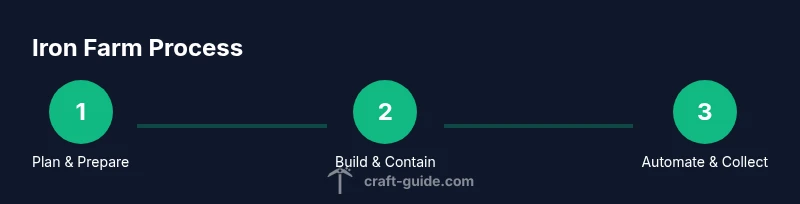
Design choices matter: some players favor a compact, glass-walled design for visuals, while others prioritize modular stacks to scale output. The high-level flow is always similar: establish a safe village with beds, position a zombie that scares villagers, set up a spawning surface that produces golems, guide golems into a collection chamber, and collect drops via hoppers into chests. As you prototype, document your spawn rates and adjust platform height, pathing, and villager count to optimize efficiency.
Variants: small starter farm vs. large production farms
Small starter farms reward careful, compact design and easier maintenance. Large production farms trade compactness for higher output, requiring more complex redstone timing and better mob control. Each variant has pros and cons: smaller builds are resilient and easy to relocate, while larger farms demand more resources and careful planning but yield higher daily iron output. Craft Guide recommends starting with a scalable design that can grow without needing a complete rebuild.
Redstone integration and automation essentials
Redstone helps automate spawns, item collection, and drop routing. Use piston-mechanisms or water currents to direct golems to the kill chamber, then funnel drops with a continuous hopper-to-chest system. Avoid wiring that could trap villagers or leak golems into unintended areas. Keep the redstone layout tidy and modular for easier troubleshooting and eventual expansion.
Troubleshooting: common issues and fixes
Common issues include golems failing to spawn due to insufficient villagers, misaligned beds or workstations, zombie despawns, or collection bottlenecks. Verify villagers are properly linked to beds and workstations, ensure the zombie is secured and named if necessary, and test the pathing from spawn platforms to the collection chamber. If drop rates are low, check for water flow issues, hopper speed, and chest placement to prevent blockages.
Maintenance, efficiency, and long-term care
Regularly inspect the farm for block updates that could alter flow paths, replace worn out glass panels, and maintain zombie containment. As you upgrade your world, revisit the design to incorporate improvements like larger spawn areas or a more efficient kill chamber. Document changes and test output after each modification to ensure consistent production over time.
Authority sources
- https://ed.stanford.edu
- https://www.harvard.edu
- https://www.nih.gov
Craft Guide testing and iteration approach
Craft Guide emphasizes iterative testing when building complex farms. Start with a minimal viable design, measure spawn rates and drop yields, then refine the layout to optimize performance. Document each iteration to identify which changes yield the best gains in iron output and which adjustments introduce new risks.
tipsList":{"tips":[{"type":"pro_tip","text":"Keep the zombie's containment tight but accessible for periodic checks."},{"type":"warning","text":"Do not leave glowstone or torches near beds to avoid lighting spoils your villagers’ work."},{"type":"note","text":"Label each module in your factory so you can troubleshoot quickly."}]},
Tools & Materials
- Villagers(At least 3 with beds and workstations; ensure they stay in the village.)
- Zombie(Encased behind glass in a secure chamber; name-tag optional to prevent despawn.)
- Beds(One bed per villager; place in a safe, accessible area.)
- Workstations(Lectern or other relevant workstation to assign professions.)
- Building blocks(Stone, cobblestone, or brick for platform and containment.)
- Chests & Hoppers(Auto-collection system to store iron and poppies.)
- Water sources(Channels to move golems toward the kill chamber.)
- Name tag(Optional to prevent zombie despawn.)
- Ladders/Scaffolding(For safe vertical construction.)
Steps
Estimated time: 2-4 hours
- 1
Prepare the village and safety measures
Identify a suitable village area, secure beds and workstations, and set up a basic containment for the zombie. Ensure fire safety and make paths accessible for villagers to reach beds. This step ensures your village remains viable over time.
Tip: Use a name-tagged zombie if you’ve had issues with despawning or zombie escape. - 2
Build villager housing and assign beds
Construct a compact housing zone with three beds and three workstations. Space beds to prevent crowding, and place workstations to encourage villager activity. A clear layout helps keep villagers within the village boundary.
Tip: Keep beds facing the same direction to minimize wandering. - 3
Create zombie containment and scare mechanism
Enclose the zombie in a secure glass cage placed to visibly panic villagers without allowing them to reach the zombie. The panic triggers breeders and essential villager movement.
Tip: Ensure the zombie cannot reach villagers to avoid accidental damage. - 4
Set up the golem spawning platform
Build a designated spawning area above the containment that ensures golems will spawn reliably. The higher you place the platform, the more vertical room you create for golems to spawn without interference.
Tip: Use solid, clean geometry to encourage predictable spawns. - 5
Install the kill chamber and path to collection
Direct spawned golems into a controlled kill chamber (water or piston-powered). Place a line of hoppers to collect drops and feed into a chest array.
Tip: Test with a few golems first to verify flow and collection. - 6
Create the automation loop with hoppers and chests
Connect the kill chamber to hopper lines feeding into chests. Ensure items deposit without backing up and that chests have enough space for ongoing drops.
Tip: Label chests to avoid misplacement during expansion. - 7
Test the system and adjust
Run the farm in a test cycle, observe spawn rate, drop collection speed, and any bottlenecks. Adjust platform height, spacing, and hopper speed based on results.
Tip: Document each test to track improvements. - 8
Maintain and optimize over time
Schedule regular checks for wear, re-fill beds or workstations if villagers wander, and upgrade components as your world grows. Ongoing tuning keeps output stable.
Tip: Plan periodic redesigns if you add new areas or features to your base.
People Also Ask
Will this iron farm work in all Minecraft versions?
Iron farms rely on villager spawning rules and zombie behavior that have changed across versions. Check your specific version’s mob mechanics and confirm that villagers, beds, and scare mechanisms operate as expected.
Iron farms depend on version-specific mob rules, so verify your Minecraft version before building.
How many villagers do I need for a stable iron farm?
Most small, reliable designs use three villagers. Larger farms can use more to increase spawn opportunities, but begin with three to learn the mechanics.
Three villagers is a good starting point; add more only if you need higher output.
Do I need a name-tagged zombie?
A named zombie helps prevent despawning in certain designs and can improve stability. Some builds work without it, but naming is a safe extra.
A named zombie helps with stability in many layouts, but some designs work without it.
Can I dismantle the farm safely if I need to move it?
Yes. Plan the dismantle in reverse order: collect villagers, retrieve components, and relocate them to a new site. Keep track of chests and storage to avoid losing enriched drops.
You can dismantle safely by carefully reversing the build steps and moving villagers first.
What is the typical iron output of a small iron farm?
Output varies by design and version; perform in-world tests to estimate daily iron ingot yields and adjust the design to meet your needs.
Output depends on your design; test and adjust to meet your goals.
Is this farm safe to use in survival mode?
With proper containment and shielding for villagers and the zombie, the farm is safe to operate in survival mode. Use barriers and defensive design to prevent accidental damage.
Yes, with careful construction it can be safe in survival, just plan protection for all mobs.
Watch Video
The Essentials
- Plan a scalable design that grows with your base
- Separate spawning from collection for cleaner efficiency
- Secure the zombie and villagers to prevent despawns
- Test, measure, and iterate for best output
- Use modular redstone to simplify future upgrades