Minecraft Enchanting Tables: A Practical Guide
Learn to set up and maximize enchantments with Minecraft enchanting tables, optimizing bookshelf layouts, XP use, and smart combining strategies for durable gear.


By the end of this guide you will be able to set up and use an enchantment table to maximize useful enchantments on tools, armor, and books. You’ll learn how many bookshelves to place, how to choose enchantments for different scenarios, how to combine enchantments with an anvil, and common mistakes to avoid for steady progress.
What is an Enchanting Table and How It Works
Enchanting tables are a core mechanic in Minecraft that lets you apply random enchantments to items using experience levels and lapis lazuli. The interface draws from several enchantment pools, and the options you see depend on your current level and the number of nearby bookshelves. According to Craft Guide, understanding this relationship is the first step toward smarter gear upgrades. In practice, you’ll mix randomness with strategy: higher levels unlock stronger options, but they cost more XP. For most players, the goal is a balance between reliable, useful enchantments and the effort required to reach the next tier. The system rewards patience and planning, so start with modest goals and scale up as you gain XP and resources. As you experiment, you’ll notice certain enchantments pair well with specific playstyles, whether you’re pursuing a long-term mining build or a high-damage combat kit.
Bookshelves and Table Placement: The Core Budget Setup
The number and placement of bookshelves around the enchanting table determine the maximum enchantment level you can access. A standard setup uses 15 bookshelves to reach level 30 enchantments; fewer shelves reduce options. Shelves must be placed at one block distance from the table, with air between them so the game can read the full enchantment pool. Keep passages clear and avoid blocking blocks that would disrupt the enchantment interface. This layout is a good starting point for most playthroughs; you can add more bookshelves later as you go and resources grow. Expanding gradually helps you plan long term and prevents premature XP waste while you build your knowledge and hardware. With the right bookshelf setup, you’ll see a noticeable jump in the quality of options, making every enchanting session more productive.
How Enchantments Are Chosen: Levels, Luck, and Randomization
Enchantments on the table depend on your chosen level and the random draws from the enchantment pools. Higher levels increase the odds of stronger options, but there are no guarantees. Lapis Lazuli is spent to confirm an enchantment, and you can re-roll by closing and reopening the table, paying more XP. Some items have access to special or rare enchantments, which appear less often and depend on luck. The key is to decide which combination of level and option best fits your immediate goals, then use XP and books to refine your gear over time. Remember that enchanting is as much about planning as luck, so track what works for you and iterate.
Practical Setup for Beginners: A Simple Starting Layout
Start with a small dedicated room for enchanting: at least 5 by 5 blocks, with the enchanting table at the center and shelves arranged for easy access. Place up to 15 bookshelves around the table to maximize options, but you can begin with fewer and add shelves as you progress. Gather XP through normal play and mining, and keep lapis Lazuli handy. When you first enchant, choose a level 1 or 2 enchantment to learn how costs scale with level, then plan your next acquisitions based on your play style. A tidy, well-lit setup helps you stay organized, reduces mistakes, and keeps XP costs predictable as you advance.
Choosing Enchantments for Different Tools and Scenarios
For weapons, Sharpness and Power often provide reliable upgrades, while armor benefits from Protection, Unbreaking, or Feather Falling depending on the situation. For tools like pickaxes, prioritize Efficiency, Unbreaking, Fortune or Silk Touch depending on your resource goals. Enchanting a book is a stepping stone; you can later combine it with an item using an anvil to apply multiple effects. Remember that not every enchantment is available on every item; consult your current options and plan the most useful mix for your desired outcome. Mending is highly sought after but may appear irregularly, so consider alternate paths to obtain it if needed. As you experiment, you’ll discover which combinations maximize your efficiency in different biomes and playstyles.
Combining Enchantments with an Anvil: Rules and Tips
Anvils let you combine enchantments from books and items, but each merge costs XP and can become expensive quickly. Start by enchanting a blank book or a low-cost item, then add stronger enchantments later. Always check the XP cost before confirming a merge; renaming a weapon can also be useful for tracking progress. If costs get too high, wait and gain more XP before attempting another merge. The right sequence can turn a scattered set of enchants into a cohesive, high-value build that lasts long-term, especially when you align enchantments with your main activities like mining, building, or combat.
Common Mistakes and How to Fix Them
Common mistakes include under-arming your enchanting area (too few bookshelves), enchanting items at too low levels, and wasting XP by combining inefficiently. Avoid spending XP on weak options when you could wait and unlock stronger enchantments by expanding your bookshelf setup. Also, be mindful of lapis usage: ensure you keep a steady supply and don’t enchant without lapis ready. If you find yourself stuck on the same three options, consider relocating to a brighter space or slightly reconfiguring shelves to refresh the pool. Consistency and incremental upgrades beat bursts of luck, especially for long-term survival play.
Advanced Tactics: Efficiency, XP Farms, and Loot Decisions
As you progress, consider combining enchantments for maximum value: e.g., a Fortune III pickaxe with Efficiency VI can dramatically speed mining. Use XP farms to accumulate experience efficiently; keep a reliable source of mining or smelting XP. Decide whether to push for Mending via villagers or treasure books; adapt your approach to the world you play in (Java vs Bedrock) and the availability of traders. The most successful enchantment setups are dynamic: they evolve with your goals, terrain, and resources, not with a single lucky roll. In practice, plan a weekly goal to expand shelves, gather XP, and refine your enchantment strategy.
Troubleshooting Common Issues
When the enchanting table shows limited options or none at all, verify that you have the needed bookshelves and that nothing reduces the pool size. If you cannot place 15 bookshelves, you may still enchant but with fewer options. If you see mismatched costs or odd prices, check your XP level and the number of bookshelves. Ensure you have lapis lazuli and that you are in the correct version of Minecraft for the enchantments you want. If the interface is lagging, reload the world or restart the client to clear temporary glitches that can affect enchantment rolls.
Tools & Materials
- Enchantment Table(Place on a solid block; ensure space around for shelves.)
- Bookshelves(Aim for up to 15; arrange with a one-block gap from the table.)
- Lapis Lazuli(Needed to perform enchantments; keep stock nearby.)
- Anvil(Use to combine enchantments and rename items.)
- Experience (XP) orbs(Earn XP from mining, smelting, and mob farming; use to apply enchantments.)
Steps
Estimated time: 20-40 minutes
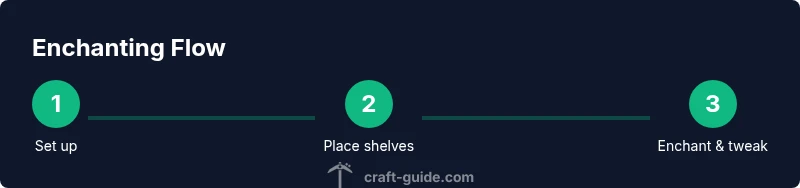
- 1
Choose a location and clear the area
Select a quiet, well-lit space for your enchanting setup. Clear any blocking blocks and ensure you have a 5x5 area with room for shelves around the table.
Tip: If you plan to expand shelves later, keep some open space behind the table for future growth. - 2
Place the enchantment table and set up the initial layout
Place the enchantment table on a solid block in the center of the room. Ensure unobstructed space on all sides for the bookshelves and easy access to XP sources.
Tip: Leave room to walk around; bending to reach shelves is slower and increases misclicks. - 3
Add bookshelves at one-block distance
Arrange up to 15 bookshelves around the table at one block distance with air between them. Start with 10 shelves to begin enchanting and learn how the pool reacts to different levels.
Tip: A clean, circular or semi-circular layout often yields the most consistent options. - 4
Gather XP and lapis lazuli
Farming XP through mining, smelting, and mob farming provides the currency for enchantments. Keep lapis lazuli readily available in a nearby chest.
Tip: Carry a small stack of lapis and an XP source nearby to avoid trips mid-enchantments. - 5
Test enchantments and adjust
Open the table, enchant a test item, observe the options, and adjust your strategy. Re-rolls require more XP, so plan how many options you want to cycle through.
Tip: If you don’t like the options, close and reopen to refresh the pool, then enchant again. - 6
Use anvil to combine and upgrade
When you have two items or books with complementary enchants, use the anvil to merge them. Monitor XP costs and rename items to track progress.
Tip: Avoid expensive merges early; save XP for high-value combinations that dramatically improve gear.
People Also Ask
What is the maximum enchantment level with 15 bookshelves?
With 15 bookshelves you can access level 30 enchantments on many items, but availability depends on the item and luck. The exact outcome can vary between worlds and versions.
You can reach level 30 enchantments with 15 bookshelves, though the exact option depends on the item and luck.
Do I need Lapis Lazuli to enchant a item?
Yes. Lapis Lazuli is required to perform enchantments in the table. Without it, you cannot enchant.
Yes, you must have lapis lazuli to enchant at the table.
Can I enchant multiple items at once?
Enchantments are applied one item at a time. You can enchant several items in sequence, but each enchantment roll consumes XP and lapis separately.
Enchant items one at a time; you can go back for more after each result.
How do I get Mending enchantment reliably?
Mending is a sought-after enchantment and can appear as a treasure option or be obtained via enchanted books or villagers depending on version. It is not guaranteed every time you enchant.
Mending is rare and may appear on books or via trading depending on your version.
Is Infinity or other specific bow enchantments worth pursuing early on?
Infinity is valuable for bow users, reducing arrow consumption. Decide based on your playstyle; you can still rely on Power and Puncture-like options until you can access Infinity.
Infinity is useful for bows, but you can proceed with Power and other basics first.
Can I rearrange bookshelves after starting?
Yes. You can rearrange bookshelves to refresh enchantment options, but be prepared for a temporary drop in available levels while you experiment.
You can move shelves, just expect some fluctuation in options while you adjust.
Watch Video
The Essentials
- Place 15 bookshelves to maximize enchantment options.
- Balance XP cost with valuable enchantments for efficiency.
- Use anvil merges to combine multiple enchantments strategically.
- Keep a steady supply of lapis lazuli and XP sources nearby.
- Expand your bookshelf layout over time to unlock stronger gear.