How Minecraft Enchanting Works: A Practical Guide for Builders
Discover how enchanting works in Minecraft—from the enchanting table and lapis lazuli to bookshelves and anvils. Learn the mechanics, level scaling, and practical tips to secure better enchantments for gear, combat, and exploration.


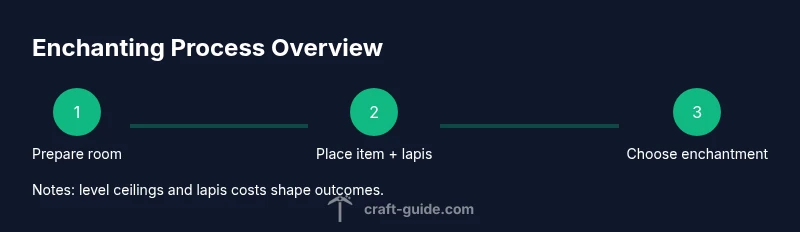
Enchanting in Minecraft uses an enchantment table powered by lapis lazuli. Place an enchantable item and lapis, then pay the level-based cost to reveal available enchantments. Surrounding the table with bookshelves raises the maximum enchantment level you can see, while anvils let you merge or apply multiple enchantments over time. The results are partially random, with higher levels yielding better options.
What enchanting is and why it matters
Enchanting is a core mechanic that adds temporary or permanent bonuses to gear in Minecraft. It sits at the crossroads of resource management, XP farming, and strategic planning. For builders, fighters, and explorers, the right enchantments can dramatically improve efficiency, durability, and combat effectiveness. According to Craft Guide, understanding the balance between the enchantment table, bookshelves, and experience is the foundation for reliable results. In practice, enchantments come from a mix of chance and setup: you expose an item to the enchantment table, spend lapis lazuli and experience levels, and then read one of several available options. The goal is to maximize value while keeping costs reasonable. This article lays out the core concepts—what enchantments are, how they’re earned, and what your first enchanting room should look like—so you can design a practical and repeatable workflow rather than chasing random luck. Craft Guide’s insights help players optimize setups and XP flows for consistent results.
How the enchantment table determines options
When you open the enchantment table, you see three enchantment options. Each option shows a required lapis lazuli cost and a level requirement. The level you can access depends on the table level, which is influenced by the number and placement of nearby bookshelves. The pool of possible enchantments expands with higher levels, giving you access to stronger effects but also introducing more variability. The exact enchantments you get are partly random within the allowed pools, so you may need to re-roll by enchanting a different item or using an anvil to combine later. In short, table level controls the ceiling, quantity, and quality of choices, while lapis is the currency that unlocks them.
The role of bookshelves and experience levels
Bookshelves are the most visible lever for better enchantments. A classic setup places 15 bookshelves around the enchanting table at an optimal distance, creating the highest level cap (in standard gameplay). More bookshelves increase the maximum possible level shown in the enchantment options, which translates into stronger potential effects. Experience levels determine whether an option is visible at all and influence the chance of higher-tier enchantments appearing. Accumulating XP through mining, farming, and combat is essential; without it, you cannot enchant beyond a few basic options. A well-designed enchanting room balances aesthetics with practical XP generation and strategic layout to streamline future sessions.
Lapis lazuli cost and level scaling
Lapis lazuli serves as the fuel for enchantments. Each option requires a specific amount of lapis, and higher-level options demand more. The cost scales with the level of the enchantment you’re trying to access, not the item type itself. This means you can enchant a low-tier item at a low cost or push toward rarer, more powerful effects by investing more lapis and experience. The lapis requirement acts as a barrier that encourages planning and XP management rather than frantic, random tinkering.
How to get better enchantments (tips)
The path to consistently better enchantments lies in preparation and strategy. Build a dedicated enchanting room with a proper bookshelf setup, stock up on lapis lazuli, and accumulate XP via safe farming methods. Craft enchanted books and use an anvil to combine enchantments across gear, preserving the best effects. Keep resources organized and build routines around your preferred playstyle, whether you’re focusing on combat, mining efficiency, or exploration. Craft Guide analysis shows that players who optimize their enchanting room and XP flow are more likely to land high-quality options without excessive costs.
Enchanting vs repairing and combining
Enchanting and repairing are two distinct workflows that often intersect. Enchanting adds new abilities to gear, while repairing restores durability, sometimes in tandem with enchantments. Anvils let you merge enchantments from multiple items or apply enchanted books to gear, which is especially useful when you want to stack beneficial effects. The trade-off is experience cost and potential loss of other enchantments during merges. Planning merges in advance helps you maximize overall value and minimize wasted XP.
Practical examples: common enchantments for different items
For swords, typical goals are high damage and reliability: Sharpness, Looting, and Unbreaking are common, sometimes paired with Fire Aspect. For armor, Protection and Unbreaking improve survivability, with Mending becoming a late-game staple on many servers. For pickaxes and shovels, Efficiency, Unbreaking, and Fortune or Silk Touch (depending on your playstyle) are frequent choices. Bows often benefit from Power, Punch, and Infinity or Flame. This section helps you translate general principles into concrete setups you can replicate.
Common pitfalls and misperceptions
Many players assume the highest table level guarantees the best enchantment. In reality, the pool of options is determined by multiple factors, including item type, XP, and randomization. Some items can’t be enchanted at all in certain versions or require specific conditions. Remember that enchantments come with trade-offs and costs; optimizing your setup is more reliable than hoping for a perfect single-roll enchantment. Focus on sustainable XP generation and modular enchantment strategies to keep advancing gear over time.
Quick reference: cheat sheet for enchantments and costs
- Always build a dedicated enchanting room with 15 bookshelves for best results.
- Use lapis lazuli to access options; more lapis unlocks higher-level choices.
- Combine enchantments with an anvil to maximize effects while conserving XP.
- Prioritize high-impact enchantments early (Unbreaking, Protection, Sharpness) and then fill gaps with supplementary options.
- Enchanted books can save you from expensive re-rolls by allowing strategic merges later.
Tools & Materials
- Enchanting table(Place on solid floor; ensure space for at least one bookshelf block away in every direction.)
- Bookshelves (15)(Placed around the table at a one-block distance to maximize level 30.)
- Lapis lazuli(Needed per enchantment; carry a stash for longer sessions.)
- Anvil(Use to merge enchantments or apply enchanted books; costs XP.)
- Books(Craft enchanted books to preserve specific enchantments for later use.)
Steps
Estimated time: 60-90 minutes
- 1
Set up the enchanting area
Create a dedicated space with a clear square around the enchanting table. Place 15 bookshelves in a ring about one block away to maximize the level cap. This keeps options strong and predictable. Pro tip: use a small, well-lit room to make the process comfortable.
Tip: Visual aid: keep the bookshelf ring level and evenly spaced. - 2
Choose your enchantable item
Pick a gear item you want to upgrade and ensure it can be enchanted in your version. Different items have different pools of possible enchantments, so plan around your current needs. If you’re undecided, start with a basic tool or weapon you use frequently.
Tip: Putting the item in a protected area lets you experiment without losing it. - 3
Place the item and add lapis
Open the enchanting table, place the item, and add the required lapis lazuli. Ensure you have enough XP to cover the cost of at least one option. The interface will display three choices based on current level and item type.
Tip: Keep a stash of XP sources nearby to avoid interruptions. - 4
Read options and pick one
Review the three enchantment options and select the one that best matches your goal. Higher-level options tend to be stronger but may come with trade-offs. If none are appealing, consider enchanting a different item or re-rolling by adding more XP.
Tip: If you’re unsure, enchant something simple first to learn the UI. - 5
If dissatisfied, re-roll or merge
If you don’t like the result, you can enchant again (which may require more XP) or use anvil merges to retain favorable enchantments from multiple items. Merges often yield a stronger final gear set, but at a higher XP cost.
Tip: Enchanted books can save you from wasted XP on retries. - 6
Gather XP for future sessions
Plan activities that generate experience rapidly, such as mining, farming, or mob farming. A steady XP stream makes longer enchantment sessions practical and reduces downtime between upgrades.
Tip: Consider a small XP farm to keep your enchantment options flowing. - 7
Test and refine your setup
Test different enchantments on various items to build a mental map of which combinations work best for your playstyle. Keep records of what worked so you can replicate success in future sessions.
Tip: Maintain a simple log for quick reference during long play sessions.
People Also Ask
What is the purpose of the enchantment table?
The enchantment table provides random enchantments for eligible items using lapis lazuli and your experience. The available options scale with the table level and the proximity of bookshelves. It’s a tool to upgrade gear in a controlled, though partly random, way.
The enchantment table gives you enchantments for eligible items, depending on table level and bookshelves, with some randomness.
Can you enchant any item?
Most gear in Minecraft can be enchanted, including weapons, armor, and tools. Some items have limited or no enchantments depending on version or item type. Always check the item’s enchantment compatibility in your current patch.
Most gear can be enchanted, but some items have limited options depending on the version.
What is the maximum enchantment level?
In standard gameplay, enchantment options can reach level 30 with the right bookshelf setup. The exact level shown depends on table level and XP, not every item will display the same options.
The maximum level shown is 30, achievable with enough bookshelves around the table.
How do bookshelves affect enchantments?
Bookshelves increase the potential enchantment levels you can access. The classic setup uses 15 bookshelves to maximize the level ceiling, resulting in stronger possible enchantments.
Bookshelves raise the level ceiling, letting you access stronger options.
What’s the best way to get better enchantments?
Improve your enclosure around the table, gather XP efficiently, and consider merging enchantments with an anvil. Enchanted books can streamline future upgrades and help you preserve top options.
Increase XP, use bookshelves, and merge enchantments with an anvil for better gear.
Do enchantments work the same across versions?
The core idea remains constant: the enchantment table, lapis, and XP control outcomes. Some enchantments or their availability can vary between Minecraft editions and versions, so verify in your current release.
The mechanism is similar, but some enchantments may change between versions.
Watch Video
The Essentials
- Enchanting uses table level, bookshelves, and XP as core levers.
- Bookshelves raise the ceiling for possible enchantments.
- Anvils merge enchantments and enable powerful combinations.
- Plan XP and lapis usage to optimize outcomes.
- Experiment with items to build reliable upgrade paths.