How to Build an Underground Base in Minecraft: A Practical Guide
Design a secure underground base in Minecraft with practical planning, lighting, and storage layouts. This guide covers location, layout, entrances, and basic redstone to help players build a hidden, efficient base.


By the end of this guide you will be able to design and build a secure underground base in Minecraft that's easy to defend, well lit, and organized for storage, farms, and redstone. You’ll choose a practical location, plan ventilation, and create a scalable layout that keeps mob spawns low and access convenient. No advanced mods required—just time, picks, and careful planning.
Why an underground base Minecraft makes sense
Underground bases excel in stealth, safety, and efficiency. The earth itself acts as a natural shield against mobs, weather, and raiding parties, while offering abundant space for storage rooms, farms, and redstone labs. For many players, tunneling down feels like cheating the terrain—until you see how cleanly a well-planned underground home flows from entry to inner chambers. According to Craft Guide, a subterranean footprint can reduce lighting needs on the surface, keep your base neat, and allow for compact, logical zoning. The key is to start with a simple shaft that becomes the spine of your base, then add rooms that branch off in a grid or a winding maze that’s easy to navigate. In a typical early-game setup, you’ll reserve the lowest levels for mining storage, fuel, and farms, while upper levels house living quarters and redstone experiments. The best designs emphasize three things: safety from hostile mobs, efficient access between zones (quick paths and clear signage), and scalable space so you can grow without tearing down walls. Keep in mind the underground environment is dark; your plan must include reliable lighting, headroom for ventilation, and a plan to manage water if you’re near caverns. Craft Guide’s team suggests thinking in layers: surface access, entry halls, and a main spine that holds your core rooms.
Planning the site: depth, access, and ventilation
Depth matters: starting near the surface means short access tunnels but higher mob risk, while deeper layers require longer tunnels and more careful ventilation. Map out an initial spine as the base’s central corridor, then add branching rooms for storage, farms, and living space. Construct a dedicated air shaft to promote airflow; even a simple vertical shaft can reduce moisture and allow you to swap stale air for fresh air using doors or trapdoors for quick cross-ventilation. When choosing a layout, aim for three zones: surface access and security, a compact living area, and a utility wing for storage and crafting. Lighting is essential to prevent mob spawns; plan torches or lanterns at even intervals and consider blue or green accents to distinguish zones. Finally, plan for water management if your base sits near a cavern or underground river—blocked water is easier to manage than flooded rooms. Craft Guide’s guidance here emphasizes scalable plans: start with a few rooms and expand as you gather resources and confidence.
Core layout and room zoning
Your base spine should connect essential areas: storage, furnace/SMELTING, a crafting/workshop block, and a living space. A typical layout places the main storage near the entrance, with adjacent farms and a drop elevator or ladder to lower levels. Enchantment rooms, an anvil corner, and a small redstone lab can be set on a separate wing to keep noise and traffic away from the living areas. Use consistent blocks and signage to reduce navigation errors; a clear floor plan makes expansion painless. Doors, trapdoors, and staircases should create intuitive pathways—avoid dead ends and consider a double exit for emergencies. Lighting should be steady but not glaring; incorporate alternate lighting (sea lanterns or shroomlights) to reduce mob spawns without creating glare. Floor plans should consider future growth: reserve space for additional storage, automated farms, and a testing area for redstone circuits. Craft Guide’s optimized base designs favor modular rooms connected by a central hallway, which makes exploration quick and predictable.
Entrances and security features
A hidden or semi-hidden entrance helps keep your base discreet while a robust security system keeps intruders out. Start with a discreet surface trapdoor connected to a one-wide shaft, or a small piston door that blends into the surrounding blocks. For true secrecy, use a secondary perimeter entry, such as a ladder shaft behind a decorative block or an iron door controlled by a weighted switch. Once inside, create a clean, well-lit corridor with a clear line of sight to the main spine. Pressure plates and tripwires can deter unwanted visitors, but rely on resettable mechanisms rather than permanent traps. Redstone circuitry should be compact and easy to troubleshoot; do not overcomplicate the entry if you’re new to wiring. Safety comes first: never seal a water or lava feature behind a door that you cannot quickly open. A well-designed entrance reduces accidental mob spawns and keeps your base secure during long play sessions.
Lighting, mobs, and air management
Underground spaces demand careful lighting to prevent mob spawning while keeping ambiance. Use a mix of torches, lanterns, and hidden lighting blocks to create even coverage without dark pockets. Place lights at regular intervals along walls and ceilings; avoid creating bright, single-source glare that reveals your layout. Air movement is easy to achieve with a simple air shaft that connects to the surface, allowing a breeze of fresh air and preventing moisture buildup. If your base intersects lava or water, seal the flow with non-solid blocks or create drainage channels that won’t flood rooms. Mob-proofing should focus on maximum coverage at floor level and in chokepoints: convert large open halls into smaller, walled sections with gates. Craft Guide’s approach is practical: plan lighting, ventilation, and water control as intertwined systems rather than separate chores.
Redstone and automation basics
Redstone is your best friend for efficiency: automatic doors, item transport, and farming automation save time and create a smoother experience. Start with a simple piston door or a gated entrance that opens with a lever or button, then progress to a compact item transport line that moves ore between storage and furnaces. Use pressure plates for convenient, responsive access to kitchens or farms, but place them where mobs cannot trigger them inadvertently. Create a dedicated power rail for furnaces and a small water stream to move items into chests. For farms, wire a basic seed-to-harvest loop that produces resources with minimal attention. Keep redstone layouts modular so you can add features without reworking the entire system. Craft Guide’s recommended practice is to test small circuits first before expanding into larger automation networks.
Finishing touches: decor and practicality
The final stage focuses on comfort and usability. Choose a cohesive color palette for floors and walls, and install signage to prevent confusion as you expand. Add personal touches like a bookshelf wall, a crafting corner, and compact storage bays that maximize space. Create a simple emergency route to the surface in case of a major cave-in or lava flood; a secondary exit can be a ladder shaft hidden behind a closet or a false wall. For farms, design vertical stack layouts that minimize walking distance and maximize daylight or artificial lighting. Finally, document your design decisions with notes or signs so future builders can understand your zoning and logic at a glance. Craft Guide’s emphasis on organization helps you keep the underground base practical, clean, and ready for future growth.
Authority sources
- https://www.nist.gov
- https://www.mit.edu
- https://www.harvard.edu
These sources offer general guidance on safety, architecture, and design principles that inform practical building in any environment. While they are not Minecraft-specific, applying their best-practice ideas helps you create more resilient underground spaces. Craft Guide Team notes that translating real-world planning concepts into Minecraft builds can improve durability and efficiency over time.
Tools & Materials
- Stone or brick blocks(Base walls and floors; choose durable blocks.)
- Wooden or stone stairs(Connect floors and ensure easy navigation.)
- Torches/lanterns/sea lanterns(Lighting to prevent mob spawns.)
- Ladders or scaffolding(Access between levels.)
- Doors or trapdoors(Secure entrances and control flow.)
- Water bucket(Drain or create water-based features.)
- Chest, barrel, or shulker boxes(Storage and organization.)
- Furnaces and blast furnaces(Smelting and smithing.)
- Redstone dust and basic components(Automations (doors, farms).)
- Fence gates or walls(Prevent mob access to farms.)
Steps
Estimated time: 60-120 minutes
- 1
Choose your location
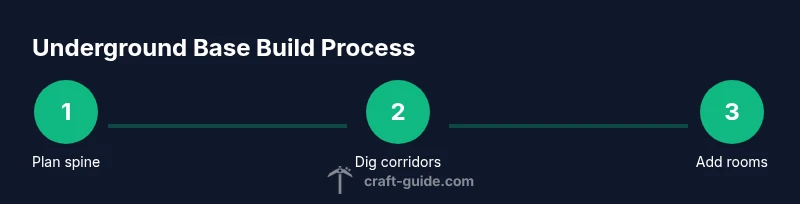
Survey the terrain and pick a spot that minimizes cliff exposure and maximizes access to caverns for mining. Decide on a vertical spine that will serve as the base's core transport route. Consider the depth to bedrock and the likelihood of nearby caves.
Tip: Take screenshots or a quick map sketch to guide future expansions. - 2
Dig the initial spine
Dig a straight vertical shaft or a shallow ramp that will become the base's central corridor. This spine should be wide enough for future expansion and should connect all planned zones with minimal turns.
Tip: Use ladders as you descend to keep the shaft safe and navigable. - 3
Roughly carve rooms
Branch off the spine to create storage, farms, living quarters, and a workshop wing. Maintain consistent room heights and plan for future growth by leaving extra space along each corridor.
Tip: Label rooms with signs to avoid confusion later. - 4
Add access and ventilation
Install staircases or ladders between levels. Create a dedicated air shaft to improve airflow and reduce moisture buildup. Keep an eye on water flow and seal any leaks quickly.
Tip: Place ventilation near central rooms to improve reach. - 5
Light and security
Place lighting evenly to prevent mobs and set up a secure entrance system (hidden door or piston door). Avoid bright gaps that reveal the layout. Test the entry and ensure you can retreat to safety.
Tip: Use a secondary escape route as a precaution. - 6
Storage and farms
Install chest clusters and automated or manual farms close to the storage area to minimize walking distance. Use signs and item frames to keep inventory organized and easy to navigate.
Tip: Plan item routing so you can move ore and food efficiently.
People Also Ask
Where is the best depth for an underground base?
There is no single best depth; plan around nearby caverns and your access needs. Depth affects mob exposure and resource availability; balance accessibility with safety.
There’s no single best depth—plan around caverns and access needs for safety and efficiency.
How do I light an underground base without creating glare?
Use a mix of sea lanterns, glowstone, and hidden lights behind slabs or stairs. Spread lights evenly to avoid dark corners that mobs can spawn in.
Mix different light sources and hide lights behind blocks for even coverage.
How can I connect surface and underground entrances securely?
Create a concealed surface entrance connected to a shaft that leads to your spine. Add a secondary exit for emergencies and a simple door mechanism.
Use a hidden surface entrance connected to a shaft with a secondary exit.
What blocks are best for walls inside an underground base?
Durable, easy-to-mine blocks like stone, brick, or concrete provide a strong, clean aesthetic and simplify maintenance.
Use sturdy blocks like stone or brick for durable walls.
How can I store items efficiently?
Group related items in labeled chests; use color-coded chests or item frames to make locating items quick. Consider a dedicated ore, food, and farming wing to minimize walking.
Label chests and group items by function for faster access.
How do I prevent floods or cave-ins?
Seal openings with solid blocks, install drainage channels, and keep water sources away from critical rooms. Build ceilings high enough to accommodate any unexpected water flow.
Seal openings and design drainage to avoid floods.
Watch Video
The Essentials
- Plan a scalable spine that connects all zones
- Ventilate early to prevent moisture
- Secure entrances to deter mobs
- Keep storage compact and organized