What Does Every Minecraft Base Need? A Practical Guide
A practical, step-by-step guide detailing the core components, layout, lighting, storage, and defenses that every Minecraft base should have. Learn how to plan, build, and expand your base with clarity and durability from Craft Guide.


In this guide you’ll discover the core components every Minecraft base needs—from a safe foundation and organized storage to lighting, farms, and defensive measures. You’ll learn practical priorities for early-game builds and scalable strategies for later expansion, all explained with clear, actionable steps.
Core needs of a Minecraft base
A solid base begins with a clear purpose: a safe shelter, a reliable storage system, a functional work area, and room to grow. According to Craft Guide, starting with safety, organization, and a defined layout makes later expansion smoother. Think of your base as a modular system where every room has a role (living space, storage, farms, and workshop). This clarity helps you prioritize materials, time, and effort in the early game while leaving room to scale as you gather more resources.
Key base purposes to consider include protection from hostile mobs, efficient access to essential resources (food, wood, stone), and a centralized storage hub to minimize wandering. With these in mind, you’ll create a foundation that supports exploration, mining, farming, and redstone projects without constantly rearranging later.
- Safety and access: protect your spawn area and build around predictable routes.
- Organization: central storage reduces time spent searching for items.
- Expansion: plan modular rooms so you can add farms, farms, and workshops without major overhauls.
Craft Guide emphasizes that starting with these priorities helps you stay focused during the chaos of early-game survival.
note":"Focus on a single, cozy shelter first, then scale out.
"} ,
Tools & Materials
- Crafting Table(Needed to craft most base components and storage systems.)
- Furnace(Smelts ores and processes food; essential early on.)
- Chests (wooden or stone)(Centralized storage to stay organized.)
- Torches or Lighting Blocks(Prevents mob spawns and improves visibility.)
- Shovel(Terrain shaping and foundation prep.)
- Pickaxe (stone or better)(Mine stone, collect building materials.)
- Building Blocks (stone, wood, or brick)(Core materials for walls, floors, and roofs.)
- Food/Campfire/Farming Tools(Sustain health while you build and farm.)
- Ladders or Scaffolding(Helps reach higher zones safely during construction.)
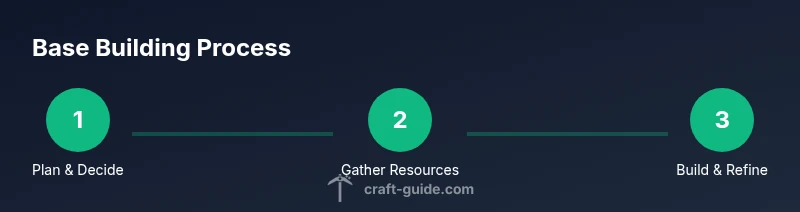
Steps
Estimated time: 60-180 minutes of playtime
- 1
Define your base purpose
Decide what your base must do in the next 1–2 in-game days: shelter, storage, farms, and a workshop. This clarity guides location choice, materials, and room layout, reducing wasted time and resources.
Tip: Write a quick one-sentence goal for the base before you start laying foundations. - 2
Scout your location
Find a flat or gently rolling area close to essential resources or a road network. Consider proximity to a cave for ore, a river for water, and easy access to your mining zone. This helps with travel time and safety.
Tip: Avoid overly exposed cliffs; look for natural barriers that can enhance defense. - 3
Lay a simple foundation
Create a small, raised platform or solid floor using durable blocks. Establish a basic loop path between planned rooms (living, storage, farms) to minimize backtracking during early construction.
Tip: Keep foundations modular so you can extend without heavy rework. - 4
Plan core rooms and connections
Draft a simple map: living quarters, storage hub, farms, and a crafting/work area. Use a central corridor or hub to keep movement intuitive and efficient.
Tip: Label corridors visually using different block tones or signs. - 5
Build sturdy walls and a roof
Construct primary walls with sturdy blocks and add a roof to protect from weather and mobs. Elevate ceilings for ventilation and easier lighting placement.
Tip: Leave space for future windows or skylights to improve ambiance. - 6
Install lighting and storage systems
Place torches or lighting blocks to eliminate dark spots. Create a centralized storage area with labeled chests and a basic item sorter if possible.
Tip: Group related items together and keep a predictable chest layout. - 7
Add farms and essential utilities
Set up a small food farm (crops or animals) and a processing area with furnace, chest, and crafting table. This reduces trips to distant farms.
Tip: Test early farming layouts to ensure steady resource flow. - 8
Implement security and plan for expansion
Light perimeter areas, install doors or gates, and consider a basic defensive layout. Plan modular extensions (additional farms, rooms, or storage) for future growth.
Tip: Keep modules loosely connected to simplify future upgrades.
People Also Ask
What is the minimum base needed in the early game?
Start with a small, enclosed shelter, a bed, a furnace, and basic storage. This provides safety, quick respawn, and fuel access as you gather more resources.
Begin with a small shelter and essential tools to stay safe and organized.
How should I design storage for efficiency?
Build a central storage hub with labeled chests organized by category. Use signs or item frames to keep items easy to locate, and consider basic sorting to reduce wandering.
Create a central area with labeled chests to save time.
What materials are best for a durable base?
Stone, brick, or polished variants offer good durability and fire resistance. Choose materials that align with your aesthetic while staying practical for construction.
Durable stone or brick bases are both strong and visually appealing.
How can I defend my base from mobs at night?
Ensure consistent lighting, seal entry points, and use doors or gates. Elevate the base to reduce ground-level mob access and consider fences around the perimeter.
Light up zones and seal doors to keep mobs out.
Is it better to build solo or with villagers?
Both work. Solo builds emphasize self-sufficiency, while villagers can provide trading opportunities. Plan a trades hub later if you want villagers close to your base.
Both approaches have benefits; plan based on your goals.
Watch Video
The Essentials
- Define a clear base purpose before building.
- Prioritize safety, storage, and modular expansion.
- Use a simple, scalable layout to ease future upgrades.
- Plan lighting and defenses early to minimize mob spawns.