How to Build a Simple House in Minecraft
Learn to design and construct a small, sturdy starter house in Minecraft with practical steps, material choices, and interior details that suit beginners and advanced players alike.


By the end, you will be able to design and build a small, sturdy starter house in Minecraft using basic materials. This guide covers planning, a practical layout, material choices, and simple interior details that work in most biomes. According to Craft Guide, starting with a compact plan reduces resource waste and keeps your early-game progression smooth.
Planning your simple house
A great starter home begins with clear planning. In Minecraft, space economy matters: a compact footprint saves resources while still offering all essential rooms. Start by choosing a site with flat terrain and easy access to water or a nearby cave for resource gathering. Think about entry points, window placement for natural light, and a small storage corner to keep inventories tidy. Craft Guide emphasizes that a well-thought-out footprint reduces unnecessary digging and makes later expansions smoother. Visualize the main room, storage, and a safe sleeping area, then sketch a rough layout on paper or in your head before you place a single block.
Layout and space planning
Your house should balance function and buildability. A simple two-room layout—one main living area and a compact bedroom—works well for beginners. Place doors to minimize hallway length and maximize usable wall space for chests, crafting tables, and furnaces. Use logical dimensions like 7x9 blocks for a compact, cozy feel, leaving room for a small inventory nook. Consider biomes: if you’re in a snowy region, plan for a door overhang to reduce snow build-up; in deserts, keep shade in mind and tuck storage away from heat. A good layout keeps essential tools within arm’s reach and makes future extensions straightforward.
Materials and resource management
Choose materials that are easy to gather and aesthetically cohesive. Common starter materials include oak or spruce planks, a door, glass panes for windows, and cobblestone accents for durability. Avoid overcomplicating with rare blocks in the first build; prioritize readily renewable resources like logs, planks, and basic stone variants. A simple palette speeds up construction and looks clean. Plan for a consistent block rhythm—alternating walls with a single accent material—so the house reads well at a glance. Keeping inventory costs down is crucial for progression, so batch-smelt and craft whenever possible to maximize efficiency.
Foundations, walls, and doors
Begin with a solid foundation, typically a raised or level floor, to prevent moisture and mobs from entering. Build up your walls using a stable, repeating pattern that suits your chosen aesthetic, then install the door in a central location for symmetry. Windows should be sized to provide light without sacrificing privacy; use glass panes rather than glass blocks for a lighter feel. Reinforce corners with a contrasting block for visual interest, and ensure the height allows for a comfortable ceiling—not so low that you feel enclosed, not so high that it wastes materials.
Roof design and finishing touches
A simple pitched or flat roof keeps the build approachable. For a classic look, a gable roof with wooden stairs and slabs adds depth without complexity. Alternatively, a flat roof with a small parapet can feel modern and is easy to complete. Exterior details like a small porch, a half-block awning, or a fence boundary help define the home’s character. Lighting isn’t just functional—it enhances curb appeal. Place lanterns or torches away from combustible blocks and ensure indoor lighting reaches all corners to prevent monster spawns.
Interiors, lighting, and safety
Inside, allocate a dedicated storage wall, a crafting zone, and a simple bed nook. Use lighting strategically: place torches on walls to avoid cluttering surfaces while keeping the space bright enough for workbenches. A compact kitchen corner can be added with a furnace, smoker, and an anvil as you expand. Safety comes from design: keep doors accessible, avoid lava near the floor, and plan a quick escape route if you’re playing on a hostile surface. A well-lit, organized interior helps you stay productive and inspired to expand later.
Tools & Materials
- Pickaxe(Stone or better recommended for speed.)
- Axe(Useful for clearing trees quickly.)
- Shovel(Compact dirt and gravel digging.)
- Blocks for walls (oak planks)(Plan a consistent palette.)
- Door (wooden)(Place in a convenient entry.)
- Glass panes(For light without bulk.)
- Cobblestone or stone variants(Optional accents for durability.)
- Ladders or stairs(Assist access to upper levels.)
Steps
Estimated time: 60-120 minutes
- 1
Choose location and footprint
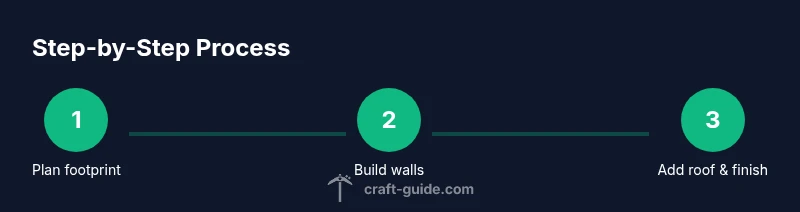
Scan the terrain and mark a rectangular footprint that fits your planning. Keep at least a 7x9 block area for a compact, comfortable space. This step sets the foundation for easy expansion later.
Tip: Use temporary blocks to map corners before committing. - 2
Lay the foundation
Clear the footprint and place a solid floor. Level ground or build a raised platform to prevent moisture and mobs from entering. Ensure the corners are square for clean walls.
Tip: Check diagonals to verify right angles. - 3
Build the walls
Erect walls using your chosen planks, keeping door placement visible from the outside. Maintain a consistent height for a neat silhouette.
Tip: Pause to align windows with interior storage zones. - 4
Install doors and windows
Place a door on the front or side that makes daily access convenient. Add glass panes or windows along the walls to maximize light and visibility.
Tip: Spread windows to balance light and privacy. - 5
Add the roof
Construct a simple roof using stairs or slabs to create a readable roofline. A pitched roof reads more classically, while a flat roof feels modern and is easier to build.
Tip: Ensure slopes prevent water from pooling. - 6
Finish interior basics
Lay a floor, set up a storage wall, a crafting area, and a bed nook. Keep paths clear and avoid cramped corners to improve movement.
Tip: Place torches along walls to save surface space. - 7
Add lighting and safety measures
Illuminate the interior and exterior to deter mobs. Check for dark spots and adjust lighting where needed.
Tip: Avoid placing torches on top of chests to prevent clutter. - 8
Test and refine layout
Walk through the house at different times of day to see how lighting works and whether doors open smoothly. Make small adjustments for flow.
Tip: Consider additional storage or a second room if resources allow. - 9
Prepare for expansion
Leave space and access for future rooms or a second floor. A modular approach makes upgrades quick and painless.
Tip: Document dimensions so you can plan future additions.
People Also Ask
What blocks are best for a simple Minecraft house?
Starter homes benefit from readily available materials like wood planks, cobblestone, and glass. These blocks are easy to obtain and craft without complex resources. As you progress, you can add stone accents for durability and style.
For a starter home, use wood planks, cobblestone, and glass. They’re easy to gather and look clean; upgrade with stone accents as you play more.
How much space do I need for a starter house?
A compact footprint around 7 by 9 blocks is a good starting point. It fits essential rooms like a living area, storage, and a bed nook while leaving room for future expansion.
Aim for about seven by nine blocks to start. It’s enough for the basics and leaves space to grow.
Can I build this in Survival mode?
Yes. A simple starter house is ideal for Survival mode since it provides shelter, storage, and a safe space to craft and cook. Gather basic resources first, and reinforce doors and lighting to stay safe at night.
Absolutely. It’s a great Survival starter—just gather basics first and light it up.
How do I light the interior safely without mobs nearby?
Place torches on walls away from chests and spawn areas. This prevents clutter and ensures mobs can't spawn in dark corners. Alternatives include lanterns or glowstone, depending on resources.
Light the inside by putting torches on walls, not on surfaces cluttering storage. Consider lanterns later.
What biomes are easiest for a starter house?
Steven plains and forests are ideal for beginners due to flat terrain and abundant wood. Avoid extreme biomes initially, since uneven terrain and harsher climates complicate early builds.
Plains and forests are best for a first house; they’re flat and wood-rich.
Do I need to worry about mobs at night with a starter house?
A simple, enclosed shelter with a door and lighting prevents most mob spawns. Always close up and light windows at night, then sleep to reset the day cycle.
Yes, close the door and keep it lit at night to stay safe.
Watch Video
The Essentials
- Plan first, then build to save resources
- Keep a simple layout with room for expansion
- Use a cohesive material palette for a cleaner look
- Light interiors to deter mobs and improve work efficiency