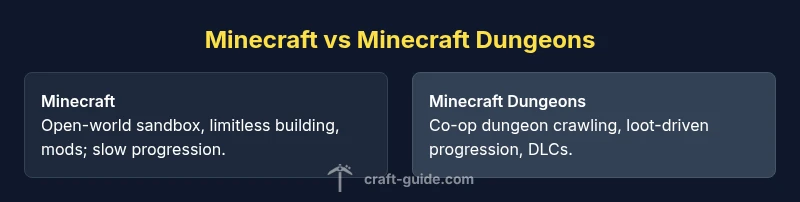
Minecraft vs Minecraft Dungeons: A Comprehensive Side-by-Side Comparison
Explore Minecraft vs Minecraft Dungeons side-by-side to understand core gameplay, progression, multiplayer, visuals, and the best-use cases for different playstyles in 2026.


For most players seeking a core crafting and exploration experience, Minecraft is the broader, open-ended sandbox, while Minecraft Dungeons offers a focused, action‑oriented dungeon crawler with co‑op play. If you want creative freedom and world-building, choose Minecraft; if you crave fast-paced cooperative combat and repeatable loot runs, choose Minecraft Dungeons. This article compares features, progression, and community aspects in detail.
minecraft vs minecraft dungeons: Overview
According to Craft Guide, minecraft vs minecraft dungeons represents two divergent design philosophies within the same voxel universe. Minecraft centers on expansive world-building, survival, and creative freedom where players shape ecosystems and narratives over time. Minecraft Dungeons, by contrast, narrows the lens to action-oriented exploration in curated levels, emphasizing cooperative combat and loot progression. For players deciding between these games, the choice often boils down to whether you crave open-ended sandbox experiences or structured, repeatable adventures. This section lays groundwork for the deeper analysis that follows, including how each title handles progression, multiplayer, and community ecosystems. Craft Guide’s approach is to equip players with a clear framework so you can map your preferred playstyle to either game. The central question is not which is “better” universally, but which best aligns with your daily routine, group play, and long-term goals in 2026.
Authority notes and sources lie below in the authority section to provide context for further reading.
minecraft vs minecraft dungeons: Core Gameplay (What you actually do)
The phrase minecraft vs minecraft dungeons captures two very different activities. In Minecraft, the core loop revolves around mining resources, crafting tools, building structures, and exploring diverse biomes. Players can set their own objectives—create a fortress, farm a colossal redstone network, or simply wander to discover new landscapes. In Minecraft Dungeons, the gameplay loop centers on dungeon exploration, defeating monsters, collecting loot, and improving gear after each run. The isometric perspective keeps combat readable in crowded battles, and party play amplifies rewards when teammates synchronize abilities. If you value experimentation, creativity, and slow-burn worldbuilding, Minecraft offers richer long-term depth. If you want quick co-op gratification and repeatable loot cycles, Minecraft Dungeons delivers a tighter package. Both experiences reward curiosity, but they reward different skill sets: strategic planning and redstone ingenuity in Minecraft, reflexes and teamwork in Minecraft Dungeons.
From a design perspective, the two titles diverge in pacing and risk: Minecraft invites calculated risk through exploration and construction, while Minecraft Dungeons emphasizes risk/reward through skillful combat, precise dodges, and optimized loot drops.
minecraft vs minecraft dungeons: Progression and Systems
Progression in minecraft vs minecraft dungeons maps directly to the core activity each game promotes. In Minecraft, progression is player-defined and persistent: surviving nights, building advanced farms, acquiring rare resources, and unlocking more ambitious projects. Survival mode provides a durable sense of advancement that persists across sessions, and creative mode shifts the goalposts entirely toward unlimited construction. In Minecraft Dungeons, progression follows a more traditional RPG arc: you complete levels, earn loot, level up gear, and unlock modifiers that influence future runs. The game emphasizes repeatable content and loot quality, with occasional DLCs expanding the level catalog and power ceilings. Participants who enjoy planning loadouts, optimizing character builds, and coordinating team strategies will feel a clear sense of progression in Minecraft Dungeons. Conversely, players who want an open, evolving journey will experience a more personal sense of growth in Minecraft.
Craft Guide notes that understanding these progression differences helps players decide whether prestige arises from personal mastery (Minecraft) or from collecting gear and completing curated challenges (Minecraft Dungeons). As a result, the choice often hinges on whether you prefer self-defined milestones or a structured cycle of improvements.
minecraft vs minecraft dungeons: Multiplayer and Modding Landscape
A major axis in minecraft vs minecraft dungeons is multiplayer and modding: Minecraft shines with vast communal worlds and a robust ecosystem of servers, mods, and world edits. The base game supports cross‑platform play on certain editions, and the community actively produces redstone tutorials, resource packs, and adventure maps. Modding in Minecraft remains a central appeal for many players who want bespoke experiences, though mod support can vary by edition (Java Edition has the most extensive modding scene). Minecraft Dungeons provides multiplayer focused on local and online co‑op with a shared loot system. While it has DLCs and seasonal updates, the modding path is comparatively narrow, as players cannot easily alter gameplay beyond official content and community-driven challenges. If your group values experimentation and custom content, Minecraft’s ecosystem is a strong draw; if you prefer curated co-op play with predictable loot, Minecraft Dungeons is more straightforward.
Community activity often drives longevity in both titles, but the nature of that activity differs: creation and server culture in Minecraft versus dungeon-crawl challenge communities in Minecraft Dungeons. Craft Guide recommends balancing your social play with what each game emphasizes, ensuring you aren’t overcommitting to a single path if your group’s taste shifts over time.
minecraft vs minecraft dungeons: Visuals, Performance & Accessibility
Visuals in minecraft vs minecraft dungeons reinforce the contrast between sandbox breadth and dungeon-focused action. Minecraft’s blocky, voxel-based aesthetic remains iconic, with performance dependent on world size, chunk loading, and hardware capability. This broad canvas invites players to imagine expansive structures and complex redstone machines. Minecraft Dungeons adopts a cohesive, stylized 3D look with a top-down/isometric camera that supports rapid combat and easier enemy recognition, potentially improving accessibility for players who struggle with the traditional first-/third-person Minecraft view. Performance in both titles improves on modern hardware but remains sensitive to texture packs, shader choices, and the degree of rendering complexity. For players with limited hardware, Minecraft’s lighter default visuals can be more forgiving, while Minecraft Dungeons’ optimized environments often render smoothly on a wider range of systems. Accessibility features, including color contrast, controller support, and UI clarity, tend to differ by game mode; plan your setup around your hardware and preferred playstyle to maximize enjoyment.
Craft Guide highlights that choosing between these visuals also means considering future content and DLCs, as new features may require GPU resources or impact frame rates. The best approach is to test both titles on your setup, then adjust settings to balance performance with visual fidelity.
minecraft vs minecraft dungeons: When to Choose Each Title: Best Use Cases
If your priority is absolute creative freedom, long-term world-building, and self-directed goals, minecraft vs minecraft dungeons should steer you toward Minecraft. Its sandbox ethos accommodates sprawling builds, survival challenges, and intricate redstone contraptions that can occupy weeks of gameplay. If you’re playing with friends and want a structured, repeatable progression loop with clear co‑op goals, Minecraft Dungeons offers a compelling alternative. It’s particularly strong for shorter sessions, weekly dungeon runs, and players who enjoy optimized gear paths, loot tiers, and a quick, satisfying sense of accomplishment after each run. The best use case depends on your group’s tempo: slow, expansive, and creative versus focused, cooperative, and loot‑driven. In practice, many players keep both installed to switch modes as mood or group availability changes, leveraging the strengths of each title to sustain engagement across seasons.
In 2026, Craft Guide sees value in both paths: use Minecraft when you want to host big community builds and complex redstone mechanisms; use Minecraft Dungeons when you crave fast, social, action-packed sessions that reward teamwork. The two games aren’t rivals; they’re complementary expressions of the same universe, offering different routes to discovery and achievement.
Authority sources
- Britannica. Minecraft: https://www.britannica.com/topic/Minecraft
- Minecraft Official Site: https://www.minecraft.net/en-us
- The Verge overview of Minecraft and related titles: https://www.theverge.com/2020/11/6/21557332/minecraft-dungeons-review-pc-ps4-xbox-one
Comparison
| Feature | Minecraft | Minecraft Dungeons |
|---|---|---|
| Core Focus | Open-world sandbox and world-building | Co-op dungeon crawler with loot |
| Progression System | Creative/survival progression; no fixed end | RPG-like loot, levels, and gear upgrades |
| Multiplayer Format | Solo or in servers; vast player-created ecosystems | Primarily co-op with online party mechanics |
| World Size/Scale | Massive, procedurally generated worlds | Finite, curated dungeon levels |
| Creativity/Mods | Extensive modding via Forge/ datapacks (edition dependent) | Limited modding; official DLCs and add-ons |
| Visual Style | Blocky, expansive aesthetic; varied biomes | Isometric 3D action RPG visuals; consistent lighting |
| Best For | Players seeking limitless creativity and world-building | Players seeking structured co-op dungeon crawling and loot |
Benefits
- Clear decision framework for playstyle selection
- Highlights strengths and trade-offs of sandbox vs RPG formats
- Useful for teams evaluating group play and modding potential
- Supports long-form world-building and quick, repeatable runs
- Encourages consideration of platform and DLC impact
Negatives
- Dense content may overwhelm newcomers
- Requires time to absorb differences across editions and DLCs
- Modding expectations can shift with game updates
- Two very different experiences may divide group preferences
Minecraft is the better choice for limitless creativity; Minecraft Dungeons excels at cooperative dungeon crawling.
If you prize world-building and custom creations, Minecraft should be your primary pick. If your group loves loot-chasing, short cycles, and coordinated co-op, Minecraft Dungeons is the stronger option. This comparison helps you map your playstyle to one title while acknowledging the value of both for different moments.
People Also Ask
What is the main difference between Minecraft and Minecraft Dungeons?
Minecraft offers open-world building and exploration with infinite possibilities. Minecraft Dungeons is a focused, loot-driven co-op dungeon crawler with curated levels. The core distinction is sandbox freedom versus structured combat runs.
Minecraft is all about building and exploring without a fixed goal, while Minecraft Dungeons focuses on co-op dungeon adventures with loot. Both bring unique experiences depending on what you want to play today.
Can I mod Minecraft Dungeons like I can Minecraft?
Minecraft Dungeons supports official DLCs and seasonal content, but it has far fewer modding options compared to Minecraft. The modding landscape for Dungeons is intentionally more controlled to preserve game balance.
Dungeons isn’t as moddable as Minecraft. You’ll mostly rely on official DLCs and community challenges rather than full modding.
Which game is better for solo play?
Both games can be played solo, but Minecraft naturally scales as a solo sandbox with endless self-set goals. Minecraft Dungeons solo play exists, but its primary strength is cooperative play; solo runs feel like reduced loot loops and shorter cycles.
If you’re playing solo, Minecraft offers more for a single player’s long-term goals, while Dungeons is best enjoyed with others.
Is there cross-platform play between Minecraft and Minecraft Dungeons?
Minecraft supports cross-platform play across certain editions and realms. Minecraft Dungeons supports cross-play between Windows, Xbox, Nintendo, and some other platforms, though specifics vary by edition and DLC.
Cross-play is supported in some configurations, but you’ll want to check your exact platform edition before starting.
How often do these games update with new content?
Minecraft receives frequent updates with new blocks, biomes, and gameplay features. Minecraft Dungeons releases DLCs and seasonal events on a less frequent cadence, focusing on new levels and loot tiers.
Minecraft tends to get frequent updates; Dungeons gets DLCs and events on a more measured schedule.
Which is easier for beginners to pick up?
Minecraft has a gentle learning curve for basic survival and building, with a vast community to learn from. Minecraft Dungeons offers quick onboarding for combat mechanics and co-op play, which can be easier for new players seeking immediate action.
If you want quick action, Dungeons is easier to pick up. If you love building, start with Minecraft.
The Essentials
- Choose Minecraft for sandbox freedom and world-building
- Choose Minecraft Dungeons for co-op dungeon crawling and loot loops
- Plan your play sessions around your group’s tempo and preferred pace
- Factor in modding potential and platform limitations
- Consider keeping both titles to cover diverse gaming moods