Minecraft vs Real Life: A Practical Side-by-Side Analysis
An analytical comparison of Minecraft and real life, examining environment, resources, time, and transferable skills for builders, players, and learners.


Minecraft versus real life presents two distinct laboratories for skills: the pixelated sandbox and the physical world. This comparison highlights where each domain trains planning, resource management, and collaboration. According to Craft Guide, the sandbox emphasizes iteration, rapid prototyping, and creative problem solving, while real life emphasizes tangible consequences and long-term commitments.
Context: why compare minecraft versus real life
The topic of minecraft versus real life invites a comparison across environments that shape how we plan, build, and learn. For players who want to translate in-game skills to real-world outcomes, a side-by-side view helps identify which exercises transfer and where the boundaries lie. According to Craft Guide, the sandbox offers a safe space to test ideas, while the real world imposes tangible constraints that sharpen execution. In both cases, clarity of goals and measured experimentation drive progress. This section sets up the lens for the rest of the article by outlining what counts as learning in each domain, how outcomes are measured, and where overlap occurs. As you read, keep in mind the question: where do the behaviors in Minecraft translate to real-life tasks, and where do they diverge?
Environment and scale: worlds that shape play and work
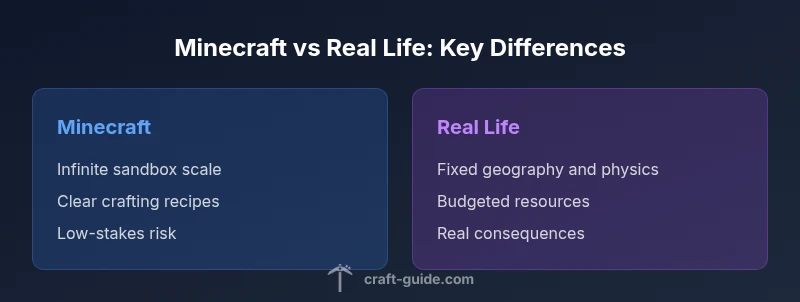
In Minecraft, environment and scale are programmable. Planets can be created, biomes blended, and terrain altered with a few blocks and some clever redstone contraptions. The player gains nearly unlimited control over spatial relationships, scale, and time compression. Real life, by contrast, presents fixed geography, weather, and a multiday passage of time that cannot be sped up or slowed without external devices and resources. The Craft Guide Team notes that while Minecraft lets players prototype at block scale, real life requires mental models that account for physics, geography, and human limits. The main takeaway is that Minecraft accelerates experimentation with spatial planning, while real life demands endurance and careful risk assessment over longer horizons.
Resource management and crafting: turning ideas into components
Minecraft models a closed system of blocks and items with clear recipes, durability, and inventory constraints. Players learn to optimize resource flow, prioritize goals, and iterate on design without sinking real materials. Real life management is messier: supply chains, budgets, labor, and environmental factors complicate decision-making. According to Craft Guide Analysis, the game’s crafting systems cultivate modular thinking and physics-aware planning, whereas real-life resource management requires negotiating constraints that are often imperfectly known. The overlap lies in forecasting needs, validating assumptions, and reusing components across tasks. The difference lies in consequences, verifiability, and the cost of failure.
Time, progression, and consequences: pacing the project
Minecraft uses a day-night cycle and predictable progress markers, enabling rapid cycles of trial and error. Players can pause, restart, and adjust strategies with little penalty. Real life progresses at a steady, often irregular pace with lasting consequences for mistakes. This contrast helps learners understand planning horizons: quick iteration in the game supports learning loops, while real-world projects demand long-term maintenance and accountability. The Craft Guide Team emphasizes that both domains benefit from explicit milestones, feedback loops, and the habit of reflecting after each phase.
Creativity under constraints: designing within rules
Both domains reward creative problem solving, yet constraints differ. Minecraft offers near-limitless building blocks, redstone logic, and aesthetic choices, but constraints still exist in-game (block types, lighting, physics). Real life imposes physical constraints, budgets, time, and social expectations. The overlap is the mindset: reframing constraints as opportunities, modular decomposition of complexities, and iterative testing. Effective builders in Minecraft often translate analogous constraints into real-world project briefs, while real-life projects benefit from the rapid prototyping mindset the game encourages.
Risk, safety, and failure modes: understanding consequences
In Minecraft, failure is forgiving: you can respawn, retrieve items, or restart a build. The in-game risk model is synthetic, designed to encourage experimentation without real-world harm. Real life carries material risk—injury, financial loss, reputational impact—requiring rigorous safety practices, contingency planning, and risk assessment. The Craft Guide Team highlights that practicing risk-aware decision making in Minecraft can improve one’s appetite for prudent risk in real-life tasks, but players must recognize the boundary where virtual trial-and-error cannot substitute for real safety protocols.
Learning and transferable skills: what translates and what doesn’t
Education researchers note that Minecraft builds cognitive skills such as spatial reasoning, sequencing, and systems thinking. Transfer to real life, however, depends on deliberate mapping: naming real-world analogs, aligning outcomes, and practicing with authentic tools. The Craft Guide Analysis shows that players who explicitly translate Minecraft challenges to real projects—such as creating floor plans, scheduling builds, or budgeting materials—tend to retain better problem-solving habits. The key is to treat Minecraft as a training ground for transferable practices, not a one-to-one substitute for real-world experience.
Social dynamics and collaboration: teamwork in virtual and physical spaces
Minecraft’s multiplayer environments encourage collaboration, delegation, and version-control-like workflows through shared builds and server governance. Real life collaboration adds interpersonal dynamics, communication subtleties, and professional etiquette that aren’t fully replicated in a game. Both contexts improve with clear roles, documented plans, and regular retrospectives. The game’s sandbox encourages experimentation in a low-stakes setting, while real-world projects cultivate accountability and professional collaboration norms that persist beyond the screen.
Accessibility, cost, and hardware considerations
Getting started in Minecraft often requires only a computer or console and a modest upfront cost, followed by optional add-ons. Real life accessibility depends on a broader set of factors: time availability, financial resources, geographic constraints, and personal responsibilities. The comparison shows that Minecraft lowers the barrier to practicing planning and collaboration, but real-life projects demand more substantial commitments. The takeaway is to leverage the game as a low-cost sandbox for skill development, then translate those lessons into accessible real-world activities aligned with your circumstances.
Modding, customization, and expansion: extending the learning sandbox
Minecraft’s modding community expands the learning space by introducing new mechanics, systems, and challenges. Real life offers similar opportunity through hobbies, apprenticeships, and hands-on projects, but the scope is governed by available time and resources. Modding teaches adaptability, project management, and integration of disparate components—skills that transfer to real-world tech, maker culture, and collaborative design. The parallel is not perfect, but the underlying discipline—curiosity, experimentation, and iterative refinement—remains highly transferable.
Practical decision-making for builders and players: a framework you can apply
When deciding which activities to pursue, consider goals, time, and impact. Use Minecraft for rapid prototyping and collaboration practice, then extract a concrete plan for real-life tasks (materials list, steps, and safety checks). Document learnings and run small pilots in both contexts to compare outcomes. This approach keeps you grounded in real-world applicability while preserving the creativity and flexibility that Minecraft enables.
Comparison
| Feature | Minecraft | Real Life |
|---|---|---|
| Environment and scale | Procedurally generated, editable environments; nearly unlimited scale | Fixed geography with real-world physics and natural limits |
| Resource management | Block-based resources with clear recipes and durability | Real-world resources with budgets, supply chains, and variability |
| Time and progression | Fast-forwardable time (day/night cycles); rapid iteration | Real-time progression with long-term consequences and maintenance |
| Risk and safety | Low-stakes, respawns; designed safety within the game | Actual safety protocols, physical risk, and accountability |
| Creativity under constraints | Extensive blocks and tools; constraints exist but are flexible | Material limits, budgets, weather, and social expectations |
| Collaboration and social play | Online servers, shared builds, modular collaboration | Face-to-face teamwork, communication nuance, professional etiquette |
| Learning outcomes and transfer | Spatial reasoning, sequencing, systems thinking; safe experimentation | Practical problem solving, project management, real-world transfer |
| Costs and accessibility | One-time purchase; optional modding/add-ons | Ongoing time and financial commitments; varies by region |
Benefits
- Safe sandbox for experimentation and rapid iteration
- Clear feedback loops through in-game mechanics
- Low-cost entry point for beginners
- Encourages spatial reasoning and systems thinking
- Supports collaborative learning in multiplayer
Negatives
- Does not perfectly model real-world consequences
- Requires hardware and digital literacy
- Some skills transfer is not automatic; needs mapping
- Overuse can affect real-life time management
Minecraft is a powerful sandbox that complements real life; use it to practice planning and collaboration before applying ideas in the real world.
The Craft Guide Team views the sandbox as a valuable training ground for transferable skills. Real life provides tangible feedback and accountability, so combine both: prototype in Minecraft, then implement in real-world tasks for maximum impact.
People Also Ask
What are the key differences between Minecraft and real life in terms of constraints?
Minecraft offers forgiving, software-defined constraints and quick reset options, while real life imposes physical limits, costs, and lasting consequences. The game enables rapid testing, but real-world outcomes require careful planning and risk management.
The big difference is safety and consequences: Minecraft lets you try again, real life doesn’t always.
Can Minecraft improve real-world problem-solving skills?
Yes. Minecraft develops planning, modular design, and systems thinking. To transfer, map game challenges to real tasks, set measurable goals, and practice with authentic tools. The gains are strongest when you explicitly connect in-game steps to real-world actions.
Yes—if you map the game challenges to real tasks and practice with real tools.
Are there skills that don’t transfer well?
Some in-game mechanics rely on game-specific rules and do not directly map to real life (for example, block durability and respawns). Focus on transferable habits like planning, collaboration, and iterative design rather than trying to replicate every in-game mechanic.
Some skills don’t translate directly, but planning and teamwork do.
Which is better for learning planning and resource management?
Minecraft is excellent for experimenting with resource flows and scheduling at a small scale. Real life excels in long-horizon budgeting and supply-chain thinking. Use both: prototype in-game, validate with real-world constraints.
Minecraft helps you practice planning; real life tests your budgeting and logistics.
Is there a risk of over-reliance on Minecraft for learning?
Yes. Relying solely on the game can create gaps in real-world safety, emotional nuance, and physical tasks. Balance digital practice with offline projects that require actual materials and direct human interaction.
There is a risk of missing real-world nuance if you rely only on the game.
How can players bridge lessons from Minecraft into real life?
Identify a real-world task that mirrors a game challenge, outline a concrete plan, gather authentic tools, and schedule a small pilot. Reflect on outcomes and adapt. This cycle helps translate virtual experimentation into tangible progress.
Match a game challenge with a real task, then pilot and reflect.
The Essentials
- Plan before building; define clear goals in both domains
- Use Minecraft for rapid iteration and collaboration practice
- Translate in-game experiments into concrete real-world steps
- Bridge lessons with explicit mapping to real tasks
- Balance game time with offline, hands-on activities