Why Is Minecraft Bedrock Laggy? A Troubleshooting Guide
Discover practical fixes for Minecraft Bedrock lag. This guide covers hardware checks, graphics tweaks, network tips, and world-size adjustments to restore smooth gameplay.


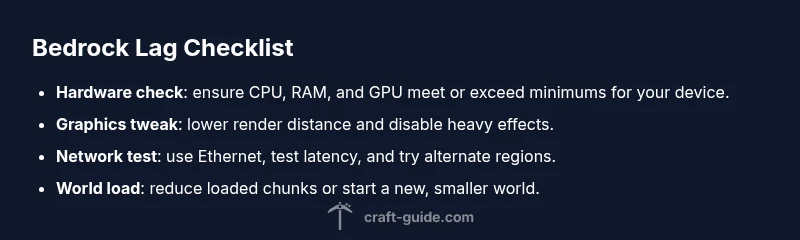
Bedrock lag is usually caused by a mix of hardware limits, high graphics settings, and occasional network latency. Start with a quick 3-step fix: lower render distance, switch to a balanced graphics preset, and ensure your device drivers are up to date. If lag persists, test network stability and try playing with a smaller world or offline to gauge performance.
Quick Assessment and Baseline
If you’re noticing Bedrock lag, begin with a baseline assessment to separate hardware limits from settings or network issues. According to Craft Guide, most lag sources cluster around three themes: device capability, render settings, and connectivity. Launch a fresh world with graphics set to a balanced preset and observe FPS and responsiveness in both offline and online modes. Track changes after each adjustment to identify the bottleneck. For this guide, the keyword why is minecraft bedrock so laggy is part of your diagnostic language, helping you tailor checks by platform (PC, console, or mobile). Craft Guide’s analysis from 2026 emphasizes that simple baseline checks often reveal the root cause before deeper edits.
Common Causes of Bedrock Lag
Lag in Bedrock can stem from several interrelated factors. Common culprits include hardware limits (CPU, GPU, RAM), overly ambitious graphics settings for the device, many entities or complex redstone displays in the world, and network latency when joining online servers. Another frequent source is a large, heavily loaded world with many loaded chunks, which taxes the engine even on capable devices. Background apps stealing RAM or CPU cycles can also degrade performance. Understanding these causes helps you prioritize fixes rather than guessing.
Hardware and System Considerations
Your device’s hardware envelope largely determines Bedrock performance. PCs with mid-to-low end GPUs or insufficient RAM will struggle with higher render distances. Consoles are tied to their generation’s capabilities and firmware; mobile devices can be especially sensitive to thermal throttling and background processes. Storage speed matters too—an SSD can reduce texture streaming hiccups compared to a slower HDD. Regular maintenance, such as closing unused apps and keeping drivers updated, can yield noticeable gains without changing game settings.
Graphics and Settings Tweaks for Bedrock
Tweaking in-game graphics often yields the biggest FPS gains. Start with lower render distance, turn off particulates and fancy graphics, and disable motion blur. Reducing texture quality and turning off motion blur can also help on devices with limited GPU power. If you enable V-Sync or dynamic resolution, monitor how it affects input latency. Each tweak should be tested in isolation so you can quantify its impact before stacking multiple changes. Remember, small adjustments can mean big performance gains, especially when you’re chasing a more stable framerate.
Network and Server-Related Lag
Online play introduces another axis of lag: latency. A high ping to the server, unstable Wi‑Fi, or a congested network can create rubber-banding and stutter even if your device is capable. Prefer wired Ethernet when possible and ensure your router isn’t overloaded by other devices during gameplay. If you’re hosting, consider a server with a closer location to your region or enable server-side optimizations if available. Offline testing is a strong diagnostic method: if offline performance is solid, network factors are likely at fault.
World Size, Chunks, and Storage
World size and loaded chunks can drive lag, particularly on devices with limited RAM. Reduce the world’s active chunk radius in settings and avoid loading extremely large or resource-intensive areas in the same session. Clearing cache or reinstalling Bedrock can help if texture streaming or asset loading has become corrupted. Regularly backing up worlds prevents data loss when you experiment with settings that affect world generation. These adjustments can often be the difference between choppy frames and smooth gameplay.
When to Seek Professional Help and Prevention Tips
If lag persists after all targeted tweaks, consider seeking help from a shop or technician, especially for hardware upgrades or firmware issues. Preventive steps include keeping drivers up to date, avoiding background processes during play, and using a consistent network setup. Regularly review game updates and compatibility notes, as patches can shift performance requirements. A proactive mindset—testing changes in a controlled way and documenting results—keeps lag from creeping back in.
0
Steps
Estimated time: 30-60 minutes
- 1
Open game settings and baseline test
Launch Bedrock, open the Settings menu, and confirm the current render distance, graphics preset, and any active resource packs. Start a new world in offline mode to establish a baseline FPS snapshot.
Tip: Document FPS before and after each change to measure impact. - 2
Reduce render distance and graphics load
Dial down render distance to a conservative level and switch graphics to a balanced preset. Disable particles and fancy effects if the device struggles with post-processing. Run a quick test and note FPS changes.
Tip: Make one change at a time to quantify impact. - 3
Close background applications and update drivers
Exit other applications that consume CPU/RAM. Check for and install the latest graphics and chipset drivers for your device. Reboot and launch Bedrock again to see if performance improves.
Tip: If you can’t update drivers, disable auto-updates during play. - 4
Check network stability
If playing online, test your network with a wired connection if possible. Ping the server and observe any jitter or packet loss. Try a different server region to compare latency.
Tip: A charged network improves response time and reduces lag spikes. - 5
Test offline vs online performance
Play in an offline world or with a local server to compare. If offline performance is significantly better, the issue is likely network-related or server-side.
Tip: Use a clean world to avoid corrupted data causing stutter. - 6
Evaluate world size and chunks
If the world is large with many loaded chunks, consider starting a fresh map or reducing active chunks in settings. Periodically streamlining your world reduces CPU/GPU load.
Tip: Back up worlds before making major structural changes. - 7
Plan maintenance and future-proofing
Create a routine to check for updates, run performance tests, and back up data. Consider hardware or network upgrades if lag remains a frequent issue.
Tip: Schedule monthly checks to prevent lag from reoccurring.
Diagnosis: Bedrock lag persists despite basic fixes
Possible Causes
- highInsufficient hardware resources (CPU, RAM, GPU)
- highGraphics settings too high for the device
- mediumNetwork latency or server-side issues
- mediumExcessive loaded chunks or large world size
Fixes
- easyLower render distance and graphics settings; ensure drivers are up to date
- easyClose background apps and free RAM; switch to a power plan that favors performance
- easyTest in offline mode to isolate network issues
- mediumConsider hardware upgrade or move to a smaller, simpler world for long-term Lag reduction
People Also Ask
What exactly is Bedrock lag and how can I tell it apart from a simple FPS dip?
Bedrock lag describes when gameplay becomes choppy, stuttery, or non-responsive. It differs from a momentary FPS dip because it persists across attempts to play, affects interactions, and is tied to specific causes like hardware limits, settings, or network. Start by isolating each factor to identify the root cause.
Bedrock lag means the game stays choppy beyond a momentary FPS drop. Check hardware, settings, and network to pinpoint the cause.
Does lag affect all platforms the same way, or do some devices lag more than others?
Lag impact varies by platform due to hardware capabilities and OS optimization. Mobile devices are often more sensitive to thermal throttling, while consoles have fixed hardware ceilings. PCs vary widely, so adjusting settings can yield different results across platforms.
Lag shows up differently depending on your device, but the fix approach is similar: tweak settings, check hardware, and test network.
Will upgrading hardware always fix lag, or are there cheaper fixes that work well?
Hardware upgrades can help, especially when FPS remains low after optimizing settings. However, many lag sources are solvable with settings tweaks and network improvements, which are cheaper and faster. Start with the low-cost steps before budgeting hardware upgrades.
Upgrading can help, but many lag issues are solvable with settings and network tweaks first.
How do I test whether lag is network-related rather than a local issue?
Test by playing offline or on a local server and comparing performance to online play. If offline is smoother, network latency is likely the issue. Use a wired connection and ping tests to measure stability.
If offline runs smoother, the lag is probably network-related. Try a wired connection to verify.
Should I disable servers or play offline to fix lag when I have a strong internet connection?
Even with a strong internet connection, server-side load or distance can cause lag. Check latency to the server and try a different region or host if possible. Offline play helps confirm if the issue is server-related.
If you still lag online, try offline to see if it’s the server or your setup.
Are there any safe mods or add-ons that help reduce lag on Bedrock, or should I avoid them?
Bedrock mods and addons exist, but they can introduce instability or violate terms of service on some platforms. Stick to official settings/tweaks first, and research any mod’s compatibility before installing.
Mods can cause more issues if not compatible. Prefer official tweaks first.
Watch Video
The Essentials
- Lower graphics and render distance first for big FPS gains
- Test offline to isolate network-related lag
- Keep drivers up to date for consistent performance
- Monitor memory and CPU usage to spot bottlenecks
- Plan regular maintenance to prevent recurring lag