Minecraft Tricks On or Off: A Practical How-To Guide
Learn how to enable or disable popular Minecraft tricks safely, test ideas in a controlled environment, and document outcomes to improve your builds, farming, and exploration—all with a practical, beginner-friendly approach.


By the end of this guide, you’ll know how to turn minecraft tricks on or off—understanding when to enable cheats, how to toggle command-based tweaks, and how to test ideas safely in Creative or Survival. You’ll learn practical steps, see real-world examples, and avoid common pitfalls. Whether you’re after faster builds, smarter farming, or cleaner redstone setups, this guide shows you how to approach tricks with intention.
Understanding minecraft tricks on or off
In Minecraft, the term tricks refers to small, repeatable adjustments you can make to how you play, build, or automate. Tricks can be experimental settings, command-based tweaks, or subtle quality-of-life changes that alter your experience without completely altering the core rules. The phrase minecraft tricks on or off describes the practice of turning these adjustments on when needed and off when you want a more traditional, challenge-focused playthrough. According to Craft Guide, approaching tricks with intent helps you test ideas while preserving game balance. This section clarifies what counts as a trick, distinguishes vanilla options from modded enhancements, and sets expectations for what is safely reversible in different game modes. The overarching idea is reversibility: keep changes easily undoable so you can iterate without losing progress.
Core categories of tricks you can enable or disable
Tricks in Minecraft fit into several broad groups. Command-based tweaks let you alter inventory, mode, or spawn behavior with simple inputs. Building and automation hacks cover faster scaffolding, compact farms, and clever redstone layouts that automate chores. Movement and combat tricks focus on sprinting, jumping efficiency, and positioning that can save time in exploration or combat. Cosmetic or quality-of-life tweaks adjust visuals, sounds, or interface elements to streamline your workflow. When you plan your approach, separate on/off decisions for each category help you measure impact and avoid overloading the world with too many simultaneous changes. Craft Guide recommends starting small—test one trick at a time and document results so you can compare apples to apples.
How to evaluate the impact of a trick
Before you flip a trick on, define a simple test: what changes, how will you measure success, and what could go wrong. Compare performance (frame rate, lag spikes), balance (is the trick giving unfair advantage), and user experience (does it improve or complicate gameplay). If you’re testing in Survival, consider whether the trick shifts challenge, loot availability, or mob behavior. In Creative, focus on build speed and creative flexibility. Keep a running log of settings used, the exact commands issued, and observed outcomes. Craft Guide analysis stresses documenting both positive and negative effects to help future decisions and prevent repeated mistakes.
Setting up a safe testing ground
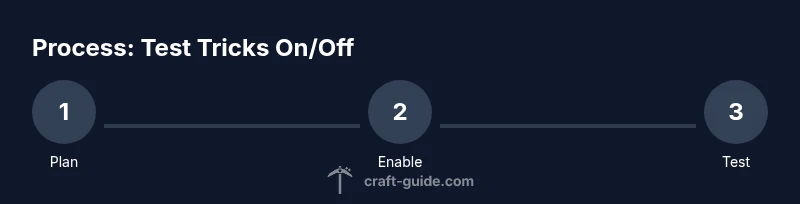
The safest way to experiment is to create a dedicated testing world or copy your current world. Back up the original before you begin and keep changes reversible. Use a separate seed or a fresh, clean file to isolate effects. If you’re testing with cheats, enable them only in the testing environment and disable them when you return to a standard session. Version parity matters too: if you upgrade Minecraft, re-test all tricks to verify compatibility. A controlled environment minimizes surprises and protects your main world from unintended side effects.
Practical on/off examples you can try
- Example 1: Enable a basic command-based tweak to teleport between points for quick navigation, then toggle it off when you resume normal exploration. This helps you map routes without permanently changing server rules.
- Example 2: Use a simple /give command in a private testing world to plan a build, then revert to inventory-based gathering in Survival.
- Example 3: Toggle a visual tweak (like a shader-related lighting tweak) in Creative and evaluate how it affects visibility and performance before applying to a public map.
- Example 4: Test a construction trick, such as a compact scaffold technique, in a copy of your base and compare build time with and without the trick.
- Example 5: Experiment with a redstone shortcut in a controlled arena, then switch it off to gauge how it changes redstone signal reliability during real gameplay.
Common mistakes and how to avoid them
- Skipping backups: Always clone your world before testing, especially with cheats on.
- Testing in public worlds: Keep experiments private or in a controlled server to avoid affecting other players.
- Not documenting changes: Without a clear log, it’s hard to compare results or revert.
- Overloading with tricks: Start with one or two changes, then expand gradually to keep performance stable.
- Assuming version parity: Every update can change how tricks behave; re-test after patches or major updates.
Craft Guide recommendations for learning tricks
The Craft Guide team emphasizes a methodical approach: start with small, reversible tweaks, practice in a safe testing environment, and document every experiment. This reduces risk and speeds up mastery. As you gain confidence, you can layer additional tricks while keeping a clear rollback plan. The goal is to elevate your gameplay without compromising world integrity—especially important when sharing maps or playing with friends.
Tools & Materials
- Minecraft game (Java or Bedrock edition)(Use a version you can safely test in (preferably a fresh copy for experiments))
- World backup or testing world(Create a separate directory or copy to isolate experiments)
- Access to cheats/commands (if testing commands)(Enable in testing environment only)
- Note-taking tool (digital or paper)(Log settings, commands, and observed outcomes)
- Stable internet connection (for guides/mods)(Optional for downloading resources or updates)
- Optional: mods or resource packs(Only in testing environments; verify compatibility)
Steps
Estimated time: 25-40 minutes
- 1
Decide your testing scope
Choose between Creative or Survival, and determine whether you will use cheats for experimentation. This defines what counts as reversible in your playthrough and helps you set safe boundaries before you begin.
Tip: Document your scope at the top of your log so you can compare before/after results later. - 2
Enable cheats in a testing world
If you’re using Java Edition, open the world to LAN and switch cheats on for testing. In Bedrock, use your platform’s built-in options to enable experiment mode if available.
Tip: Keep cheats enabled only in the testing environment to avoid unintended side effects. - 3
Test a simple trick or command
Run a basic command or tweak (e.g., a teleport or quick item grant) to verify cheats are functioning as expected in your test world.
Tip: If nothing happens, recheck spelling, permissions, and whether cheats are actually enabled. - 4
Observe gameplay impact
Play for a short session and note performance, balance, and player experience changes introduced by the trick.
Tip: Look for lag, desync, or unintended mob behavior as early warning signs. - 5
Document outcomes and decide on reversibility
Record what worked, what didn’t, and how easily you can revert to the original state if needed.
Tip: Create a rollback plan, including a backup restore point and a checklist to undo changes. - 6
Iterate with additional tricks
Add one new trick at a time and repeat the testing cycle to build a catalog of safe, reversible enhancements.
Tip: Avoid stacking too many tricks at once to keep results clear.
People Also Ask
What counts as a 'trick' in Minecraft?
A trick is any repeatable adjustment that changes how you play, build, or automate. This can include command-based tweaks, build hacks, or quality-of-life changes. In vanilla play, many tricks are reversible and designed to be experimented with in safe testing environments.
A trick is any repeatable tweak you can turn on or off to change how you play. It can be a command, a building shortcut, or a small automation tweak, and it should be reversible so you can undo it later.
Can I use tricks in Survival mode?
Yes, but with caution. Some tricks may give an unintended advantage or affect balance. Always test first in a separate world and keep a rollback plan. In Survival, prioritize reversible tricks that do not ruin the challenge.
You can, but test carefully in a separate world first, and keep a rollback plan ready.
How do I safely enable or disable cheats?
Enable cheats only in a testing environment or by opening the world to LAN with cheats on. Disable cheats immediately after testing. Always document what you enabled and for how long.
Enable cheats only where you’re testing, then turn them off and record what you did.
Do tricks require mods or are they possible in vanilla Minecraft?
Many tricks are possible with vanilla commands and settings. Mods can extend options, but they introduce compatibility concerns. Start with vanilla tricks in a safe test world before exploring mods.
Most tricks can be done with vanilla features; mods are optional but add more options, with extra caution.
Will using tricks affect multiplayer worlds?
Tricks can disrupt game balance or cause unfair advantages in multiplayer. Always coordinate with server admins and test changes in a closed environment before applying to public servers.
Yes, be careful on multiplayer servers and test privately first.
How do I revert a trick after testing?
Keep a rollback point and note the exact steps to undo. If possible, use world backups or create a fresh copy to restore to the previous state.
Make a plan to revert, and use a backup to return to your previous state.
Watch Video
The Essentials
- Plan tests in a dedicated world before applying tricks to a live map
- Back up your world and document every change
- Test one trick at a time to measure impact clearly
- Revert changes quickly using a planned rollback
- Use tricks to enhance creativity without compromising balance