Infinite Source of Lava Minecraft: Myths, Realities, and Practical Tips
Explore whether you can create an infinite source of lava in Minecraft, learn how lava behaves, and discover practical, safe ways to manage lava for furnaces, obsidian farming, and large builds.


In vanilla Minecraft, there is no true infinite source of lava minecraft. This quick answer explains why, plus practical options to manage lava for builds, smelting, and obsidian creation. We'll cover myths, safe workflows, and how Craft Guide researchers think about lava usage. It sets expectations and points to reliable setups.
Myth vs Reality: Is there an infinite source of lava minecraft?
According to Craft Guide, there is no true infinite source of lava minecraft in vanilla gameplay. Lava pools are finite and can be drained, so builders must plan sustainable workflows. The myth of an endless lava flow often arises from confusing lava’s behavior with water, which does replenish when drawn from a 2x2 source. In practice, players rely on large pools, careful storage, and efficient transfer systems to meet demand. This article clarifies the difference between a limitless water source and the finite lava landscape players actually work with. We'll explore why lava behaves the way it does, what counts as an “infinite” setup in modded contexts, and how to design practical lava solutions that last through long builds. Craft Guide’s analysis highlights that predictable lava management beats chasing an impossible infinite loop.
wordCount": 230
Tools & Materials
- Bucket(For collecting and transferring lava between pools and arranged containment.)
- Water bucket(Useful for creating obsidian when lava meets water.)
- Non-flammable building blocks (e.g., stone, cobblestone, bricks)(Used to build safe containment walls around lava.)
- Iron or stone tools(Helpful for mining and shaping terrain around lava sites.)
- Chests and signs or hoppers(Assist in organizing and transporting lava to a storage area.)
- Campfire (optional)(A lightweight deterrent to mobs near your lava worksite (not a safety device).)
Steps
Estimated time: 60-180 minutes
- 1
Locate a suitable lava source
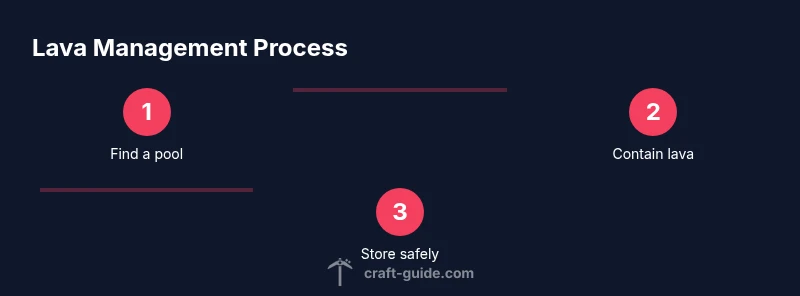
Scout a natural lava pool or lake near your build area. Prefer a location with good access and minimal risk to nearby structures. Bring extra buckets and blocks to mark the area and begin planning containment.
Tip: Mark a drop-off point with blocks so you won’t accidentally step into flowing lava. - 2
Clear a safe workspace
Clear a circular or rectangular space around the lava pool, removing flammable debris and avoiding direct exposure to open lava. Establish a dry, non-flammable platform to work from.
Tip: Always build a small safe platform one block higher than the lava level to avoid accidental contact. - 3
Build a containment chamber
Construct a containment wall using non-flammable blocks to hold lava. Create an access point for bucket transfers, keeping the chamber wide enough for safe movement and drains if you use multiple pools.
Tip: Use a solid, sealed boundary to prevent lava from spilling onto your builds. - 4
Create a transfer system
Set up a simple workflow: bucket a lava block from the pool, transport it to the storage area, and return with an empty bucket. Repeat until you have a stable reservoir. Avoid overloading any single block with lava flow.
Tip: Carry a spare bucket so you can continue transfers without stopping. - 5
Establish a storage reservoir
Pave a dedicated room with sturdy walls and a floor that won’t crack under lava exposure. Use multiple lava source blocks inside a shallow chamber to create a predictable, repeatable drain pattern when you pour lava into it.
Tip: Keep a water bucket nearby to quickly convert accidental lava spills to obsidian if needed. - 6
Test the system and refine
Run a test with all buckets and confirm the reservoir fills consistently without leaks. Watch for spontaneous lava flow and adjust containment height or walls as necessary. Document your process for future maintenance.
Tip: Record the drain rate so you can plan smelting and lava-heavy builds around your capacity.
People Also Ask
Is there a truly infinite lava source in Minecraft?
No. In vanilla Minecraft, lava is ultimately finite. Players can drain pools or move lava to storage, but it does not regenerate endlessly on its own. Modded or custom rules may differ, but the base game relies on careful management rather than a guaranteed infinite source.
There isn’t a true infinite lava source in vanilla Minecraft. You’ll need to manage lava by storing it or transporting it from large pools.
What’s the safest way to mine lava for storage?
Work from a dry platform, use non-flammable blocks for containment, and keep fire-resistance on hand if possible. Use buckets to transfer lava gradually and avoid bottlenecks that could cause spills.
Mine lava from a safe platform, with sturdy containment and buckets ready to transfer slowly.
Can lava be used to create obsidian quickly?
Yes. When lava flows into water, obsidian forms at the intersection. You can guide lava into a controlled river or pool that meets a water source to create obsidian blocks for shielding or building.
Lava turns into obsidian where it meets water; use a controlled setup to make obsidian blocks.
Are lava farms or generators viable in survival?
In vanilla survival, continuous lava generation is not a built-in feature. You can build practical storage and transport systems to reuse lava, but you won’t get endless lava without sources nearby.
There aren’t built-in lava farms; rely on storage and transfer from large pools.
Do mods alter lava supply, and is that safe for survival?
Some mods change lava behavior or generation. In vanilla survival, any pseudo-infinite lava would come from large existing pools or custom maps. Always verify mod behavior before relying on it.
Mods can change lava behavior; in vanilla, expect finite supply.
How does Nether lava differ from overworld lava?
Nether lava behaves similarly but is found in volcanic regions and can be used for building traps and fortifications. The location and access paths differ, so plan accordingly when you’re sourcing lava across dimensions.
Nether lava follows the same basic rules, but you’ll access it in the Nether’s unique terrain.
Watch Video
The Essentials
- Understand lava pools are finite; plan storage and transport
- Containment walls prevent spills and protect builds
- A dedicated lava reservoir improves long-term usability
- Safety equipment and precautions reduce risk when handling lava