How to Get Rid of Minecraft Tips: A Practical Guide
Learn how to get rid of Minecraft tips using vanilla settings, UI tweaks, and safe mods. This educational guide covers step-by-step actions, backups, and troubleshooting for a distraction-free Minecraft experience.


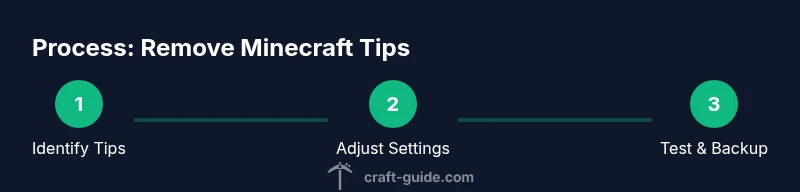
You’ll learn how to get rid of minecraft tips across vanilla and modded setups. This quick guide shows where tips appear, how to disable them in Settings, and safe alternatives like UI tweaks or lightweight mods. By following these steps, you’ll reduce on-screen prompts while preserving your Minecraft experience. It covers both screens and in-game popups.
Why disabling tips in Minecraft can improve focus
For many players, the on-screen tips in Minecraft can become distracting during focused builds or complex redstone experiments. The desire to get rid of minecraft tips stems from wanting a clear view of the world and a streamlined user interface. According to Craft Guide, reducing UI clutter helps players concentrate on core tasks and reduces cognitive load during creative sessions. In this section we explore why disabling tips can be a smart choice and how to approach it without compromising essential guidance. We’ll discuss how different editions (Java vs Bedrock) handle tips and what you can reasonably expect to control. The goal is to provide practical, actionable steps that work across common setups, from fresh installs to modded environments. By planning carefully and testing changes in a safe world, you can tailor Minecraft's tips to your preferred workflow while keeping important prompts accessible when you need them.
Additionally, it’s helpful to acknowledge that the Craft Guide team emphasizes methodical changes over sweeping, risky edits. This mindset helps players maintain stability while reducing disruption from tips during builds or exploration.
Ultimately, understanding where tips come from and how they behave helps you decide the least disruptive path to cleaner visuals.
Where tips appear in Minecraft and what to disable
Tips appear in a variety of contexts, including initial loading screens, the pause menu, and occasional in-game overlays. The exact content and frequency can vary between versions and editions. To decide what to disable, start by identifying whether the prompts are part of the core UI, a feature flag, or a mod-provided overlay. In vanilla setups, you typically have some control via Settings; in modded environments, additional layers can introduce tips that are not governed by the base game. In this section we map out the common sources of tips, explain how to distinguish essential guidance from optional prompts, and prepare you to apply changes without breaking core functionality.
Understanding tip sources helps you target the right controls. If a tip appears only in certain modes or on first launch, that context may guide your change approach. Remember that some prompts are designed to help new players learn mechanics; unless you’re sure a prompt is unnecessary, consider keeping critical tips while removing redundant ones.
The Craft Guide team notes that a methodical approach — starting with vanilla options and only moving to mods if needed — tends to yield the most stable results. A careful assessment of where tips come from minimizes the risk of missing important guidance during complex tasks.
Vanilla methods to reduce or hide tips
In standard Minecraft, the most straightforward way to reduce prompts is to locate the UI or tips-related options in Settings. Look for sections labeled Tips, Hints, UI, HUD, or Accessibility. If you find a toggle labeled something like 'Show tips' or 'Show hints,' switch it off and test in a new world or creative mode. If no such option exists, consider lowering the frequency of prompts by adjusting related UI features or turning off nearby features that might generate tips. After changing settings, restart the game if needed and verify across screens (main menu, loading screen, pause). While vanilla options may not remove every tip, you can significantly reduce on-screen clutter with careful toggling.
If you’re unsure where a particular tip is sourced, try temporarily changing the game’s language to another locale; some prompts are language-dependent and hiding the text may reduce distraction during builds. This approach keeps core guidance available in case you need it, while removing non-essential prompts.
Non-vanilla approaches: UI tweaks and configuration guidance
If vanilla controls are insufficient, you may explore non-vanilla approaches cautiously. For example, you can use a lightweight resource pack to minimize HUD elements, or adjust language strings to shorten tip text (without breaking localization). Always back up your saves before applying resource packs or language changes. If you rely on mods, search for ones that explicitly suppress popups or tip overlays and ensure compatibility with your Minecraft version and launcher. Keep mod load order clean and document changes to revert if something goes wrong.
Another practical tactic is to disable tips only in Creative mode or a subset of worlds where you don’t need tutorial prompts. This strategy preserves tips in survival or new-player contexts while maintaining a clean interface during detailed builds.
Modded approaches for full tip control
Modded approaches offer the strongest control over on-screen tips. By using Forge or Fabric-compatible mods, you can introduce options to suppress popups globally or within specific game states. Before installing mods, back up your worlds and profile data. Verify compatibility with your Minecraft version and launcher, and read the mod’s instructions carefully to avoid conflicts with other plugins or datapacks. After installing, test in a dedicated test world to confirm tips no longer appear in key screens. If a mod introduces new prompts, update or remove conflicting mods and re-test. This path provides the most comprehensive tip management, but requires careful maintenance.
Backups, testing, and safety
Always start with a full backup of your world and game profile before making changes that affect the UI. Create a clean restore point so you can compare before-and-after behavior. Test changes in a safe, experimental world (creative or with a copy of your main world) to ensure you don’t lose progress or corrupt data. Document every change, including mod versions, resource packs, and settings toggles, so you can revert if needed. Regular backups become a habit that protects your builds, especially when experimenting with mods or large UI tweaks. Craft Guide emphasizes the importance of safety-first when attempting any modification.
Troubleshooting common issues when tips reappear
If tips reappear after a game update or a mod change, revisit the Settings and recheck each toggle. Some updates reset certain options or re-enable prompts. Verify mod compatibility and load order; disable recently added mods one by one to identify conflicts. Clear caches or re-import resource packs if tips persist after language changes. In doubt, start fresh in a new profile to determine whether the issue is global or tied to your current world configuration. Craft Guide recommends maintaining a changelog to track changes and quickly backtrack if something breaks.
Alternatives: customizing tips instead of removing them
If you still want some guidance but don’t want clutter, consider customizing how tips appear. For example, adjust the appearance (size, color, opacity) to be less intrusive while keeping helpful prompts available. You can also target tips by context—allow prompts during early-game tutorials but suppress them during long creative sessions. This balanced approach preserves learning aids for new players while offering you a streamlined interface during advanced tasks. Craft Guide suggests experimenting with one change at a time and testing across different worlds to gauge impact.
Tools & Materials
- Minecraft installed (Java or Bedrock edition)(Ensure you have the latest patch for consistency.)
- Backup storage (external drive or cloud)(Critical before mods or config edits.)
- Mod manager (Forge or Fabric)(Optional if you plan to use mods.)
- Compatible mod or resource pack (optional)(Choose lightweight options to minimize risk.)
- Text editor or config tool(For editing config files if needed.)
Steps
Estimated time: 60-90 minutes
- 1
Open Settings and locate Tip options
Launch Minecraft and navigate to Settings. Use the search bar if available to filter options by 'tip', 'hint', or 'HUD' to quickly locate relevant toggles. The goal is to identify any vanilla controls related to on-screen prompts.
Tip: If the search lacks results, manually inspect the UI, HUD, and Accessibility sections. - 2
Toggle off vanilla tips
If you find a toggle for 'Show tips' or 'Show hints', switch it off and test in a new world. Verify all primary screens (main menu, loading, pause) to confirm changes take effect.
Tip: Restart the game after changing the setting to ensure persistence across sessions. - 3
Test changes in a safe world
Create or load a test world to check whether prompts still appear during building, exploration, and redstone experiments. If tips disappear in most contexts but persist in some, note the contexts for deeper investigation.
Tip: Use Creative mode to maximize visibility of any remaining prompts. - 4
Explore non-vanilla options only if needed
If vanilla options aren’t sufficient, consider lightweight resource packs or mods designed to suppress popups. Back up your data beforehand and only use trusted sources.
Tip: Read reviews and ensure compatibility with your game version and launcher. - 5
Backup before modding or config edits
Before installing mods or editing configuration files, create a full backup of your world and profile. This gives you a safety net if something breaks.
Tip: Store backups in a separate location to prevent corruption. - 6
Install and test a tip-suppressing mod (optional)
If you choose to use mods, install a lightweight utility (Forge/Fabric compatible) that suppresses tip overlays. Launch in a test world to verify behavior before applying across worlds.
Tip: Keep mod versions aligned with Minecraft version to prevent conflicts. - 7
Revisit after updates
Game updates can reset UI options. Re-check tips after updates and reapply desired toggles if necessary.
Tip: Maintain a changelog to track updates and reversions. - 8
Document and reflect
Record the exact settings, mods, and steps you used. This helps you reproduce the effect or revert later.
Tip: A simple checklist can speed future changes.
People Also Ask
Can I completely remove on-screen tips in vanilla Minecraft?
In vanilla Minecraft, you should first check Settings for a tips-related toggle. If no option exists, consider using a mod or configuration approach with caution. Always back up your worlds before attempting any modification.
In vanilla, look for a tips toggle in Settings; if not available, you may need a mod or config tweak, and always back up first.
Will disabling tips affect other UI features?
Disabling tips typically reduces on-screen guidance but should not disable core UI features. Some prompts may be system- or mod-generated, so verify behavior across modes and screens after changes.
Disabling tips usually lowers prompts without breaking core UI, but check all screens after changes.
Are there risks with editing config files or using mods?
Editing configuration files or using mods carries compatibility risks and potential data loss. Always back up worlds, choose reputable mods, and test changes in a separate world before applying to main saves.
Back up your worlds, choose trusted mods, and test in a separate world before applying changes.
Do tips reappear after updates?
Yes, some updates reset UI options. Re-check tip-related settings and mod compatibility after each update, and adjust as needed.
Tips can come back after updates; verify settings and mods post-update.
Is there a performance benefit to removing tips?
Disabling tips may reduce on-screen overlays and cognitive load, potentially improving focus during builds. It usually does not improve FPS, but a cleaner UI can feel smoother.
You might feel a cleaner, less distracting interface, though performance gains are usually minimal.
Watch Video
The Essentials
- Start with vanilla settings before mods.
- Back up worlds to prevent data loss.
- Test changes in a safe world across screens.
- Document all modifications for easy reversibility.