What Minecraft Seed Has the Most Villages? A Practical Guide
Discover why there isn’t a single seed that guarantees the most villages in Minecraft and learn practical methods to evaluate seeds for village-rich maps with biome awareness and tested workflows.


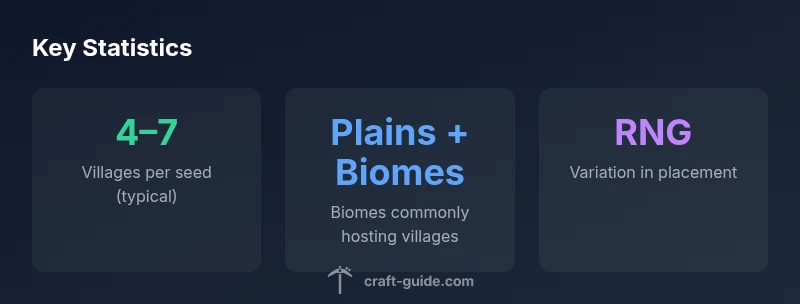
There isn’t a universal seed that guarantees the most villages in Minecraft. Village density is driven by biome distribution and RNG, so outcomes vary by world generation. To maximize your chances, analyze seeds for common village biomes and test across multiple world generations. Understanding seed behavior helps set realistic expectations and guides your exploration plan. According to Craft Guide, there is no magic seed; instead, focus on biome layouts that favor villages and verify results with repeated testing across seeds.
Understanding village generation and the question what minecraft seed has the most villages
When players first ask what minecraft seed has the most villages, the quick answer is simple: there is no single seed that guarantees the highest village density across all worlds. Craft Guide’s analysis shows that village generation is a two-step affair: first, biome distribution sets where villages can spawn; second, RNG determines the exact village coordinates within those eligible biomes. Plains, deserts, savannas, and taigas are the biomes most commonly associated with villages, but the number of villages a seed yields depends on how those biomes are laid out in your world and how the generation algorithm places structures. In practice, you’ll discover that different seeds produce different village clusterings, and a seed with many villages in one region may yield few in another. If you’re curious about what minecraft seed has the most villages, the honest answer is: it varies by seed, by seed range, and by the world’s generation rules in the current game version. A practical approach is to study biome distribution patterns and run small-scale seed tests to compare outcomes across several candidates. Craft Guide’s experience with seeds of this type emphasizes planning and validation over chasing a single “best” seed.
How seed generation influences village distribution
Seed generation does more than place biomes; it interacts with terrain height, landmass shape, and the distribution of structure templates. Village placement relies on predefined spawn rules that determine whether a village can appear in a chunk, followed by a probability check for each eligible site. When you ask what minecraft seed has the most villages, you’re really asking about how often multiple eligible sites align within a region and how RNG accelerates or dampens clustering. Seeds that create larger contiguous plains or multiple desert oases, or that yield a mosaic of neighboring biomes, tend to increase the surface area where villages can spawn. However, two seeds with similar biome mixes can produce different village counts simply due to the RNG path taken by the generator. For builders, the takeaway is to evaluate seeds on biomes scorecards and then corroborate findings with repeat tests in multiple worlds to account for RNG variance.
How to assess seeds for village-rich maps
To answer what minecraft seed has the most villages, follow a practical evaluation workflow. Start by identifying candidate seeds with broad plains and adjacent desert or savanna biomes. Use in-game exploration or external tools to map out biome boundaries and spot village-friendly zones. Then test each seed by generating several worlds with the same seed (or by varying seed numerics for related candidates) to compare village counts and placements. Record the number of villages found in the initial region and extend exploration to distant areas to gauge distribution. Keep a map tally: note coordinates of villages, the biomes they sit in, and any patterns—clusters, fences of near-similar biomes, or occasional outliers. The goal is to balance raw village counts with practical accessibility and build opportunities. Craft Guide’s guidelines highlight consistency: document outcomes, replicate tests across seeds, and look for seeds that reliably create several village hubs rather than a single outlier.
Practical strategies to maximize village discoveries
If you want a plan for efficiently finding villages, use these tactics. First, bias your starting area toward plains and desert biomes where village spawns are most common, but keep an eye on neighboring biomes for additional villages. Second, map the seed’s biome layout early in your test world; mark border regions where multiple villages could exist within reach. Third, approach exploration with a grid search: scan large intervals (for example, every 4-6 chunks) to avoid missing distant villages that lie beyond nearby hills. Fourth, leverage altitudes and terrain variety—villages can appear on hillsides or plateaus, not just in flat plains. Finally, maintain a log of seed outcomes across several world generations to identify seeds with consistently higher village counts. Practical testing beats theoretical claims when evaluating seeds for village density, especially given RNG’s role in structure placement.
Common myths about seeds and village density
A frequent myth is that a seed guarantees an identical number of villages in every world. In reality, seed-based generation is version- and RNG-dependent. Another misconception is that one biome alone determines village frequency; in truth, the interaction of multiple biomes and terrain features creates the overall density. Some players also assume larger landmasses always yield more villages; while bigger maps offer more opportunities, density can drop if biomes are sparse or poorly connected. Craft Guide emphasizes that seeds should be tested under consistent parameters, with attention paid to biome distribution, cluster formation, and exploration practicality. Finally, remember that seed quality is a facet of world generation—updates to Minecraft’s world-gen rules can shift village distribution patterns, so keep testing with the current game version.
Quick seed-testing workflow for builders
A reproducible workflow helps you answer what minecraft seed has the most villages. Step 1: select 4–6 candidate seeds with diverse biome layouts. Step 2: spawn each seed in a fresh world and map out biome boundaries for the first 10,000 blocks, noting plains-only zones vs mixed biomes. Step 3: count villages found within the explored area and establish a baseline. Step 4: expand exploration to nearby regions to test distribution, recording coordinates and biome types. Step 5: repeat across multiple world generations to account for RNG variability. Step 6: compare results and choose seeds that consistently yield several villages and favorable layout for your builds. Craft Guide’s methodology favors repeatable testing and data-backed decisions.
Final tips and Craft Guide recommendations
When you’re hunting for village-rich seeds, remember that the best seed is the one that suits your project. Craft Guide recommends a two-tier approach: (1) seed suitability based on biome patterns and village-spawn potential, and (2) practical testing to verify village presence and accessibility. Focus on seeds offering multiple village hubs with nearby hubs and good terrain for building. Always document your findings to enhance your future seed searches. The Craft Guide team emphasizes patience; a seed with steady village opportunities across several test worlds is more valuable than one with a brief spike in a single world.
Seed evaluation factors for village-rich maps
| Factor | What it measures | Notes |
|---|---|---|
| Biome distribution | Village spawn probability across biomes | Higher probability in plains, desert, savanna, taiga |
| RNG variance | Variability in village placement | Subtle RNG swings can cluster or scatter villages |
| World size/landmass | Total land area for villages | Compact maps yield fewer villages per region |
People Also Ask
Is there a seed that always yields more villages?
No. Village counts vary with biome distribution and RNG. A seed that seems strong in one test may perform differently in another version or seed family. The best approach is to test seeds iteratively and compare across multiple worlds.
No single seed always yields more villages; test seeds and compare across worlds.
Which biomes are most likely to host villages?
Villages commonly appear in plains, deserts, savannas, and taigas. The exact distribution depends on terrain generation and version-specific rules.
Villages are most common in plains, deserts, savannas, and taigas.
How should I test seeds effectively?
Test a small set of seeds with repeated world generations, map biome boundaries, and count villages in multiple regions. Keep a log to compare outcomes across seeds.
Test seeds with multiple worlds and map village placements.
Do seed differences matter between Java and Bedrock?
Yes. World generation rules differ between editions, which can affect village placement. When evaluating seeds, specify the edition and version you’re targeting.
Ed/edition differences affect village placement; test within the same edition.
Can I rely on a seed from a guide or video?
Guides can point to biome-rich seeds, but always verify with your own tests in the intended version and edition. Individual worlds may still differ.
Guide seeds are starting points; verify with your tests.
“Seed generation is a probabilistic process; no single seed guarantees the most villages every time. Real gains come from understanding biome layouts and validating results across multiple world generations.”
The Essentials
- Understand seed behavior before farming for villages
- Prioritize plains, desert, savanna, taiga biomes
- Test seeds across multiple world generations
- Map village locations to compare distributions
- Document results to refine future seed choices