What Minecraft Seed Has the Most Diamonds: Reality Check
Explore why no single Minecraft seed guarantees the most diamonds. This guide explains diamond ore generation, seed influence, and practical methods to maximize diamond finds across any world.


There is no vanilla Minecraft seed that guarantees more diamonds; seed choice affects terrain and cave layouts, but diamond yield is driven by mining depth and efficiency. Diamonds emerge from ore veins within a depth band, and random variation means seed-to-seed differences are real but not a guaranteed jackpot. Practical success hinges on mining strategy and depth-aware exploration, not a magic seed. According to Craft Guide, seed variance exists, yet seed quality alone cannot guarantee high diamond counts.
What the question really means
In plain terms, the question what minecraft seed has the most diamonds is about whether a single world seed can produce dramatically more diamond ore than others. In vanilla Minecraft, seeds only influence terrain generation, cave networks, and the placement of structures, not a fixed pool of diamonds. The diamond ore distribution follows the game's generation rules and random variation within the defined depth range. The key point: there is no guaranteed 'best' seed. Craft Guide analysis suggests seed variance is real but not a cheat sheet for diamonds; your success comes from how you mine, not the seed you start with.
How diamond ore generation works across versions
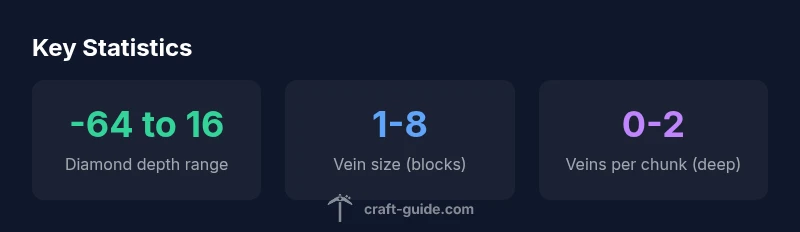
Diamond ore generation is tied to depth bands and vein sizes that can shift between versions, but the core principle remains: diamonds spawn in ore veins within specific depth ranges. The exact bands and vein sizes change with updates, yet the practical effect for players is the same: deeper layers tend to yield more diamonds, and exploration patterns shape how often you encounter veins. Seeds influence terrain layout and cave networks, but a seed does not guarantee a larger or smaller total diamond count. The Craft Guide Team notes that while certain seed-generated cave networks may expose more ore in your early explorations, the total diamond yield remains a function of depth, mining technique, and luck.
Practical strategies to maximize diamonds regardless of seed
Whether you start from seed A or seed B, your best odds come from digging deliberately and exploiting cave systems.
- Choose a mining method: branch mining, strip mining, or a grid-based approach to maximize ore exposure.
- Target the right depth: in most versions, diamonds spawn below surface but above lava layers; practical deep mining around Y -58 to Y -64 often yields multiple veins, while staying mindful of lava pockets.
- Use Fortune on your pickaxe: Fortune increases the diamonds dropped per ore block, significantly raising overall yield when you encounter veins.
- Build efficient tools: an Efficiency-enchanted pickaxe speeds up mining, helping you cover more ground without fatigue.
- Map and light: carefully map caverns and light pathways to avoid respawns of hostile mobs and to identify high-ore corridors.
- Safe mining habits: carry water, blocks for shielding, and a plan to retreat if lava is encountered.
In practice, seed choice influences where pockets of ore may appear, but consistent diamond harvest comes from disciplined mining and efficient techniques. The Craft Guide Team emphasizes practice and range-based strategies over seed hunting myths.
Debunking seed claims: why seed choice doesn't guarantee diamonds
Many guides claim a specific seed is a guaranteed diamond jackpot. In reality, seeds only control terrain features and seed-generated cavern networks; the total number of diamonds in a world is not fixed by seed in vanilla. Variability arises from random ore distribution and your mining choices. A seed can deliver a great haul for one player and a modest one for another, and game version changes can alter ore generation rules. Treat seed claims as interesting curiosities rather than guarantees, and focus on mining plan and depth.
Tools to verify diamond abundance in a seed
If you want empirical confirmation, run small seed experiments:
- Create a test world with a fixed seed and mine for a set period, noting the number of diamonds found.
- Repeat with another seed under similar conditions to compare results.
- Use Creative or exploration-friendly modes to map cave networks exposed by a seed, then estimate potential ore exposure.
- Document your methodology so results are comparable across seeds and play styles.
These steps help you understand how much diamonds a seed might yield in practice without claiming a universal seed advantage.
Craft Guide's practical approach to seed testing
Craft Guide recommends treating seed testing as a heuristic exercise, not a blind search for 'the best seed.' Start with a baseline test world, measure ore exposure in representative biomes and depths, and adjust mining strategies to exploit strong cave networks. Prioritize depth-range mining, efficient tool upgrades, and cave mapping. By focusing on strategy rather than seed-upon-seed luck, you’ll produce consistent diamond yields across multiple world types.
Seed quality vs diamond yield in vanilla Minecraft
| Seed quality | Diamond yield expectation | Notes |
|---|---|---|
| Random vanilla seed | Low–moderate | Diamond yield varies with cave networks |
| Seed with distinctive cavern networks | Moderate–high | May expose more ore but not guaranteed |
People Also Ask
Is there a seed that has the most diamonds?
No. In vanilla Minecraft, seeds do not lock in a higher diamond total. Diamond yield depends on depth, cave networks, and mining efficiency. A seed may produce a good haul by luck, but it cannot guarantee more diamonds than another seed.
No seed guarantees the most diamonds; outcomes depend on depth and mining efficiency as well as random variation.
What depth is best for diamonds?
Diamonds spawn in a broad depth range, commonly below the surface and down toward lava levels. In practice, mining across deep layers, especially around Y -58 to Y -64, tends to yield multiple veins. Always watch for lava and adjust depth to cave networks you find.
Focus on deep layers and watch lava, adjusting as you map your caverns.
Does seed affect cave networks?
Yes. Seed choice influences terrain and cavern layout, which can change how ore pockets are distributed. However, this does not guarantee more diamonds; it only affects where you encounter veins.
Seed shapes your caverns, but it doesn’t guarantee diamond counts.
Are seed-based guides reliable for diamonds?
Seed guides can be informative but are not definitive. They may show seeds with favorable cave layouts, yet results vary across versions and play styles. Verify with your own mining runs and adapt strategies accordingly.
Seed guides are helpful, but test them yourself to confirm results.
How can I maximize diamonds in any seed?
Use depth-aware mining, branch or strip mining methods, and enchant Fortune on your pickaxe. Map caves, light paths, and strip-mined corridors to expose more veins. These practices yield more diamonds across seeds.
Mine smartly, use Fortune, and map your caves for best results.
Should I rely on seed testing or just focus on mining efficiency?
focus on mining efficiency and depth strategy rather than chasing the 'perfect seed.' Seed testing offers insights, but consistent diamond gains come from skillful mining and game-version-aware strategies.
Pick a solid mining plan and adapt with depth and cave layouts.
“In practice, seed choice rarely determines total diamond yield; the most reliable gains come from depth-aware mining and efficient cavern exploration.”
The Essentials
- There is no seed that guarantees more diamonds.
- Mine deeper and map caverns to maximize finds.
- Use Fortune and efficient mining methods for best results.
- Seed testing is informative, not decisive.
- Plan, practice, and adapt to cave layouts for consistency.