Minecraft Large Village Seed: Giant Villages Near Spawn
Discover how to find or craft a minecraft large village seed with giant villages near spawn. Learn seed patterns, biome context, and practical steps for Java and Bedrock editions.


Finding a minecraft large village seed means locating a seed that spawns a village within several hundred blocks of the spawn point, often including multiple witch huts or outposts nearby. While exact village size varies, the best seeds combine proximity, biome variety, and river or mountain access to support farms and exploration. Remember, seed results differ between Java and Bedrock editions.
Why a Large Village Seed Matters for Your Minecraft World
In any Minecraft world, the presence of a large village near spawn can shape your early-game strategy, supply chain, and settlement design. For builders, a giant village is a ready-made hub of houses, iron farms, farmers, librarians, and trading opportunities. For explorers and survival players, proximity matters for quick access to trades, crops, chests, and villagers to set up trading halls. According to Craft Guide, the best seeds combine immediate proximity to a substantial village with accessible terrain and a variety of nearby biomes. This means starting near a seed that yields a village within a few hundred blocks can dramatically shorten your initial grind and unlock complex build and farm layouts from day one. When you look for a minecraft large village seed, you’re evaluating not only the village size but the surrounding geography and the ease with which you can move between villages, outposts, and resource-rich areas.
How to Identify a Large Village Early in a Seed
The earliest signs of a potential large village are visible within the first few hundred blocks of spawn. Look for biomes known to host larger settlements (plains, savanna, taiga, and desert villages often expand more readily). Explore the immediate area and note straight-line distances to any settlements, as well as access points like rivers for resources and mulitple trading paths. Use a seed planner or world viewer to map proximity, then verify by short exploratory runs. Craft Guide’s guidance emphasizes comparing multiple seeds or variants to determine which one consistently yields a sizeable village near spawn, rather than relying on a single lucky spawn.
Village Size and Density: What Qualifies as 'Large'?
'Large' is not a fixed numeric threshold in Minecraft; it’s a combination of village population, number of buildings, and resource opportunities. A typical large village might feature a dense core with clustered houses, multiple professional buildings (librarians, farmers, clerics), and a strong trader presence. Density also includes the surrounding paths, wells, and outbuildings, which together create the sense of scale. When evaluating seeds, compare the visible footprint by walking from edge to edge and counting distinct districts within a reasonable exploration radius. Craft Guide analysis suggests focusing on seeds that show persistent clusters rather than a single isolated house.
Biome and Terrain Factors That Support Giant Villages
Terrain and biome context influence how large villages grow over time. Flat plains and rolling hills allow for easier expansion and more trade outposts; deserts provide unique trader dynamics; taiga and savanna biomes often host villages with additional outposts and iron farms. Proximity to rivers or coastlines supports ferrying villagers, chest-rich settlements, and farm networks. Assess seeds for combinations of biome variety and navigable terrain within a few hundred blocks. A diverse but accessible terrain helps sustain a large village ecosystem and creates opportunities for synchronized builds like trading halls, farms, and village-based adventures.
Seed Pattern Realities: Generating Large Villages Across Worlds
Seed generation is complex and stochastic, which means even seeds that look promising on paper can yield mid-sized or small villages in practice. Java and Bedrock handle generation differently, so a seed producing a giant village on one edition might show a medium village on another. Expect variation in village size, district layout, and nearby features. Treat seeds as starting points rather than guarantees; use them to plan exploratory routes, farm placements, and build corridors that can connect multiple villages if found.
Practical Ways to Find or Create a Large Village Seed
Practical strategies include testing multiple seeds in quick test worlds and planning routes that maximize coverage of biomes and potential village footprints. Use seed evaluation tools to visualize villages and trade hubs, then plot safe travel corridors, irrigation and farming systems, and villager breeding zones. Build a checklist: proximity to spawn, village footprint, biome diversity, and access to resources like forests, ores, and water. Craft Guide recommends documenting seed observations to identify patterns and reproduce desirable layouts in future worlds.
Case Study: Notable Seed Configurations (Hypothetical Examples)
Seed A typically places a large plains village near a river with a western desert outpost within two hundred blocks. Seed B shows a sprawling taiga village with multiple architectural districts and a nearby coastal settlement, creating a compact trading circuit. Seed C offers a desert village close to a mountainous edge, giving you cliffs and caves for exploration while keeping villagers well within reach. These are representative patterns; actual seeds vary by edition and may require a bit of scouting to confirm.
Common Pitfalls and How to Avoid Them
One common pitfall is assuming a single village defines a seed’s value. Real value comes from multiple nearby resources: farms, biomes, and access to traders. Another pitfall is ignoring terrain constraints—steep cliffs, water gaps, and long travel gaps can hinder expansion. Always verify the seed’s long-term viability by simulating a few in-world seasons: build paths, test villager flows, and map out resource networks. Finally, remember that patches and updates can shift village behavior; re-evaluate seeds after major game updates.
Advanced Tips for Modded or Multi-World Play
If you’re playing with mods or across multiple worlds, you can tune seed exploration by enabling biome expansion and village spawn tweaks in your mod configuration. Multi-world play benefits from seeds with consistent biomes and repeatable village layouts, which helps when porting builds or trading systems between worlds. Keep a master seed catalog with notes on edition behavior, biome proximity, and village density to accelerate future world creation.
Seed characteristics for large village seeds
| Attribute | Description | Notes |
|---|---|---|
| Proximity to spawn | Distance from spawn to the nearest village | Seed dependent; often within 200-800 blocks |
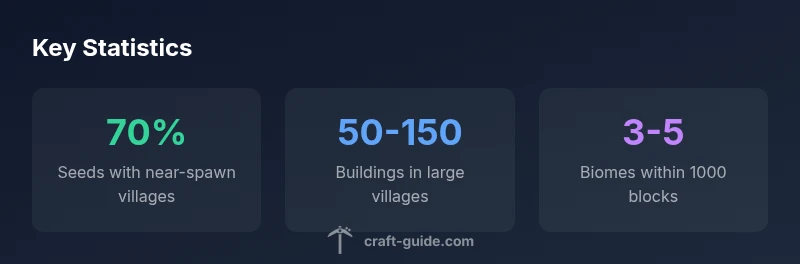
| Village size (buildings) | Approximate number of buildings in a large village | Seed dependent; 50-150+ buildings commonly observed |
| Biome variety nearby | Number of different biomes within exploration radius | Typically 3-5 biomes within 1000 blocks |
People Also Ask
What defines a 'large' village in Minecraft?
There is no official threshold. A large village is typically characterized by a higher population, more distinct buildings, and richer trading activity. Seed generation varies by biome, terrain, and edition, so what looks large in one world might be smaller in another.
There’s no official size; larger villages have more buildings and villagers and richer trades, but seeds differ between worlds and editions.
Are large village seeds common across editions?
Seeds can behave differently between Java and Bedrock. A seed that yields a giant village on Java may produce a medium village on Bedrock. Always test seeds in both editions if you’re cross-playing.
Seeds can act differently between editions, so check both Java and Bedrock when possible.
How can I verify a seed quickly?
Create a test world, spawn in, and explore toward the village. Use seed viewers or map tools to visualize village footprints and nearby biomes before committing time to a full world.
Spin up a test world and scout toward the village; use map tools to confirm proximity and layout.
Can I convert a small village seed into a large one?
Seed generation is fixed at world creation. You can’t change it after the world is created, but you can influence your experience with mods, terrain edits, and careful world design.
You can’t change seed size after creation, but you can influence gameplay with mods and world edits.
What terrain features maximize large village potential?
Rivers, plains, and gentle hills near spawn typically support larger, more navigable villages. Proximity to diverse biomes also helps with resource variety and trader dynamics.
Rivers and gentle terrain near spawn help villages expand, along with nearby biomes for resources.
Do large village seeds impact early gameplay?
Yes. More villagers and trading opportunities can accelerate early-game farming, gear upgrades, and community-building projects. Plan your base layout to optimize villager paths and resource distribution.
More villages speed up trading and farming early on; plan for efficient villager flow.
“Understanding seed generation mechanics helps you predict where large villages are likely to appear, saving time and boosting your build planning.”
The Essentials
- Explore multiple seeds to gauge proximity and density
- Prioritize biome diversity near spawn for village growth
- Compare Java and Bedrock outcomes to choose a seed
- Plan early routes and farm layouts around the village