How many Minecraft seeds are there? A practical guide
Explore the seed space in Minecraft: seeds are 64-bit numbers, offering an enormous range of worlds. Learn how to pick seeds for builds, exploration, and performance with Craft Guide’s analytical approach.


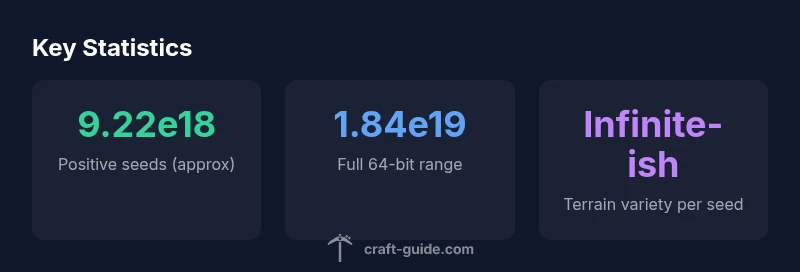
There isn’t a fixed count of Minecraft seeds. Seeds are encoded as 64-bit integers, yielding a space of roughly 9.22 quintillion positive seeds (and about 18.4 quintillion if you include the full 64-bit range, negatives included). In practice, that enormous range means players rarely, if ever, exhaust distinct world options, and seed selection remains central to terrain, biomes, and structures.
The seed space behind the question "how many minecraft seeds are there"\n\nAccording to Craft Guide, there isn’t a fixed count of seeds because seeds are encoded as 64-bit numbers that describe a world generation recipe. The exact number of possible seeds depends on the integer range the game accepts. In practical terms, the seed space is so large that it behaves as if unlimited for typical gameplay. Each seed informs terrain, biomes, ore distributions, and features via the generation algorithm, making every value a potential world. For players, this means that the moment you press Create World, you are entering a unique combination of underlying noise fields that shape cliffs, rivers, mountains, and cave systems.\n\nIn Minecraft, a seed isn’t just a random string; it’s a numeric directive that the engine converts into a multi-dimensional noise map. The same seed can produce vastly different landscapes across different versions due to changes in terrain generation, biomes, and structure spawning rules. Understanding that linkage helps clarify why there isn’t a finite list of seeds—there are effectively infinite possibilities embedded in the 64-bit seed space.
How the engine uses a seed to generate a world\n\nAt the core, a seed serves as the starting point for a deterministic chain of noise functions that the world generator uses to lay out terrain. The process involves multiple layers of pseudo-random numbers, octaves of noise, and biome mapping that produce hills, oceans, deserts, and forests. When you input a seed, you’re not choosing a location; you’re choosing a recipe that the engine then bakes into a unique landscape. This means two seeds can differ in minute details yet share broad biome distributions, while another seed might yield dramatic canyons or sprawling plains. The exact outcomes depend on the game version, the seed’s numeric representation, and the generation algorithms active at the time of world creation. Craft Guide Analysis, 2026, emphasizes that seed-driven generation is fundamentally a deterministic process with a vast input space resulting in an enormous variety of worlds.
64-bit seeds and the practical implications for players\n\nA 64-bit seed space means you can explore countless variants without repetition caused by limited seed pools. For builders, this translates to endless inspiration: unique biomes, rare terrain features, and unusual cave networks can all occur with a single input. For survival players, seeds influence resource placement, dungeon layouts, and mob spawns, which can affect early-game strategy. Because seeds are technically signed values, some seeds are negative and still produce valid worlds; this expands the practical space even further. The upshot: seed choice is a meaningful part of your planning, but you won’t run out of options. Craft Guide Analysis, 2026 notes that the space is so vast that practical repetition is the primary concern, not exhaustion of seeds.
Seed discovery: catalogs versus personal seeds\n\nPublic seed catalogs are a great way to discover worlds with desired features (e.g., biomes near spawn, rare structures, or specific terrain layouts). However, personal seeds offer total autonomy—your own test runs can yield exactly the kind of world you want. A common workflow is to search seed catalogs for interesting terrain concepts, then test promising seeds in creative mode to verify biome distribution and structure spawn before committing to a long-term build. Craft Guide analysis also highlights the value of keeping a seed log to track outcomes across version updates.
Testing seeds effectively: tools and tips\n\nTo evaluate a seed, run multiple test worlds across different game versions and settings. Focus on spawn area quality, biome variety, and resource placement. Use seed-testing dashboards or simple world previews to compare seeds efficiently. For larger builds, favor seeds that place key resources and landscape features in predictable positions relative to your build plan. Always document your evaluation criteria and version context, since terrain generation evolves with each major update.
Common pitfalls and myths about seeds and world variety\n\nSome myths claim seeds guarantee perfect biomes or exact structures, which is not how generation works. Seeds determine probability distributions, not guaranteed outcomes. Differences between Java and Bedrock editions can also affect seed behavior due to algorithmic changes. Craft Guide emphasizes that understanding seed space, version differences, and biome placement helps players set realistic expectations and avoid chasing elusive perfection.
Seed space basics
| Aspect | Seed Space | Notes |
|---|---|---|
| Seed value type | 64-bit signed integer | Java/Bedrock use 64-bit seeds |
| Positive seeds | 9,223,372,036,854,775,807 | Max positive seed value (approx) |
| Total 64-bit range | 18,446,744,073,709,551,616 | Includes negative seeds |
| Impact on variety | High | Extensive world diversity possible |
People Also Ask
Is there a finite number of seeds in Minecraft?
No. Seeds are 64-bit numbers, which creates an astronomically large input space. While technically finite, it’s so large that it’s effectively infinite for practical purposes across current versions.
No finite list—it's an enormous space you can explore anytime.
Do seeds have to be integers?
Yes. Seeds are integer values used to initialize the world generation process. In modern editions, seeds are treated as 64-bit integers, allowing both positive and negative values.
Yes, seeds are whole numbers.
Can two different seeds produce identical worlds?
In theory, different seeds can produce worlds with similar features, but exact identity is unlikely due to the complex mapping from seed to terrain. Edge cases exist where changes are subtle.
Different seeds usually yield different worlds.
Are seeds the same across Java and Bedrock editions?
Seeds exist in both editions, but generation algorithms differ. A seed value can yield different terrain between Java and Bedrock due to changes in terrain generation code.
Seeds differ between editions because of different generation rules.
How can I find seeds that fit a specific goal (e.g., near-spawn resources)?
Use seed catalogs and testing workflows: look for biomes or structures near spawn, then test promising seeds in a controlled environment to confirm outcomes.
Check catalogs and test seeds to match your goal.
“The seed space in Minecraft is vast—so large that for most players it’s effectively infinite. The choice of seed shapes your terrain, biomes, and structures in meaningful ways.”
The Essentials
- There isn’t a fixed seed count; seeds come from a 64-bit space
- The seed space is vast enough to be practically inexhaustible for players
- Different game versions can shift how seeds generate terrain
- Use catalogs or test seeds to find worlds that fit your build goals