Do Minecraft Maps Update: A Complete Step-by-Step Guide
Learn how to do minecraft maps update with safe backups, compatible tools, and practical steps. Craft Guide explains how to update map data for Java and Bedrock editions, helping you keep your builds current.


Updating Minecraft maps means refreshing the map data to reflect new terrain, biomes, or features added in game updates. This guide shows when to update, what you need, and a safe, practical path for both Java and Bedrock editions. By following concrete steps, you can keep your maps current without losing progress. Craft Guide provides practical, beginner-friendly instructions for maps and seeds. do minecraft maps update
What updating Minecraft maps really means
According to Craft Guide, updating a map means refreshing its underlying data so new terrain, biome shifts, or added structures become visible to players without rebuilding the world from scratch. This process is not about repainting the entire map with new seeds; rather, it focuses on ensuring the map reflects the current world state after patches or feature additions. The phrase do minecraft maps update appears here as part of the practical guide, illustrating that you can align your maps with the latest game changes while preserving your existing builds and achievements. Whether you play on Java or Bedrock, the core idea remains the same: update the map data so explorers see current geography, not yesterday’s landscape. This helps keep multiplayer servers coherent and personal maps accurate for new adventures, build planning, and seed exploration.
When you approach an update, plan for two outcomes: an incremental refresh (small changes only) or a full redraw (bigger re-visualization of biomes or new structures). The goal is to minimize disruption while maximizing accuracy. Craft Guide emphasizes consistency across versions to prevent corrupted coordinates or mismatches in chunk rendering, which can ruin navigational accuracy or spawn-point reliability. The first step toward doing minecraft maps update is to understand what will actually change on screen and what will stay the same. This awareness informs backup strategies, tool choices, and the testing protocol you’ll follow in the next sections.
What updating Minecraft maps really means
According to Craft Guide, updating a map means refreshing its underlying data so new terrain, biome shifts, or added structures become visible to players without rebuilding the world from scratch. This process is not about repainting the entire map with new seeds; rather, it focuses on ensuring the map reflects the current world state after patches or feature additions. The phrase do minecraft maps update appears here as part of the practical guide, illustrating that you can align your maps with the latest game changes while preserving your existing builds and achievements. Whether you play on Java or Bedrock, the core idea remains the same: update the map data so explorers see current geography, not yesterday’s landscape. This helps keep multiplayer servers coherent and personal maps accurate for new adventures, build planning, and seed exploration.
When you approach an update, plan for two outcomes: an incremental refresh (small changes only) or a full redraw (bigger re-visualization of biomes or new structures). The goal is to minimize disruption while maximizing accuracy. Craft Guide emphasizes consistency across versions to prevent corrupted coordinates or mismatches in chunk rendering, which can ruin navigational accuracy or spawn-point reliability. The first step toward doing minecraft maps update is to understand what will actually change on screen and what will stay the same. This awareness informs backup strategies, tool choices, and the testing protocol you’ll follow in the next sections.
Tools & Materials
- Minecraft game (Java or Bedrock) installed(Ensure you’re on a supported version for the map you’re updating)
- World backup method(Create a full backup of your world before updating maps)
- Map editor or data viewer (optional)(Amidst, MCA Selector, or other tools can help inspect map data)
- Change log or patch notes(Refer to version notes to anticipate what data may change)
Steps
Estimated time: 45-90 minutes
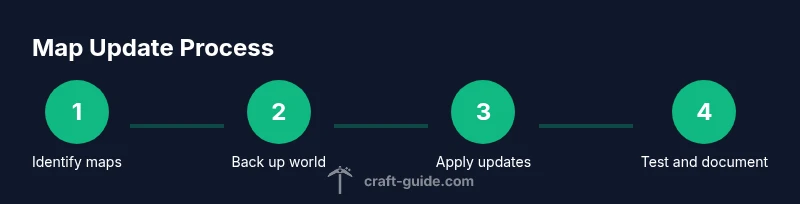
- 1
Identify maps to update
Scan your world or server inventory to locate maps that will be affected by the patch or feature change. Look for maps with outdated biomes, new structures, or altered terrain inclusive of your planned routes. If you’re updating a server, coordinate with admins to determine which maps require refresh.
Tip: Document the map IDs and current seed/coords before proceeding. - 2
Back up your world
Create a full backup of the world data, including all maps and player data. Backups are essential as updates can cause data desynchronization between client and server. Store backups in a separate drive or cloud location.
Tip: Verify the backup by restoring to a test copy to confirm integrity. - 3
Check edition compatibility
Ensure you’re updating maps with the correct game version for your platform (Java vs Bedrock). Cross-check patch notes for any map-related changes that require specific client features or server settings.
Tip: If mods are involved, confirm their compatibility with the new version first. - 4
Load map data for review
Open the maps in your editor or in-game console to review current data. Compare against patch notes and identify chunks that may render differently or need re-seeding. Focus on high-traffic areas and navigational waypoints.
Tip: Keep changes minimal during the first pass to avoid accidental re-seeding. - 5
Apply map updates
Implement the update by refreshing map data, re-importing world state, or regenerating affected chunks as appropriate. Avoid wholesale re-seeding unless absolutely necessary, to minimize risk of losing existing progress.
Tip: Test updates on a local copy before applying to live worlds. - 6
Test in-game
Enter the world and validate that maps display the updated terrain and new features correctly. Check coordinates, spawn points, and pathfinding for accuracy. Have players walk routes to verify visual updates.
Tip: Record discrepancies with screenshots for later fixes. - 7
Document and share
Log the changes made, the game version, and any known caveats. Share update notes with players or teammates so that everyone understands what changed and why.
Tip: Maintain a changelog to simplify future updates.
People Also Ask
What does it mean to update Minecraft maps?
A map update refreshes the map data so current terrain, biomes, and structures reflect newer patches. It preserves player progress and avoids starting from scratch.
A map update refreshes your map to show new terrain and features while keeping your progress.
Can I update maps without losing progress?
Yes, with proper backups and careful application of changes. Always validate changes on a test world before applying to the main world.
Yes—back up first, test carefully, and you can update without losing progress.
Is updating maps different for Java vs Bedrock?
There are nuances in rendering and chunk handling between editions, so ensure you follow edition-specific steps and patch notes.
Java and Bedrock handle maps differently, so check edition-specific steps and notes.
What risks come with updating maps?
Potential desynchronization between client and server, chunk rendering glitches, or accidental re-seeding. Backups and staged testing reduce risk.
Risks include desync and glitches; back up and test to reduce them.
How long does updating typically take?
Time varies with map complexity and the number of maps affected. Plan for 30-90 minutes and adjust based on testing results.
It usually takes from half an hour to about an hour depending on the scope.
Do server maps require a separate update?
Server maps often need a coordinated update with downtime and synchronized backups. Follow your admin team's plan.
Yes, server maps usually need coordinated downtime and careful backups.
Watch Video
The Essentials
- Back up first to prevent data loss.
- Verify edition compatibility before updating maps.
- Test updates in a copy world to catch issues early.
- Document changes for future reference.