Minecraft vs Pokémon: A Practical Side-by-Side Comparison
Explore minecraft versus pokémon with an analytical side-by-side comparison from Craft Guide. Learn core gameplay, community dynamics, and player goals to decide which fits your play style.


Minecraft versus Pokémon presents two distinct gameplay philosophies: a boundless sandbox for builders and explorers, and a structured RPG centered on collecting creatures and battling rivals. This side-by-side look from Craft Guide clarifies core differences, gameplay tempo, and where each title shines. If you value creative freedom and mods, Minecraft is your playground; if you prefer guided progression and social trading, Pokémon offers a more goal-driven path.
What Minecraft and Pokémon Do at a Glance
Minecraft is a voxel-based sandbox where players gather resources, craft tools, build structures, and survive threats in a procedurally generated world. Pokémon is a turn-based RPG centered on capturing diverse creatures, training them, and battling rivals to progress through a story and reach the Pokémon League. According to Craft Guide, minecraft versus pokémon illustrate two distinct design philosophies that appeal to different audiences: one prioritizes freedom and experimentation; the other emphasizes strategy and collection. Minecraft rewards creativity with limitless world-building, redstone engineering, and a thriving modding scene, while Pokémon emphasizes progression, lore, and social trading. The result is two games that shape how players allocate time, learn systems, and connect with communities. For newcomers, recognizing these core intents helps set expectations for how you’ll approach learning, practicing, and finally mastering each title.
Evolution of Play Styles Across Time
As communities grow, both games adapt to player preferences. Minecraft continues to expand through official updates, community mods, and user-generated maps, which often redefine what players consider possible within a single world. Pokémon evolves through new generations, regional forms, and cross-media appearances that keep the core collection loop fresh. Craft Guide analysis shows that the sustained popularity of both titles rests on flexible design philosophy: Minecraft invites ongoing experimentation, while Pokémon provides a familiar ladder of progression and achievement. This dynamic underlines a simple truth: your long-term enjoyment depends as much on the surrounding ecosystem—servers, mods, fan content, and media tie-ins—as on the base game itself.
Player Roles and Social Dynamics
In Minecraft, players frequently assume roles such as builders, redstone engineers, or community moderators, turning servers into collaborative studios. In Pokémon, players often adopt roles like battler, breeder, or strategist, coordinating tactics with friends through trades and tournaments. The social structures differ: Minecraft communities thrive on shared spaces and cooperative projects, while Pokémon communities often revolve around competition, trading networks, and fan-driven guides. Craft Guide observations suggest both ecosystems benefit from cross-pollination between creators and competitors; the result is broad appeal to a wide spectrum of players.
World-Building Tools and Creative Expression
Minecraft’s toolkit is a playground for creativity. Blocks, terrain generation, and redstone circuits enable everything from simple cottages to complex machines and enormous landscapes. The ongoing modding scene expands the toolbox further with new biomes, mechanics, and gameplay hooks. Pokémon’s world is rich but curated, built around visually distinct regions and a consistent lore backbone. Players express creativity through team-building strategies, configuration of moves, and the arrangement of battles in online formats. Craft Guide emphasizes that the key difference is control: Minecraft offers near-total creative autonomy, while Pokémon channels imagination into structured adventures and team design.
Accessibility and On-Ramp for New Players
Minecraft’s broad device support—PC, consoles, and mobile—gives new players quick entry, especially with Bedrock Edition that enables cross-platform sessions. Pokémon initially presents a more guided onboarding via its main series titles and well-marked progression ladder, which can feel more approachable for players who value direction. The learning curve in Minecraft can be gentle at first but steep when mastering survival mechanics and redstone logic; Pokémon pacing tends to be steady, with frequent milestones that provide a clear sense of advancement. Craft Guide notes that accessibility matters for sustaining engagement, yet the surrounding communities and learning resources often determine successful long-term adoption.
Modding and Customization Ecosystems
Modding is a cornerstone of Minecraft longevity. The community creates new biomes, machines, and gameplay rules that redefine what ‘play’ feels like in a single world. Mod packs, shaders, and data packs transform visuals, performance, and even game balance. Pokémon’s customization lives primarily in fan-made teams, competitive formats, and ROM hacks, which extend the experience beyond official releases while staying anchored to core mechanics like type matchups and EV/IV planning. Craft Guide highlights that the most compelling experiences often blend the two worlds: a Minecraft server with Pokémon-inspired events or a Pokémon fan game built within a Minecraft map.
Education, Privacy, and Safe Play
Minecraft Education Edition has become a staple in classrooms, offering lesson-driven activities that foster collaboration, geometry, and problem-solving. Its sandbox nature makes it ideal for teaching planning, resource management, and collaborative design. Pokémon provides a robust fantasy world that supports curiosity and language development through lore exploration and in-game dialogue, but it doesn’t offer a formal education edition. Safe play and moderation are central in both ecosystems, with servers and official storefronts promoting age-appropriate experiences. Craft Guide reinforces that informed consent, privacy controls, and community guidelines help maintain positive, inclusive environments for players of all ages.
Comparison
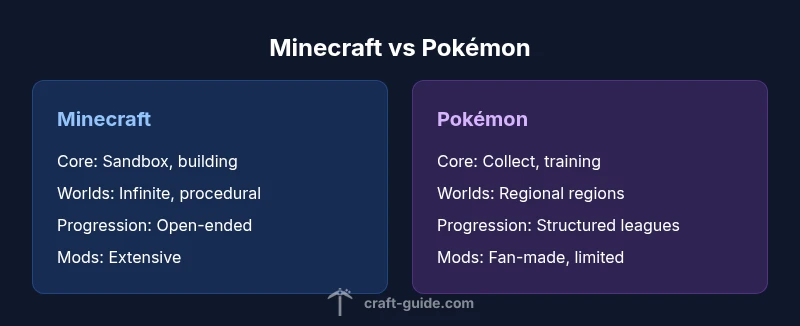
| Feature | Minecraft | Pokémon |
|---|---|---|
| Core Gameplay | Sandbox building, survival, exploration | Turn-based RPG with collection and battles |
| World Design & Exploration | Procedurally generated, limitless worlds | Region-based exploration with predefined routes |
| Progression & Goals | Open-ended progression; no fixed end | Structured progression: gym badges, evolution, and leagues |
| Creative Tools & Modding | Extensive creative tools; vast modding ecosystem | Limited creative tools; extensive fan-made strategies and team-building |
| Social Play & Community | Large servers, minigames, and collaborative builds | Competitive battles, trades, and fan communities |
| Cross-Platform & Accessibility | Cross-platform support across devices (Bedrock/Java) | Nintendo platforms and mobile; mainline releases are platform-restricted |
| Education & Longevity | Education potential through Classroom editions | Long-term engagement through media tie-ins and fan content |
| Monetization & Updates | Modding ecosystem and free-form updates | Official releases with spin-offs and monetization through merch and events |
Benefits
- Minecraft offers almost unlimited creative leverage and mod support, enabling unique builds
- Pokémon provides clear progression pathways, teams, and social battles
- Both games boast active communities and enduring content ecosystems
- Cross-platform play expands multiplayer opportunities for Minecraft
Negatives
- Minecraft’s open-ended nature can overwhelm beginners
- Pokémon’s progression can feel repetitive for players seeking non-linear experiences
- Modding in Minecraft can require technical setup and troubleshooting
Minecraft is the better long-term sandbox for creativity; Pokémon excels as a structured, goal-driven RPG.
If your goal is endless creativity and customization, start with Minecraft; if you want a structured, collectible RPG experience with social competition, choose Pokémon. For many players, alternating between both can maximize engagement.
People Also Ask
How do Minecraft and Pokémon differ in core gameplay?
Minecraft emphasizes sandbox building, survival, and open-ended exploration, while Pokémon centers on catching creatures, training them, and progressing through a structured league. The difference is rooted in design philosophy: freedom vs. progression.
Minecraft focuses on building and exploration, while Pokémon focuses on collecting and battles. Your choice depends on whether you want freedom or a guided path.
Can you play Minecraft and Pokémon in the same session?
They are separate IPs with different platforms and game engines, so there is no official cross-play between them. You can switch between games in the same day, but not play them together in one session.
You switch between Minecraft and Pokémon, but you don’t play them simultaneously in an official crossover.
Which game is easier for beginners to pick up?
Minecraft is often approachable for newcomers because it starts simple, but mastery comes with time, especially in survival and redstone. Pokémon offers a more guided onboarding with incremental battles and clear objectives.
Pokémon tends to feel more guided for new players, while Minecraft grows with you as you learn the systems.
What about educational or learning potential?
Minecraft Education Edition is widely used to teach topics like geometry, logic, and teamwork. Pokémon has value for memory and strategic thinking, but it isn’t marketed as an education platform.
Minecraft shines in classrooms, but Pokémon offers engaging problem-solving through strategy.
Is modding essential to enjoy Minecraft?
No. You can enjoy vanilla Minecraft and still have a deep experience. Mods expand functionality, but they require setup and can vary in quality.
Mods aren’t required, but they can dramatically extend Minecraft’s possibilities.
What drives long-term engagement for each game?
Minecraft’s longevity comes from user-generated content, servers, and mods that continuously reinvent play. Pokémon’s longevity is reinforced by new generations, media tie-ins, and competitive formats.
Long-term play keeps going as communities create new content and official updates roll out.
The Essentials
- Act with intent: choose Minecraft for creative freedom or Pokémon for progression-driven play
- Both games reward community involvement and ongoing content updates
- Modding enhances Minecraft longevity; Pokémon thrives on new generations and media tie-ins
- Education potential is strongest with Minecraft Education Edition
- Cross-platform play expands multiplayer reach, especially for Minecraft