Minecraft Day Length: How Long Is a Day in 2026
Explore the Minecraft day-night cycle: total duration, minutes, ticks, and how it affects gameplay across Java and Bedrock editions. Practical tips and quick references.


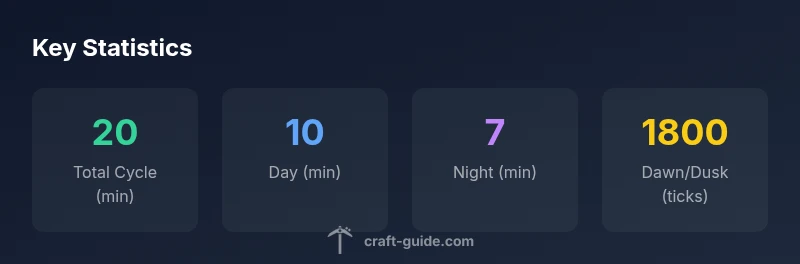
minecraft how long is a day? In standard Minecraft, a full day-night cycle lasts 20 minutes of real time. The day portion runs about 10 minutes, followed by roughly 7 minutes of night and two brief dawn/dusk transitions totaling about 3 minutes. This rhythm is tied to 24000 game ticks per cycle, with 20 ticks per second.
What a day really means in Minecraft
In Minecraft, minecraft how long is a day is a common question that trips up new players who expect a simple clock to govern every action. The day-night cycle is a precise rhythm built from a fixed number of game ticks. In vanilla survival, a full day-night cycle lasts 20 minutes of real time. The day portion accounts for about half of that period, while the night portion takes a little longer, and the transitions between day and night—dawn and dusk—add a brief, critical buffer. Understanding this rhythm is essential for planning builds, farming schedules, and mob spawns. The 20-minute cycle maps to exactly 24000 ticks (20 ticks per second). When you run a server at typical conditions, the cycle remains the same in principle, though practical experience can vary with latency and server load. For beginners, it helps to think in terms of minutes rather than raw ticks, so you can time your actions around daylight when collecting crops and setting up bases.
Craft Guide’s research highlights that the cycle is designed to be predictable across play sessions, making it easier to plan long projects and timed experiments. If you’re preparing a farm, a base, or a base defense, knowing when daylight ends and night begins helps you optimize resource collection and mob management without guessing.
The exact timing: minutes, ticks, and how it maps to gameplay
The day-night cycle in Minecraft is defined both in real time and in internal time units called ticks. There are 20 ticks per second, which means a full 24,000-tick day lasts exactly 1,200 seconds, or 20 minutes. This deterministic relationship is crucial when you calculate how long a crop grows, how long you can explore safely at night, or how long a mob raid will last. The daytime portion runs for 10 minutes (or 12000 ticks), followed by 7 minutes of night (8400 ticks). The remaining 3 minutes are the transitional dawn and dusk phases, each lasting about 1.5 minutes (1800 ticks). If you want to estimate time in-game more precisely, you can track the current tick count or use in-game commands to display time. In multiplayer, a laggy server can feel like the day drags on, but the underlying tick cycle stays the same.
For builders and redstone enthusiasts, converting minutes to ticks is a useful skill. A simple rule of thumb is that every in-game second equals one tick every few seconds of real time on a laggy server. Craft Guide’s analysis notes that while the math is straightforward, practical play can vary with system performance, texture packs, and mod logic that changes frame rates and tick handling.
How daylight affects gameplay and mob spawns
Daylight is more than just a visual cue; it changes how mobs behave and spawns. During daytime, hostile mobs stop spawning in most areas because the bright light level keeps darkness at bay. This affects patrols, mine runs, and farming plans. At night, hostile mobs become common, and you’ll need shelter, lights, or defensive tactics. The dawn and dusk transitions are brief windows when light levels fluctuate, and some mobs may spawn depending on terrain and light exposure. Phantoms also track player activity and sleep patterns; if you haven’t slept for several in-game days, you’ll face phantom attacks at night.
Craft Guide’s team notes that understanding spawn logic helps players optimize farms and base defense. If you’re planning a big build, schedule heavy work for daytime and use night to prep resources, travel, or explore caves with torches and safety nets.
Practical tips to manage time: farming, camping, and automation
Practical time management in Minecraft starts with a reliable sense of when daytime ends. A straightforward method is to keep a tight schedule: light up your base, finish essential tasks before dusk, and sleep at night to reset to morning. Beds are the most reliable tool for skipping to day, instantly shifting your world to daylight and giving you safe travel options. For technical players, commands like /time set day or /time add allow you to tweak the cycle for testing or creative builds. Daylight sensors and daylight cycles you could use in redstone farms can help automate lighting and crop timing. A well-timed build sequence can reduce the risk of night-based threats and maximize productive daylight.
Variants across editions and server settings
In vanilla Minecraft, the day-night cycle length is consistent between Java and Bedrock editions. The core timings — 20-minute full cycle, 10 minutes of day, 7 minutes of night, and 1.5-minute dawn/dusk — remain constant in standard worlds. Differences you may encounter come from server performance and tick stability, especially on large servers or under heavy resource loads. Mods and server plugins can adjust time rules or override daylight cycling, but in pure vanilla play the cycle is fixed. If you’re playing across devices, the core rhythm still applies, though client performance may influence your perceived pacing.
Visual and auditory cues for day progression
Visual cues are your best guide when you’re deep in a build or on a long mining expedition. Notice the sun’s arc across the sky, the glow of torches as night approaches, and the color shift of the sky during dawn and dusk. Audio cues, such as birds and ambient daytime sounds fading into the creak and call of night creatures, also signal transitions. These cues help players coordinate tasks like farming, exploration, and resource gathering. By tuning into these environmental signals, you can optimize activity windows without constantly consulting a clock.
Craft Guide recommends leveraging both visual and auditory cues as a natural timekeeper in-game. By aligning your schedule with the day-night cycle, you can design more efficient farms, safer bases, and smoother exploration routes.
Quick reference cheat sheet
- Full cycle: 20 real-time minutes
- Day: 10 minutes; Night: 7 minutes; Dawn/Dusk: 1.5 minutes each
- Total ticks per cycle: 24000
- Use /time set day to skip to morning; sleep to reset to day
- Expect mobs to be more active at night and during dusk
Timeline breakdown of the Minecraft day-night cycle
| Phase | Duration | Ticks | Notes |
|---|---|---|---|
| Day | 10 minutes | 12000 | Daylight period |
| Dawn | 1.5 minutes | 1800 | Sunrise transition |
| Dusk | 1.5 minutes | 1800 | Sunset transition |
| Night | 7 minutes | 8400 | Dark period with mob spawns |
People Also Ask
How long is a Minecraft day in real time?
A full cycle is 20 minutes in real time, with 10 minutes of day and 7 minutes of night plus 3 minutes of dawn/dusk. The cycle equals 24000 ticks at 20 ticks per second.
A full day in Minecraft is twenty minutes, with ten minutes of day and seven minutes of night, plus dawn and dusk.
Can I change the day length in vanilla Minecraft?
In vanilla Minecraft you cannot change the base cycle. You can advance the clock with /time set day or night, or disable daylight cycling with gamerule doDaylightCycle.
You can’t change the base cycle, but you can set time manually with commands.
Do day lengths differ between Java and Bedrock?
The cycle duration is the same across editions in standard worlds; performance and server latency can affect perceived timing.
The cycle length is the same, but performance can make it feel different.
How do twilight phases affect mobs?
Mobs spawn more heavily at night and during dawn/dusk when light levels drop; phantoms appear if you haven’t slept for several days.
Mobs are most active at night; dawn and dusk are transitional periods with spawn chances.
What about lag or laggy servers?
Lag can make day feel longer or shorter for players, but the game's tick rate aims for 20 tps; actual world time may drift under heavy load.
Lag can change how the day feels, but the cycle still targets 20 ticks per second.
“The day-night cycle in standard worlds is a fixed rhythm that maps 24000 ticks to 20 minutes of real time, allowing precise planning for builds and mobs.”
The Essentials
- The full day-night cycle lasts 20 minutes.
- Plan farming and building for daylight windows.
- Use beds to skip to day for safety and efficiency.
- Understand ticks to time redstone and growth experiments.