How Long Is a Minecraft Day? The Day-Night Cycle Explained
Discover how long a Minecraft day lasts in real time, including day, dawn, dusk, and night, with practical implications for farming, exploration, and mob timing.


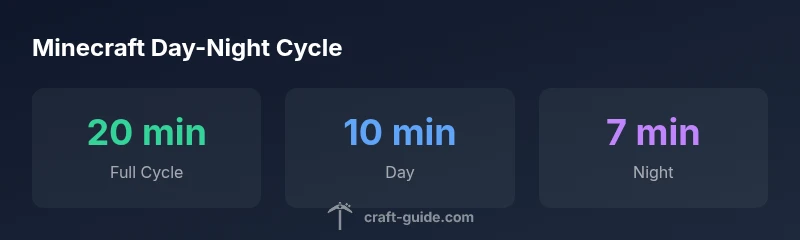
In Minecraft, a full day-night cycle lasts 20 minutes in real time. The daytime portion runs about 10 minutes, while dawn and dusk each take around 1.5 minutes, and the night spans roughly 7 minutes. This cadence is consistent across Java and Bedrock editions, though servers or mods can shift timings slightly.
What the day-night cycle represents in Minecraft
The game measures time using ticks, with 20 ticks passing every second. A full day-night sequence spans 24000 ticks, which translates to 1200 seconds in real time — exactly 20 minutes. The cycle is broken into distinct phases: daylight, dawn, night, and dusk. Each phase has its own characteristic lighting and mob behavior, which players use to plan builds, farming, and exploration. For players, understanding this cadence is crucial for timing resource grabs, safe travel, and mob farming strategies. Craft Guide emphasizes that the cycle is a fixed rhythm in vanilla Minecraft, providing a reliable frame for gameplay rather than a random luck-based system.
Key takeaways about the cycle include the predictability of dawn and dusk transitions and the peak light of daytime, which affects spawns and visibility. While mods or server settings can alter perceived timings, the underlying cycle remains a constant reference point for most players and builders.
Translating ticks to minutes: a practical guide
For players who prefer a real-time sense of pace, the math is straightforward once you know the tick rate. With 20 ticks per second, 24000 ticks equal 1200 seconds, or 20 minutes. This means:
- Daytime lasts about 10 minutes of real time
- Dawn and dusk each last about 1.5 minutes
- Night lasts about 7 minutes
If a server runs on a nonstandard tick rate due to plugins or hardware performance, the perceived timings can shift slightly. A helpful rule of thumb is to observe one full cycle in your world and map it to 20 minutes, then adjust your planning accordingly. Craft Guide recommends using a simple timer in-game or on a watch to keep track of these intervals during resource runs or builds.
To test timings, you can monitor the sun’s altitude in daytime, or use a map with time markers, ensuring you’re counting in real time rather than counting on memory alone.
Why timing matters: mobs, farming, and exploration
Mob behavior is tightly linked to the cycle. During the night, hostile mobs spawn in dark spaces and become a significant hazard for unprepared players. Daylight reduces hostile spawns and makes exploration safer, but visibility and weather can still affect navigation. Farms, especially crop-based systems, often rely on day-night timing to maximize efficiency (for example, harvesting during daytime when mobs are less aggressive). Builders can time resource gathering and redstone mechanisms around the predictable windows to minimize risk and maximize output. For new players, treating the cycle as a routine helps establish efficient routes, safe housing, and reliable farming schedules.
Craft Guide notes that the cycle’s stability makes it a reliable framework for planning long-term projects, even when world generation or terrain differs from one world to another.
Editions, servers, and potential timing discrepancies
The 20-minute day-night cadence is a bedrock of Minecraft across Java and Bedrock editions. However, real-world factors can create small deviations:
- Server tick rate: If a server is lagging, the perceived cycle can feel longer or shorter.
- Modifications: Mods and datapacks that adjust day length, spawn rates, or tick frequency can shift timings.
- Client performance: On lower-end hardware, client-side performance can blur the transitions slightly, especially during heavy lighting changes or thunderstorms.
When planning large builds or timed events on a server, it’s wise to confirm the cycle with a test run and to note any deviations introduced by the server setup. This guarantees your schedules, mob farms, and visitor timers stay aligned with reality rather than memory.
Quick timings you can rely on for session planning
Common play sessions—like a typical evening session—often revolve around a few predictable windows:
- Daytime: about 10 minutes of bright, safe travel and farming.
- Dawn and dusk: roughly 1.5 minutes each, great for short transitions or window-shopping for resources.
- Night: about 7 minutes, ideal for cautious exploration or mob farming in prepared locations.
Using these anchors, you can design efficient routes, time-sensitive builds, and safety strategies without constantly checking a clock. Craft Guide suggests keeping a manual or in-game timer handy during major projects.
How to test timings in your world
The most reliable method is to observe a full cycle in your own world. Start at a known daylight phase and let the world play out; use a timer to confirm durations. If you’re running a server, compare your observed cycle against 20 minutes and adjust expectations for players’ activities accordingly. You can also use command blocks or datapacks to display a ticking countdown or time-of-day indicator to help coordinate gatherings, farming shifts, or boss fights.
Common myths and quick clarifications
- Myth: Day length changes with weather. Fact: Weather affects visibility and mob behavior but not the fixed cycle length.
- Myth: Night lasts forever on a large map. Fact: Night lasts about 7 minutes, regardless of map size, unless modified by mods or server settings.
- Myth: Dawn and dusk are the same length as daytime. Fact: Dawn and dusk are transition periods; each lasts about 1.5 minutes, not equal to daytime duration.
Minecraft day-night cycle timings in real time
| Phase | Duration (real-time) | Notes |
|---|---|---|
| Day | 10 minutes | Bright, safe travel and farming window |
| Dawn | 1.5 minutes | Transition to daytime |
| Night | 7 minutes | Mobs spawn; low visibility |
| Dusk | 1.5 minutes | Transition to night |
| Full cycle | 20 minutes | Total cadence per day-night cycle |
People Also Ask
How long is a Minecraft day in real time?
A full day-night cycle lasts 20 minutes in real time. Daytime is about 10 minutes, dawn and dusk 1.5 minutes each, and night about 7 minutes. This is consistent across Java and Bedrock editions, unless mods or servers alter timings.
A full Minecraft day is twenty minutes in real time, with day for ten minutes, dawn and dusk each around one and a half minutes, and night around seven minutes.
Does day length differ between Java and Bedrock editions?
The overall cycle length is the same across Java and Bedrock editions, but some minor differences can appear due to world settings or client-server synchronization. In standard vanilla play, timings are effectively the same.
In vanilla play, the day-night length is the same for Java and Bedrock, though mods or server settings can cause small variations.
Can mods change the day-night cycle?
Yes. Datapacks or mods can alter tick rates or day length, changing the perceived cycle. Always verify timings in your modded world before planning events.
Mods can change the timing, so check your world’s day length before big builds or hunts.
What’s the best time to start nighttime activities?
Night begins after dusk and lasts about seven minutes. Plan nighttime activities toward the end of the dusk transition to maximize daylight-friendly prep time.
Start night activities as dusk ends so you have a last push with some daylight left.
How can I use day-night timings for farming in survival mode?
Schedule farming tasks for daytime when lights are brightest and mobs are less aggressive. Use the dawn and dusk transitions to harvest quick crops or breed animals with less risk.
Farm during the day, and use dawn and dusk for quick harvests and quick-breed runs.
“Understanding the day-night cycle is essential for optimizing mob timing, farming efficiency, and planning builds in any Minecraft world. The cycle provides a predictable rhythm players can rely on, even as terrain and challenges vary.”
The Essentials
- The full day-night cycle lasts 20 minutes in real time.
- Day lasts about 10 minutes; dawn and dusk are about 1.5 minutes each; night is about 7 minutes.
- Plan farming, travel, and mobs around these windows to maximize safety and efficiency.
- Mods or server tick rates can cause small timing shifts; test your world for exact timings.
- Use the cycle as a reliable framework for timed builds and large projects.