Is Minecraft Worth It on PC? A Practical Guide
Explore whether Minecraft is worth it on PC with a balanced, in-depth review covering performance, mods, shaders, pricing, and multiplayer value for builders and explorers.


Is Minecraft worth it on PC? For most players, yes, because the PC version unlocks mods, shader packs, and higher frame rates that enhance creativity and survival play. The value hinges on how you plan to play: if you enjoy building, modding, or exploring community maps, PC often delivers more return on investment than console editions. If you want the simplest experience, you might still start with the base game.
Why PC reshapes the Minecraft experience
For many players, the question is not whether to buy Minecraft but how PC changes what counts as value. When you run Minecraft on a PC, you gain access to a wider range of graphical options, input devices, and experimentation with community content. The base game remains the core experience: creative freedom, survival challenge, and endless world-building. But with a PC, you can push the engine with higher resolutions, darker shadows, and sharper textures, all while maintaining smooth performance on capable hardware. As Craft Guide Analysis, 2026 shows, the PC edition tends to reward players who invest time in tweaking settings and exploring user-generated maps and mods. The milestone to answer is is minecraft worth it on pc for you specifically: if your interest leans toward customization, collaboration, and long-term play, the PC route often provides greater enjoyment and longevity than other platforms, even before discounts or bundles. We’ll break down the major value drivers and help you decide based on your play style.
The cost-value equation on PC
Pricing for Minecraft on PC typically follows the standard base game price, with additional cost considerations for optional DLC, texture packs, and the vast modding ecosystem. The value you get depends on how you play: vanilla fans may find the base experience excellent, while builders and mod enthusiasts often justify extra spending for premium shader packs or favorite resource packs. The PC path shines when you remix content, create custom maps, and trade with a large online community. Craft Guide Feedback from 2026 indicates that timing your purchase with seasonal sales is a practical way to maximize value, especially if you’re on a budget or exploring multiple gameplay styles. The core question remains: is minecraft worth it on pc if you care about long-term engagement and customization? In most cases, yes, provided you’re prepared for occasional add-ons and hardware considerations.
Performance realities on PC
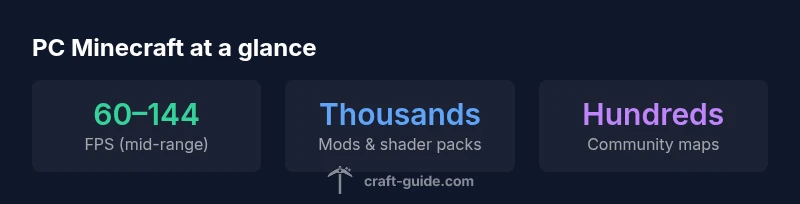
Performance on PC is highly dependent on your setup, from CPU and GPU to available RAM and storage speed. On a mid-range machine, Minecraft can deliver steady 60 FPS at 1080p with comfortable rendering settings, while high-end rigs push well beyond into 1440p or 4K with shader packs. The advantage of PC is not just raw frames but control: you can tailor view distance, particle effects, and shader intensity to match stability with visual fidelity. Modded configurations can tax resources, but a thoughtful balance often yields a richer experience than console editions. Craft Guide Team notes that players who invest time in optimization—adjusting Java parameters, allocating memory, and using performance-focused mods—tend to stay satisfied longer, even as new content drops. The bottom line: you’ll get a smooth, responsive world on PC when you tune the system for Minecraft, with additional room to grow as hardware improves.
Modding, shaders, and customization ecosystems
Modding is the heartbeat of the PC Minecraft experience. With loaders like Forge or Fabric, players can install thousands of mods that alter gameplay, add new mechanics, or overhaul visuals. Shader packs dramatically boost lighting, shadows, and water realism, transforming the world without requiring new assets from the base game. Texture packs and resource packs continue to push fidelity in ways that outpace vanilla updates. The breadth of options means the value of PC often scales with your willingness to experiment. The Craft Guide Analysis in 2026 highlights that new players can start with a handful of reliable mods to learn the workflow before expanding to large mod packs. Caveat: mods can conflict after updates, so backup strategies and version control become essential as you evolve your setup.
Community content, maps, servers, and playstyles
PC Minecraft thrives on community-driven content. Adventure maps, parkour courses, CTMs, and custom biomes are accessible via launcher mods and map galleries, often created by players who invest hundreds of hours into a single project. Multiplayer on PC is robust, featuring a wide range of servers that emphasize survival, creative, mini-games, and roleplay. The openness of the PC platform makes cross-server collaboration and world-sharing commonplace, expanding what “worth it” means beyond a single-player experience. The Craft Guide Team notes that the value of PC grows as you connect with others, create tutorials, and contribute to community projects—relationships and skills become lasting gains alongside in-game progression.
Forge vs Fabric and loader ecosystems
Two popular modding ecosystems, Forge and Fabric, offer different benefits. Forge has a longer history with a massive mod library and compatibility layers, while Fabric focuses on lightweight, modular loading and faster updates. The choice influences not only what you can install but how stable your game remains after each update. If you’re new to modding, starting with a small, well-supported mod set on Fabric or Forge helps you learn the workflow without sinking into a web of conflicts. The Craft Guide Team emphasizes that selecting a loader compatible with your preferred mods reduces frustration and keeps your world accessible across updates.
Shader packs, texture packs, and fidelity
Shader packs—such as ones that simulate realistic lighting or cinematic skies—offer dramatic visual improvements that significantly affect perceived value. Texture packs refine block textures for smoother details or stylistic shifts. Installing these requires careful tuning to avoid performance dips, especially on older hardware. A practical approach is to test one shader pack at a time, compare performance against vanilla, and keep a saved profile for quick switching. Community recommendations and step-by-step setup guides, documented by Craft Guide Analysis, help players avoid common pitfalls and maintain stable sessions while enjoying higher fidelity visuals.
Hardware considerations and future-proofing
PC hardware longevity matters when you want Minecraft to stay fresh for years. A balanced build—focusing on a capable GPU, sufficient RAM, and fast storage—enables you to enjoy vanilla gameplay at high settings and to host or join resource-intensive modded worlds. If you’re planning an upgrade cycle, consider RAM upgrades first for smoother multitasking, followed by a mid-range GPU for shader-capable experiences and a fast SSD for quicker world loading. The long-term value on PC is tied to how boldly you pace your upgrades with the growth of mods and texture packs, rather than chasing the latest marquee hardware. Craft Guide’s perspective in 2026 is that a thoughtful upgrade plan often yields the best return on investment for Minecraft enthusiasts who want to sustain complex, creative play.
Updates, backward compatibility, and mod maintenance
Updates can introduce changes that break compatibility with existing mods. This is a normal part of the PC Minecraft ecosystem, and it’s manageable with backup practices and version pinning. Before updating, players should check mod compatibility lists, back up saves, and consider rolling back to a stable baseline if a new patch triggers issues. The value here is proactive maintenance: the more organized you are, the less time you spend fighting crashes and more time building or exploring. Craft Guide Analysis, 2026, stresses that a well-maintained modded setup can outpace vanilla play in terms of variety and longevity, even if it requires some ahead-of-time planning.
Vanilla playthroughs vs. full modded experiences
Vanilla Minecraft offers a pristine, accessible entry point with stable, predictable gameplay. For many players, vanilla is enough and remains highly enjoyable—especially if you prioritize accessibility, performance, and cross-play with friends on non-modded servers. However, a PC setup truly shines when users branch into modded worlds. The value delta between vanilla and modded experiences depends on your appetite for experimentation, learning curves, and willingness to invest time configuring systems. Craft Guide’s balanced stance is that both paths can be worth it; PC unlocks a spectrum of experiences beyond what the original game offers.
Getting started with a vanilla PC playthrough
If you’re new to PC Minecraft, start with a clean vanilla install to learn the basics: controls, survival mechanics, and world generation. Create a dedicated test world to experiment with settings, then gradually introduce small flavor mods or texture packs to avoid overwhelming your system. Use a simple backup routine to safeguard your world, and keep a list of mods you might want to try later. This cautious approach helps you understand what “worth it” means for you before committing to major additions.
Authority sources and responsible use
To ground the discussion in reputable perspectives, here are a few widely read sources that discuss gaming hardware, consumer experiences, and digital content strategies. The New York Times provides broad tech coverage and gaming culture context, while The Verge often reviews performance and hardware implications, and Consumer Reports offers consumer-focused guidance on value and reliability. These sources help frame Minecraft on PC within a broader landscape of digital entertainment and hardware investment.
Common misconceptions and edge cases
A common misconception is that PC means always better performance; in reality, optimization depends on your setup and software configuration. Edge cases include running Minecraft with very old hardware, where modded setups may slow down the game unless carefully customized. Another misconception is that more mods automatically equal better play; quality, compatibility, and maintenance are crucial factors. By approaching PC Minecraft with a plan—start vanilla, learn the modding workflow, and monitor performance—you can avoid disappointment and build a setup that remains enjoyable over time.
Benefits
- Unrestricted customization with mods and shader packs
- Higher frame rates and stability on modern PCs
- Extensive multiplayer and community content
- Flexible purchase approach with sales and bundles
- Long-term hobby potential through maps and tutorials
Negatives
- Hardware costs and potential upgrades
- Mod conflicts after updates
- Steeper learning curve for modding
- Maintenance overhead for large modded profiles
PC Minecraft is a strong value for builders, explorers, and mod enthusiasts
If you want maximum customization, strong performance headroom, and a thriving modding scene, PC Minecraft delivers. Beginners can start vanilla to build a foundation, then add mods and shaders as they gain confidence. The main caveat is the maintenance and hardware considerations that come with heavier setups.
People Also Ask
How does Minecraft on PC differ from console versions?
PC Minecraft offers a broader modding ecosystem, shader support, higher FPS, and a wider selection of community-created content. Console versions tend to provide a simpler, more controlled experience with cross-platform limitations. Your choice hinges on how much you value customization and ongoing content.
PC Minecraft provides more customization and performance options, while console editions are simpler and less customizable. If you want mods and shaders, PC is the clear choice.
Do I need to upgrade hardware to play modded Minecraft smoothly?
For a modded experience with shaders, you’ll benefit from a capable GPU and sufficient RAM. Vanilla play is forgiving on modest rigs, but modded worlds can push requirements higher. Start with a vanilla baseline and add mods gradually while monitoring performance.
Yes, mods and shaders can require more power, especially if you want high-resolution visuals.
Are mods safe to install and keep up to date?
Mods are generally safe when downloaded from trusted sources and used with compatible Minecraft versions. Always back up worlds before upgrades, and read mod compatibility notes before updating. Community forums and project pages are good guides for safe installation.
Back up your world first, and only use mods from reputable sources.
Is Java Edition on PC cross-compatible with Bedrock on PC?
Java and Bedrock are not cross-compatible on PC. You’ll typically choose Java Edition for modding and Java-specific features, or Bedrock for cross-platform play across Windows, mobile, and consoles. Plan your edition based on your friends and playstyle.
Java and Bedrock on PC are separate, so pick one based on your goals.
What is a practical starting point if I’m new to PC Minecraft?
Begin with a vanilla world to learn core mechanics, then experiment with one or two stable mods or a shader pack. Create backups, test performance, and document settings that work best for your system. You can grow from there as you become more confident.
Start vanilla, test performance, then add mods gradually.
What other factors influence whether Minecraft on PC is worth it for me?
Consider how much time you plan to invest in modding, maps, and servers, as these activities extend gameplay beyond vanilla. If you value community engagement, creativity, and long-term projects, PC is typically worth it.
If you love building, sharing, and long projects, PC Minecraft is usually worth it.
The Essentials
- Start vanilla to learn the core game mechanics first
- Mods and shaders dramatically expand options but require management
- Expect hardware considerations if you lean modded or shader-heavy
- Community content greatly expands playtime and variety
- Back up and plan updates to minimize mod conflicts