Bedrock vs Java: Is Minecraft Edition Harder in 2026?
A data-driven comparison of Bedrock vs Java Minecraft editions, examining performance, combat, world-gen, and modding to answer is minecraft bedrock harder than java and help you pick your edition.


In short, the answer to is minecraft bedrock harder than java depends on what you’re testing. Bedrock generally offers steadier performance across a wider range of hardware, while Java can feel more punishing in combat and in advanced redstone scenarios. The best choice hinges on hardware, playstyle, and how important mods and cross‑play are to you. For builders and vanilla players, the differences may be subtle but meaningful in practice.
Is Minecraft Bedrock Harder Than Java? Defining 'Harder' in Context
Is minecraft bedrock harder than java? The question isn’t a simple yes or no. People weigh hardness across several axes: raw performance, how hostile the world feels in survival, combat pacing, and the availability of mods or custom content. For many players, the term harder is a bundle of experiences rather than a single metric. The Craft Guide team notes that the best answer varies with platform, personal goals, and version history within each edition. In this guide we’ll map these dimensions to practical scenarios, so you can decide which edition aligns with your goals. You’ll encounter the exact phrase is minecraft bedrock harder than java frequently as players debate challenge, comfort, and performance on different devices.
wordCount":150},
Core Metrics That Shape Difficulty
To understand hardness, we examine a handful of core metrics that consistently influence player experience: performance stability, combat pacing, world generation quirks, resource access and progression gates, and the availability of community-created content. When players ask is minecraft bedrock harder than java, they are often comparing these concrete experiences: does the game feel smoother on a wider array of hardware, are mobs and traps more punishing in one edition, and how quickly you can progress from start to endgame. Across editions, each metric matters, but the weight of each metric shifts with your platform, playstyle, and whether you prioritize modding or cross‑play. The result is that hardness becomes situational rather than absolute.
wordCount":160},
Performance and Hardware: Where Bedrock Shines
Bedrock Edition is designed to run across a wide spectrum of devices, from mid-range PCs to consoles and mobile devices. The ecosystem is optimized in C++ across many platforms, which yields more consistent frame rates and smoother world loading on lower-end hardware. The Craft Guide analysis shows that hardware constraints often drive perceived difficulty more than intrinsic game rules. If you’re asking is minecraft bedrock harder than java because you fear stuttering or long load times, Bedrock typically reduces those headaches. Still, performance isn’t the only factor: control schemes, screen resolution, and input latency also shape how hard the game feels in practice. Craft Guide notes that performance parity doesn’t automatically imply easier gameplay; you may still face tough survival situations even when frames are stable.
wordCount":170},
Combat and Movement: How Enemies Hit You Differently
Combat in Java Edition has long been associated with timing, cooldown windows, and precise movement—factors that can heighten the sense of difficulty for new players. Bedrock’s combat system differs in how it handles attack timing, hit registration, and knockback, which can feel easier or harder depending on your weapon and environment. For many players, when you ask is minecraft bedrock harder than java, the answer hinges on movement patterns, block jumping, and how quickly mobs close the distance. Java’s combat pacing rewards patient, deliberate strikes, while Bedrock emphasizes fluid, sometimes more immediate engagements. These distinctions matter most in endgame scenarios, where speedrunning, champion mobs, and boss fights reveal each edition’s strengths and weaknesses.
wordCount":170},
Modding, Add-ons, and Content Access
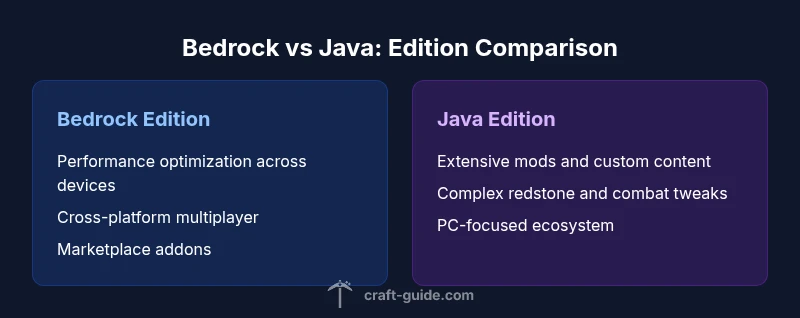
A central axis in any edition comparison is modding and user-generated content. Java Edition has a deep history of mods, patches, and community tools that modify gameplay, add new systems, or overhaul visuals. In contrast, Bedrock relies on addons and the official marketplace, which tend to be more curated and platform-friendly but offer a narrower scope for in-depth modding. For players asking is minecraft bedrock harder than java, the modding ecosystem can tilt the decision toward Java if your goal is heavy customization, early-access content, or experimental gameplay. If you value streamlined content, stability, and cross‑platform access, Bedrock’s route may feel smoother but less expansive.
wordCount":170},
World-Gen Differences and Terrain Feel
World generation shapes perceived hardness by affecting resource variety, terrain density, and the availability of favorable or challenging biomes. Java Edition has historically featured a wider range of terrain quirks and biome distributions that influence early survival, shelter-building, and exploration risk. Bedrock’s world generation is tuned for consistency across devices, sometimes producing more predictable cave networks and resource pockets on average hardware. When players ask is minecraft bedrock harder than java in day-to-day exploration, the answer often comes down to biome availability, cave density, and how often you encounter surprise hazards. Both editions offer rich exploration, but the flavor of challenge shifts with generation rules and seed behavior.
wordCount":170},
Cross-Play, Servers, and Multiplayer Realities
One practical angle in this comparison is multiplayer. Bedrock supports cross‑platform play across Windows, consoles, and mobile devices, which makes it easier to assemble a mixed‑device group. Java is PC-only and does not natively support cross‑play with Bedrock or other platforms. If your hardest criterion is multiplayer compatibility, Bedrock’s ecosystem reduces friction to play with friends who own different hardware. If your goal is learning and experimentation with server-side mods or classic Java-only maps, Java remains a powerhouse. In short, difficulty in multiplayer is often less about the edition’s code and more about the server rules, map design, and the reliability of your network connection.
wordCount":170},
Survival, Crafting, and Resource Access: Practical Impacts
Survival balance—how difficult it is to gather resources and craft essential items—often guides the is minecraft bedrock harder than java question in practice. Java’s expansive crafting options, more intricate redstone possibilities, and a broader variety of enemies can create a steeper early learning curve for new players. Bedrock tends to deliver a more approachable survival loop on a wider range of hardware, with fewer performance hiccups that disrupt play. For players who enjoy building and resource management, both editions reward careful planning, but Java’s deeper systems can feel more demanding when you begin to master complex farms, automation, and redstone tricks.
wordCount":170},
Building, Redstone, and Creative Tools
Creative mode in both editions remains powerful, yet the toolset and editor experiences diverge. Java’s redstone simulation and command-block capabilities tend to feel more expansive due to a longer history of community experiments, plain text commands, and world editing tools. Bedrock provides strong building tools, faster creative workflows, and better performance on a range of devices, but certain advanced redstone mechanics can behave differently or feel less forgiving for newcomers. If your concern is is minecraft bedrock harder than java from a building‑centric perspective, evaluate how steep your learning curve is for redstone, world editing, and modded blocks in each edition. Craft Guide’s findings suggest that the best edition for builders often aligns with whether you value rapid iteration or deep, modular control.
wordCount":170},
Choosing the Edition: A Playstyle and Hardware Checklist
To decide which edition fits you, run through a simple checklist. Do you play primarily on mobile or a low-end PC? Do you rely on mods, or do you prefer official content and marketplace addons? Is cross‑play with friends important? Do you value complex redstone and experimental maps, or do you want a stable, widely-supported experience with fewer performance hurdles? Answering these questions helps translate the abstract question is minecraft bedrock harder than java into a concrete choice. In the end, the decision reflects your hardware, social circle, and preferred gameplay loop more than a one‑size‑fits‑all hardness verdict.
wordCount":150},
Common Myths Debunked
Myth 1: Bedrock is always easier because it runs smoothly on more devices. Reality: performance helps, but the perceived hardness also hinges on combat rules, mob behavior, and world interactions. Myth 2: Java has more content, so it’s always harder. Reality: content abundance provides more tools to customize, but it also introduces learning curves. Myth 3: Cross‑play means identical experiences. Reality: cross‑play improves access but leaves edition-specific differences in combat and construction intact. Addressing these myths clarifies where the real differences lie and helps players choose wisely.
wordCount":135},
Practical Next Steps: Test, Compare, Decide
If you’re uncertain about is minecraft bedrock harder than java, plan a short test. Create vanilla worlds on both editions with the same seed, run similar survival scenarios, and record performance, reaction times, and your subjective difficulty. Use the same hardware or device as a baseline. Install one or two addons in Bedrock and one or two mods in Java to gauge how the experience shifts. By documenting concrete measurements—frame rate, loading time, hit registration, and resource availability—you’ll have a rational basis to choose your edition and start playing with confidence. Craft Guide recommends a hands-on comparison as the most reliable way to determine which edition feels harder for you.
wordCount":170}],
comparisonTable
Comparison
| Feature | Bedrock Edition | Java Edition |
|---|---|---|
| Performance on common hardware | Generally steadier/framerate | Potentially higher variability depending on JVM and mods |
| Combat mechanics | Different attack timing and hit detection; generally smoother in Bedrock | More timing-based combat with cooldowns in Java (varies by version) |
| Modding and add-ons | Add-ons and marketplace; more controlled ecosystem | Extensive mods; richer customization ecosystem |
| Cross-play multiplayer | Cross‑platform across Windows, consoles, mobile | PC-only; no official cross-play with Bedrock |
| World generation and redstone | Consistent world-gen with hardware balance | More varied redstone possibilities and tooling |
| Creative tools | Strong performance for builds; marketplace assets | Rich editing tools and commands; modded content |
Benefits
- Helps players choose edition based on playstyle and hardware
- Highlights cross-platform benefits and limitations
- Clarifies performance expectations across devices
- Encourages practical, test-based decision-making
Negatives
- Subjective nature of 'hardness' makes universal claims difficult
- Version differences can alter perceived difficulty
- Bedrock vs Java language and ecosystem diverge in ways beyond a simple scale
Neither edition is universally harder; the 'hardness' hinges on hardware, goals, and playstyle.
Java tends to pose more challenges in combat depth and modding flexibility, while Bedrock often offers smoother performance and easier cross-platform play. Your choice should align with hardware, desired content, and multiplayer needs. The Craft Guide team recommends testing both editions when feasible to make an informed decision.
People Also Ask
Is Minecraft Bedrock harder than Java in vanilla survival?
In vanilla survival, Java Edition often feels more demanding due to combat timing, mobility, and deeper redstone systems. Bedrock is typically more forgiving on performance and input responsiveness, which can reduce perceived difficulty. Overall, exact hardness depends on the biome, mobs, and your goals.
In vanilla survival, Java tends to feel tougher because of combat timing and redstone depth, while Bedrock runs more smoothly on a wider range of devices.
Can Bedrock players play with Java players?
Bedrock and Java players generally cannot play together on standard servers. Bedrock supports cross‑platform play across Windows, consoles, and mobile, while Java remains PC-only and community servers are separate. This split significantly affects multiplayer strategy and group-building options.
Bedrock and Java don’t play together on standard setups.
Which edition has better performance on low-end hardware?
Bedrock Edition tends to perform more consistently on lower-end hardware due to its cross‑platform optimization and different codebase. Java can demand more RAM and CPU, especially with large mod packs or advanced worlds. Hardware can tilt the perceived difficulty in either direction.
Bedrock usually runs smoother on weak hardware.
What about modding and add-ons?
Java Edition has a long history of mods and community tools that enable deep customization. Bedrock supports addons and a marketplace model, but the scope and flexibility are typically more limited to maintain cross‑platform stability. If mods are crucial for you, Java is the stronger choice.
If you want mods, Java Edition is usually better.
Are redstone and combat the same between editions?
Redstone behavior and combat feel differ between editions. Java offers broader experimentation with redstone timing and complex systems, while Bedrock emphasizes more predictable mechanics and different hit registration. Expect meaningful, edition-specific quirks rather than identical experiences.
Redstone and combat aren’t identical; you’ll notice differences in both.
The Essentials
- Assess hardware and cross‑play needs before choosing
- Expect Java to feel more complex in combat and mods
- Anticipate smoother performance on Bedrock on diverse devices
- Test both editions if possible for a definitive personal verdict