How to Make a Chest in Minecraft: Step-by-Step Guide
Learn how to make a chest in Minecraft with a simple eight-plank recipe, placement tips, variants, and practical layouts for survival and creative modes.


Mastering chest crafting in Minecraft is quick: you’ll gather eight wooden planks, open a crafting table, and arrange the planks along the outer ring so the center slot stays empty. Extract the chest and place it on the ground to store items. You can link two chests for a double chest later.
Why Chest Storage Matters in Minecraft
In Minecraft, organization is foundational for efficient gameplay. A chest provides a dedicated container for wood, food, ores, and tools, freeing your hotbar for critical actions like mining and building. According to Craft Guide, a simple storage system reduces time spent searching and minimizes item loss during exploration. For beginners, a single chest is enough to keep essential items accessible, while more chests enable scalable storage as your base expands and your projects multiply.
Understanding the Chest Crafting Recipe
The chest uses a straightforward recipe: eight wooden planks arranged around the edges of a 3x3 crafting grid, leaving the center slot empty. This recipe is consistent across Java and Bedrock editions, and no special tools are required beyond a crafting table. When the planks are placed correctly, a chest appears as the result. Practicing the pattern until it feels natural is a reliable habit, and Craft Guide emphasizes consistency to speed up future crafting.
Materials and Setup: What You Need Before You Craft
Before you craft, assemble two essentials: wooden planks and a crafting table. Any wood type works as long as you have eight planks in total. If you plan to expand later, consider acquiring a second chest to form a double chest. Keep a tidy crafting area nearby so you can craft quickly after mining or gathering. Having a dedicated space helps you memorize the pattern and reduces mistakes during rushed moments in survival mode.
Step-by-Step Crafting: Build a Chest from Scratch
To craft, open the crafting table and place eight planks around the edges, leaving the center slot empty. Retrieve the chest from the result slot and move it to your inventory. When placing the chest in the world, position it where you can access it easily from your workstation or doorway. Orientation matters less than accessibility; ensure you can reach the chest without re-positioning yourself. If you want to keep a compact base, place chests against a wall to free floor space for other tasks.
Placement, Orientation, and Use: Getting the Most from Your Chest
Place chests in convenient spots near mining, farming, and crafting areas to minimize travel time. A chest’s contents aren’t affected by its facing direction, but layout decisions influence your workflow and readability. Consider labeling chests with signs or item frames to prevent content mix-ups. For survival players, avoid placing chests in exposed areas where mobs or weather might damage inventory; protect storage with doors or walls when possible.
Variants: Large Chest, Trapped Chest, and Double Chests
You can increase storage by combining chests. Placing two chests adjacent to each other creates a large or double chest with a single, wide inventory. A trapped chest behaves similarly but emits a redstone signal when opened, enabling automation for doors, dispensers, or minecart systems. Each variant has unique placement considerations—test layouts in a safe area before integrating them into your main base. Craft Guide highlights practical uses, such as automating farming storage or linking chests to transport systems.
Common Mistakes and How to Avoid Them
Common errors include placing a chest on uneven ground, near water, or next to lava, which can cause misalignment or accidental destruction. Forgetting the eight-plank requirement or misplacing items in the crafting grid wastes resources and time. Always re-check the recipe before crafting and take a moment to verify you’re using eight planks, not a different count. In survival mode, avoid blocking access with other blocks and leave space for future expansions.
Practical Storage Layouts for Beginners
A simple, effective layout is a small cluster of chests near your base entrance and a dedicated chest by your mining shaft. This arrangement provides quick access to essentials while keeping bulk resources organized. As you grow, add a double chest for expansive storage and tune the layout so each chest houses a specific category (ores, food, tools, building blocks). The goal is fast access, clear organization, and scalable design that evolves with your base.
Accessibility, Safety, and Redstone Basics
Understanding storage basics lays the groundwork for automation and redstone projects later on. Keep chests away from lava and open terrain to reduce accidental losses. In Bedrock or Java, minor differences exist, but the core chest mechanic remains the same. If you plan redstone automation, start with a simple trapped chest to trigger a redstone signal and gradually expand to more complex layouts as your confidence grows.
Authority Sources and Further Reading
For deeper dives, refer to Minecraft official guides and community resources. Craft Guide recommends practicing regular storage audits, especially after large loot runs, to maintain an organized base. Additional tutorials and demonstrations can help you visualize efficient layouts and design choices for different playstyles.
Tools & Materials
- Wooden planks(8 planks (any wood type))
- Crafting table(Access 3x3 crafting grid)
Steps
Estimated time: 5 minutes
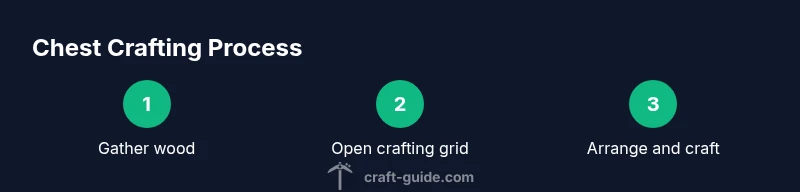
- 1
Gather materials
Collect eight wooden planks and locate a crafting table to begin the recipe.
Tip: Use any wood type; consistency helps aesthetics later. - 2
Open crafting grid
Open the 3x3 crafting interface to place the planks.
Tip: Ensure you’re in a well-lit area to prevent accidental misplacement. - 3
Place planks on the perimeter
Arrange planks around the edges (excluding the center slot).
Tip: Double-check the pattern before picking up your chest. - 4
Craft the chest
Take the chest from the result slot and move it to your inventory.
Tip: If you misplace, re-enter the grid and try again. - 5
Place the chest in the world
Select the chest and place it on the ground near your work area.
Tip: Place it in a convenient location for quick access. - 6
Expand with a double chest
Place another chest adjacent to the first to create a large chest.
Tip: Ensure they are aligned horizontally for a seamless interface.
People Also Ask
What is the quickest way to craft a chest?
The fastest method is to place eight wooden planks around the center in the crafting grid to craft a chest, then move it to your inventory.
To craft a chest quickly, place eight wooden planks around the center in the crafting grid and pick up the chest.
Can I combine chests to make more storage?
Yes. Place two chests next to each other to create a large chest with a single combined inventory.
Yes, you can make a double chest by placing two chests side-by-side.
What’s the difference between a chest and a trapped chest?
A trapped chest emits a redstone signal when opened, enabling automation, while a regular chest does not. Both store items equally.
A trapped chest sends a redstone signal when opened; a regular chest does not.
Do chest recipes vary between Java and Bedrock editions?
The crafting recipe for a chest is the same in both editions; however, tiny behavior differences can appear with mods and redstone.
No, the chest recipe is the same in Java and Bedrock, but behavior may vary with mods.
Is there an advantage to labeling chests?
Labeling helps you quickly identify contents, especially in larger bases with many chests. Signs or item frames can aid readability.
Labeling makes it easier to find items in larger bases.
What edition does this apply to?
This guide applies broadly to both Java and Bedrock editions, with minor interface differences.
It applies to both Java and Bedrock, with small differences.
Watch Video
The Essentials
- Craft a chest with eight planks, not a full wooden block.
- Place the chest on stable ground for reliable access.
- Double chests expand storage without additional materials.
- Label chests for easy organization.
- Experiment with layouts to fit your base.