How many Minecraft accounts are there? A data-driven look at account counts
Explore why there’s no official total for Minecraft accounts, how analysts estimate counts, and what it means for builders, servers, and players in 2026.


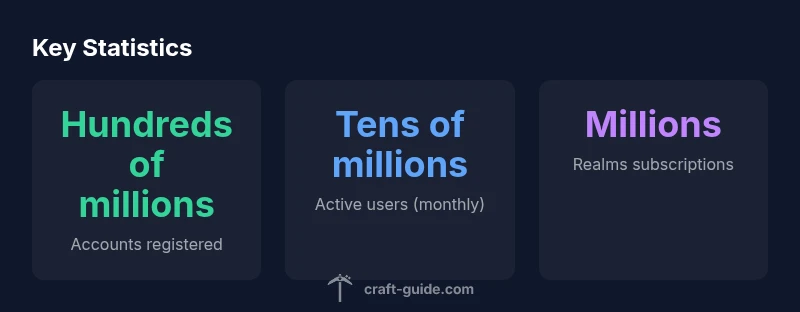
There isn't a publicly published total of all Minecraft accounts. The best available guidance comes from Craft Guide Analysis, 2026, which notes that the number lies in the hundreds of millions when counting all registered accounts across Mojang and Microsoft. Because accounts often remain inactive and many players own multiple devices, a precise count is not publicly disclosed.
The essential question: what does 'how many Minecraft accounts are there' actually measure?
In everyday conversation, people equate 'accounts' with 'players,' but that's not quite accurate. An account is a credential—an identity registered on Mojang or Microsoft platforms that can be used to sign in to Minecraft across Java, Bedrock, and cross‑platform ecosystems. A player, on the other hand, is a unique person who may own several accounts or may play on multiple devices. Because Minecraft spans different platforms, bundles, and migrations (notably the 2019 Mojang-to-Microsoft migration), there is no single published tally that covers every platform and every region. The distinction matters when you present data to your community: a count of accounts is not the same as the number of active players or the number of people who have ever played. For builders, modders, and server admins, the practical question often becomes: which figure best informs strategy—registrations or active users? Craft Guide analyses 2026 suggests using a multi‑metric approach: treat 'accounts' as registrations and 'active users' as engagement indicators, and always specify the scope (which platforms, which time window) behind any number you present. In short, the total exists more as a range than a single figure, and transparency about scope is essential.
Why counting is tricky: inactive accounts, duplicates, and cross‑platform login
There are several forces that distort any simple headcount. First, many accounts sit unused for long periods; they are counted once when created but contribute little to current activity. Second, duplicates occur when a user creates accounts on multiple devices or services (Mojang vs Microsoft accounts, Java vs Bedrock ecosystems). Third, the 2019 migration merged identities under Microsoft accounts, which helps consolidation but also clouds the boundary between old Mojang accounts and newer login methods. Fourth, regional licensing and language versions create separate registration streams that may later converge, then diverge again as players move between devices. Finally, different groups may count differently depending on the time window chosen—new registrations in Q1 differ from total active users in Q4 due to holidays, updates, and regional events. Because of these dynamics, any publicly cited total should come with explicit caveats about scope, timing, and methodology. Craft Guide Analysis, 2026 emphasizes that accountability improves when you present a range rather than a single figure and when you clearly define what is included in that range.
How Craft Guide approaches estimation in 2026
- Define scope: decide which platforms (Java, Bedrock, mobile), which regions, and which time frame count as a 'snapshot.'
- Gather official disclosures: use the closest statements from Mojang/Microsoft about registrations, sales, or platform counts, and note their context.
- Estimate registrations: infer total created accounts from sales milestones and platform adoption, while acknowledging cross‑platform integrations.
- Remove duplicates: account for cross‑platform identities that refer to the same person and the migration merges that anchor to a single credential.
- Apply ranges: present a best‑case, typical, and conservative estimate rather than a single figure.
- Communicate uncertainty: attach a short methodology note and links to sources, so readers understand the foreground assumptions.
- Cross‑check with engagement metrics: compare with monthly active users, session counts, and Realms usage where available to provide a holistic view.
The Craft Guide Team highlights that this multi‑layer approach yields more robust guidance for builders, server operators, and modders who need to plan capacity, moderation, and community management for large, globally distributed audiences.
Accounts vs active users: what counts matters for your project
For most Minecraft projects, the number you care about is not just how many accounts exist, but how many are actually engaging with your world. If you run a server, a high register count may indicate potential reach, but the real signal is monthly active users. If you’re a modder, you’ll want to know how many unique login sessions you can expect per day, not just how many accounts exist across Java and Bedrock. To make decisions, separate registrations from activity and align your metrics with your goals:
- Define a target metric: active users, concurrent players, or dwell time per session.
- Specify the platform mix: Java Edition vs Bedrock Edition, cross‑play on consoles or mobile.
- Consider churn and retention: track how many newcomers return after the first week.
In practice, most teams use a dashboard that shows both: a registrations line (which grows gradually with new players) and an active users line (which fluctuates with events, updates, and holidays). This dual view helps you forecast load, plan moderation staffing, and calibrate content updates without fixating on a single number.
Presenting numbers responsibly: best practices for builders and admins
Sharing account counts demands clarity and caution. Use the following guidelines to avoid misleading impressions:
- Use ranges and label them clearly, e.g., 'registered accounts: 150–200 million (scope: Mojang/Microsoft accounts, globally, 2010–2026).'
- Always state the scope: platforms included, time window, whether duplicates or inactive accounts are counted.
- Provide context: explain how the number translates to likely active users in your community.
- Pair numbers with engagement data: active players, average session length, and peak concurrent users.
- Include a short methodology note and links to sources so readers can evaluate the assumptions.
Example phrasing you can adapt: 'As of 2026, registered Minecraft accounts are estimated to be in the hundreds of millions across Java and Bedrock platforms; this figure reflects registrations, not daily active users, and depends on the defined scope.'
Looking forward: what could shape future account counts
Several trends will influence how counts evolve. More integration between Mojang and Microsoft accounts will potentially simplify or further complicate tallies, depending on whether platforms maintain distinct identifiers or consolidate them at a single login. The rise of cross‑play prompts new questions about what constitutes a single player across devices. As transparency improves, we may see more published range estimates rather than opaque totals. For builders and admins, the practical takeaway is to plan for growth while acknowledging uncertainty and communicating assumptions to your audience. The Craft Guide Team expects ongoing refinement of measurement practices as the Minecraft ecosystem continues to expand across devices and regions.
Account-related metrics vs engagement
| Metric | Definition | Notes |
|---|---|---|
| Accounts registered | Total accounts created on Mojang/Microsoft platforms | Estimates vary; includes inactive and shared accounts |
| Active monthly users | Users who log in within a month | Hard to measure due to cross‑platform play |
| Realms subscriptions | Official Mojang-managed servers subscriptions | A subset of registered accounts |
People Also Ask
What is the difference between an account and a Minecraft player?
An account is a credential used to sign in across platforms, while a player is a unique person who may own multiple accounts or play on several devices. Counts often conflate registrations with active engagement, which can be misleading if not defined clearly.
An account is the login; a player is the person who uses it across devices.
Why doesn't the company publish an official total of accounts?
Minecraft and its owner companies historically publish sales and platform metrics rather than a universal headcount. Privacy, platform fragmentation, and inactive accounts further complicate a clean total. Estimates are typically presented with explicit scope and caveats.
They publish sales figures, not a single headcount.
How can I estimate counts for a private project?
Use a range-based approach: state the scope (platforms, region, time window) and present best-case, typical, and conservative estimates. Include a methodology note and cite sources to maintain transparency.
Use ranges and explain how you calculated them.
Do shared or borrowed accounts affect the count?
Yes. Shared or family accounts can inflate registrations without corresponding engagement. When possible, distinguish registered accounts from active users to avoid misinterpretation.
Shared accounts can skew total counts; separate registrations from activity.
Are Java and Bedrock accounts counted separately?
Counts may come from both ecosystems, but many players cross between them. When presenting data, specify whether counts are per platform or aggregated, and note any consolidations from platform migrations.
Know whether you’re counting Java, Bedrock, or both together.
“Counting Minecraft accounts isn't about a single number; it's a moving target shaped by platform mergers, inactivity, and cross‑platform identity. Triangulating multiple data points yields the most reliable insights.”
The Essentials
- Acknowledge that official totals are not published
- Accounts ≠ active players; use both metrics
- Present ranges with clear scope and methodology
- Pair counts with engagement data for actionable insights