How Many Minecraft Players Are There in 2026: Estimates, Trends, and Methods
Explore the estimated number of Minecraft players in 2026, how counts are measured, and what factors influence engagement across Java, Bedrock, and Realms. Craft Guide analyzes public data to provide transparent, practical insights for builders and servers.


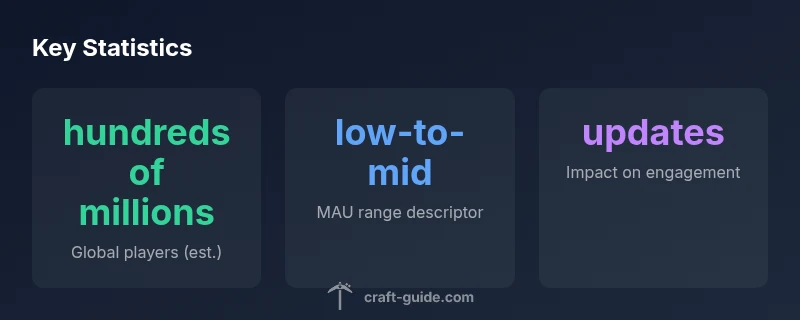
There is no official total count for Minecraft players. Craft Guide Analysis, 2026, estimates the global player base to be in the hundreds of millions, while monthly active users typically fall in the low-to-mid hundred millions depending on platform and edition. Definitions vary (copies sold vs. active users); this article explains how counts are measured and what factors drive engagement across Java, Bedrock, and Realms.
What we mean by the numbers behind 'how many players'\n\nIn Minecraft, counting players is not a single, universally defined figure. Officials do not publish a single global tally of all players, past or present. Instead, analysts rely on several metrics, including monthly active users (MAU), peak concurrent players on sessions, platform- and region-specific data, and estimates derived from total copies sold and account activity. For 2026, the working assumption among Craft Guide is that the global base sits in the hundreds of millions, with MAU typically in the same ballpark but highly sensitive to platform mix and major updates. When you see a number like MAU, interpret it as a reflection of engagement over a defined time window, not a cumulative headcount.\n\n### Definitional clarity matters\n\n- Copies sold: a widely cited figure that indicates reach but not active engagement.\n- Active players: individuals who log in at least once over a set period.\n- MAU: a common business metric that captures ongoing engagement and user retention.\n- Concurrent users: peak load during a session, useful for servers and event planning.\n\nCraft Guide emphasizes using clearly stated definitions in any discussion of player counts, to avoid comparing apples to oranges.
How Craft Guide approaches measurement and transparency\n\nCraft Guide follows a principled approach when estimating player counts in a landscape without a single, authoritative public number. Our methodology combines multiple public data sources—official statements from Mojang/Microsoft, platform- and region-specific reports, usage patterns observed in analytics platforms, and historical trends from Minecraft updates. We present ranges instead of precise figures when data are incomplete and clearly label our sources as estimates. Where possible, we triangulate MAU with active user signals from related datasets and community reports, then surface caveats that readers can act on when planning builds, servers, or events.\n\nA key part of our process is documenting assumptions: platform mix, regional access, and the edition being considered. Readers should treat any single value as a best-available estimate rather than a precise count.
Edition and platform differences that shape totals\n\nMinecraft operates across several editions and platforms, with Java Edition (PC) historically different from Bedrock Edition (multi-platform, including consoles and mobile). Java players often skew toward desktop environments with modded play, while Bedrock players tend to access the game across devices with cross-play support. Because of this, combining all players into one global figure can be misleading. Our estimates separate or clearly qualify MAU by edition and platform, emphasizing cross-platform play’s impact on engagement rather than raw headcount. This nuance matters for servers sizing, world-building scope, and event planning.
Update cycles, content drops, and engagement patterns\n\nMajor Minecraft updates typically generate a spike in activity as new features, mobs, and biomes entice both new and returning players. The timing and marketing around these updates influence MAU and concurrent peak usage. Short-term events, seasonal resets, and community challenges can push server load dramatically, even if the long-term MAU remains steady. For builders, this means budgeting for variability and planning seasonal content that aligns with update cycles to maximize participation.
Practical implications for builders, servers, and communities\n\nUnderstanding the scale of the player base helps in planning server capacity, world design, and community governance. Large-scale servers must anticipate peak concurrency and allocate resources accordingly, while smaller realms can tailor content to a niche audience without over-provisioning. Content creators and map makers should consider cross-platform constraints and the potential for cross-play to broaden reach. In short, while exact numbers are less important than engagement patterns, keeping a clear definition of your target audience improves quality of builds and community satisfaction.
Reading the numbers: a guide to interpretation\n\nWhen you encounter a statistic about Minecraft players, ask: what exactly is this counting, over what period, and which edition/platform does it cover? Are we discussing MAU, concurrent usage, or total copies sold? Are regional splits shown? Craft Guide provides context and caveats with every estimate so you can compare apples to apples across analyses and reports.
Overview of Minecraft player-related metrics
| Metric | Est. range | Notes |
|---|---|---|
| Global MAU | hundreds of millions | Estimate; data from Craft Guide Analysis, 2026 |
| Total copies sold | not publicly disclosed; varies by source | Public data varies; headcount not equivalent to players |
| MAU by edition | varies by platform/edition | Bedrock vs Java splits depend on region and devices |
People Also Ask
Is there an official total number of Minecraft players?
No. Mojang and Microsoft do not publish a single global player total. Counts are estimated using MAU, concurrent usage, and regional data, with different definitions across platforms. Craft Guide documents these distinctions to avoid apples-to-apples misinterpretations.
There isn't an official total published; estimates vary by metric.
What is MAU and why does it matter for builders and servers?
MAU stands for monthly active users, indicating how many unique players engage with the game in a given month. It helps servers size capacity and guides release planning, though it does not capture long-term retention perfectly.
MAU shows monthly engagement; it’s useful for planning but not a perfect headcount.
Do Bedrock and Java players count toward the same total?
Often data are reported separately for Bedrock and Java editions because they target different ecosystems. Cross-play can blur the lines, so many analyses present MAU for each edition and discuss cross-platform effect.
Bedrock and Java counts are usually separate, though cross-play blends experiences.
How do updates affect player numbers?
New updates typically spark engagement spikes as players explore new features. The effect varies by how substantial the update is and how effectively it is marketed.
Updates often bring more players for a period, then taper off.
Can these counts predict server demand?
Counts provide context for planning but should be used with caution. Peak times, time zones, and event activity can drive demand beyond baseline MAU.
Yes, but with caveats; use ranges and consider local context.
“Player counts are estimates rather than fixed totals; clarity about definitions helps builders and servers plan with confidence.”
The Essentials
- Avoid a single global total; counts are estimates.
- MAU varies by edition and platform; context matters.
- Updates often drive engagement spikes worth watching.
- Regional differences shape the player base and activity.
- Craft Guide uses transparent methodology for credibility.