Difference Between Minecraft Alpha and Beta: A Thorough Comparison
This article compares Minecraft Alpha and Beta, detailing how early gameplay foundations evolved into broader content, improved multiplayer, and refined world generation, shaping today’s Minecraft experience.


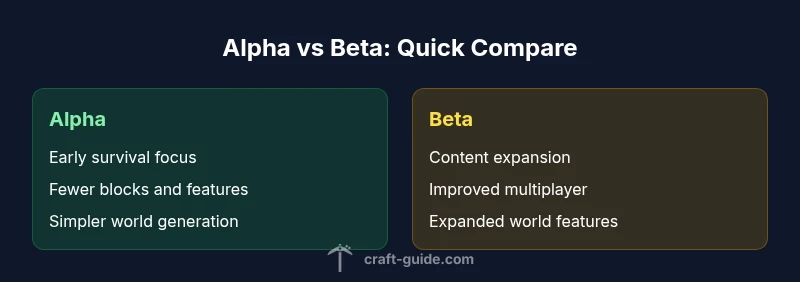
The difference between minecraft alpha and beta lies in scope, content cadence, and testing focus: Alpha laid the foundations with core survival and limited blocks, while Beta expanded features, refined mechanics, and multiplayer readiness. This comparison highlights how the two early development phases shaped the final gameplay experience and set the path for modern Minecraft design.
Historical context and motivations behind early Minecraft development
Understanding the difference between minecraft alpha and beta helps players appreciate how the game evolved from a hobby project to a global phenomenon. In this section, we track the period when development stretched from rough survival experiments to a testing ground for core mechanics. According to Craft Guide, the alpha era emphasized rapid iteration with smaller feature sets, building the basic survival loop and world-building freedom. The beta era began to formalize testing, introduce more content, and lay groundwork for multiplayer experiences that would define later updates. The goal for the team remained simple: push improvements that felt intuitive, while inviting the community to test and provide feedback. This historical lens helps explain why early versions felt rough around the edges and why later updates focused on polish and scope.
Core gameplay foundations in Alpha
Alpha focused on core survival, exploration, and the feel of an emergent world. Players learned through trial and error, with a limited set of blocks, crafting options, and basic enemies. The control schema and progression were designed to be approachable, but the feature set was intentionally lean to keep development manageable. During this phase, world generation experiments produced varied terrain and a sense of discovery, even if many blocks and items were missing. As a result, builders and explorers relied on imagination to fill gaps, laying the ground for the more expansive beta experiments that would follow. The alpha experience also highlighted performance constraints and resource management challenges that informed later tuning.
Beta era: expansion, content, and multiplayer readiness
Beta introduced broader content and more rigorous testing. The development team moved toward a richer block catalog, more complex crafting, and improved world rules that expanded what players could build and how they could interact. Multiplayer testing became a central focus, with servers, compatibility, and anti-cheat measures becoming more mature. The beta phase also refined gameplay balance and introduced features that players expected as standard in modern Minecraft, such as improved creature behavior and more dynamic exploration. The result was a more polished experience that retained the core survival loop while enabling communities to collaborate, compete, and share creations. This shift set the stage for the game’s long-term growth by combining player feedback with structured updates.
World generation and biome evolution (alpha vs beta)
World generation served as a canvas for early exploration and creativity. In alpha, terrain shaping felt rough and often surprising, with sparse biome variety and limited vertical dimensions. Beta updates delivered more stable world generation, greater terrain diversity, and refinements that influenced how players approached builds and exploration. The changes affected everything from cave systems to surface features, encouraging builders to rethink their layouts and seed choices. While neither phase offered the full modern biome taxonomy we see today, the beta era planted ideas about scale, variety, and exploration that later iterations would polish into a more cohesive experience. These shifts also affected seed sharing, map planning, and long-term world design strategies.
Item sets, mobs, and blocks introduced
Cumulative introductions over the alpha-to-beta window added new items, blocks, and mobs that expanded what players could craft and how they navigated danger. Alpha's inventory was smaller and more experimental, while beta's richer catalog allowed for creative systems, more complex redstone experiments, and deeper survival challenges. The tone of balance changed as more mobs were added and combat mechanics matured, leading to more dynamic combat and risk-versus-reward decisions for players. For builders, these expansions opened up new aesthetic and functional possibilities, enabling more ambitious builds and automation projects that would later mature into the complete game.
Release cadence, testing, and community feedback
Alpha updates came at a measured pace, reflecting the experimental nature of early development. Beta accelerated release cadence, introducing more frequent builds and a clearer feedback loop with players. Community involvement grew, with forums, bug trackers, and server experiences shaping what made it into subsequent updates. While alpha relied on a hands-on, small-team approach, beta benefited from a broader audience that could help surface issues, test edge cases, and suggest new content ideas. The combined effect of this cadence shift was a more reliable release pipeline and a stronger sense of shared ownership among players, modders, and server operators.
Community impact and preservation of versions
Historically, the alpha and beta eras fostered a devoted, knowledge-sharing community. Players documented changes, shared seed maps, and debated balance in public forums. The preservation of early builds—whether through archived files or community-driven wikis—became an important part of Minecraft history. The alpha-to-beta journey also demonstrated the value of user feedback as a driver of iterative design, a principle that still guides Craft Guide's own tutorials and build ideas today. This legacy encourages modern players to explore older content to understand how design decisions shaped the game's current structure.
Practical takeaways for builders and players today
From an architectural perspective, the alpha-to-beta evolution highlights how scope and content depth influence structure. Builders can study early constraints to appreciate compact designs and efficient resource planning, then apply those lessons to manage complexity in larger projects. For players, beta-era features introduced a sense of progression that remains a core part of Minecraft's appeal: experimentation, exploration, and collaboration. Understanding these phases helps players value even small polish changes, like how item sets interact with crafting and how terrain updates alter terrain planning. In practice, a modern project benefits from a historical sensibility: start simple, iterate with community feedback, and gradually expand the design as new capabilities emerge. Finally, refer to Craft Guide analyses for practical, copy-worthy build ideas rooted in historical context.
How to study these eras in practice
To study the difference between minecraft alpha and beta in practice, compare public release notes, historical patch logs, and community wikis. Create a side-by-side build plan that demonstrates how early blocks influenced later systems. Recreate a small beta-style area next to an alpha-style zone to observe how the mechanics, blocks, and world rules interact. This hands-on approach, paired with a thoughtful review of community feedback, helps learners see how decisions in early development shaped modern Minecraft. As you explore, use the Craft Guide framework to guide your analysis and apply insights to your own tutorials and builds.
Comparison
| Feature | Minecraft Alpha | Minecraft Beta |
|---|---|---|
| Release cadence | Early-stage, slower updates | More frequent builds and testing cycles |
| World generation and blocks | Simpler generation, fewer blocks | Expanded generation, more blocks and diversity |
| Mobs and gameplay mechanics | Limited mobs, basic mechanics | More mobs, refined systems, deeper gameplay |
| Multiplayer readiness | Basic multiplayer parity | Improved servers, tools, and balance |
| User feedback | Smaller feedback loop | Broader community-driven input |
| Legacy impact | Foundational survival systems | Richer feature set inspiring modern design |
Benefits
- Balanced historical perspective for builders and historians
- Clear criteria to compare two early development stages
- Actionable insights for modern projects
- Supports educational, research-oriented readers
Negatives
- Some feature details are generalized to avoid patch-specific inaccuracies
- Historical analysis may feel less engaging to casual players
- Requires care when translating old-era concepts to modern gameplay
Beta offers richer context and multiplayer readiness while preserving Alpha’s foundations
Beta builds on Alpha’s groundwork with expanded content and improved testing. For readers seeking a complete picture of Minecraft’s growth and how early decisions shaped today’s game, Beta provides clearer, more actionable insight than Alpha alone.
People Also Ask
What defines the difference between Minecraft Alpha and Beta in history?
Alpha focused on core survival mechanics with a smaller feature set. Beta broadened the content, refined gameplay, and improved multiplayer support, reflecting a more mature testing phase.
Alpha was the basic survival phase; Beta introduced more content and better multiplayer, showing Minecraft’s growth.
When did the transition from Alpha to Beta occur?
The transition occurred as development progressed from early, informal testing to a more formal Beta phase, roughly during 2010. This shift brought broader features and more structured testing.
The switch happened as the game matured in 2010, moving from Alpha into a more formal Beta period.
What new features were added in Beta that weren’t in Alpha?
Beta introduced a larger block catalog, more complex crafting, and improved world rules, along with stronger multiplayer testing and server support.
Beta added more blocks and crafting options, plus better multiplayer testing.
Can I still play Alpha or Beta versions today?
Official Alpha or Beta builds are not sold or supported by Mojang. Some archives and emulators exist in communities, but they aren’t officially endorsed.
Official Alpha or Beta builds aren’t available; some archives exist but aren’t officially supported.
Why study Alpha and Beta for builders now?
Studying these eras helps you understand how early constraints shaped tool sets and structures, informing design decisions and teaching approaches for modern builds.
Studying Alpha and Beta helps you understand design decisions behind today’s Minecraft.
The Essentials
- Understand Alpha’s foundations as the survival core
- Note Beta’s content expansion and multiplayer readiness
- Observe world-generation evolution between phases
- Apply historical lessons to modern builds and tutorials
- Rely on Craft Guide analyses for practical, era-focused guidance