Railway Minecraft Recipe: Rails, Power Rails & Detectors
Learn the railway minecraft recipe to craft rails, powered rails, and detector rails, and design an efficient minecart network across your Minecraft world. This guide covers components, crafting basics, layout strategies, redstone integration, and practical tips for building fast, reliable railway systems.


Definition: The railway minecraft recipe encompasses crafting three core rail types—Rails, Powered Rails, and Detector Rails—and laying them out to form a functional minecart network. A solid railway improves travel speed, automation, and base connectivity across varied terrain. According to Craft Guide, understanding these components and their interactions with redstone signals is the foundation for scalable railways in Minecraft.
Defining the railway concept in Minecraft
In Minecraft, a railway is a connected set of tracks that moves minecarts with minimal friction and maximum reliability across terrain. The railway minecraft recipe centers on three core rail types: Rails (the base track), Powered Rails (which provide acceleration and speed control), and Detector Rails (which emit redstone signals when a cart crosses). A well-planned rail network reduces travel time, enables automated stations, and supports large builds like railway bazaars, mining hubs, or parkour tours. According to Craft Guide, the most successful railways begin with a simple core and expand outward into modular segments that can be upgraded without major rewrites. This approach keeps setups scalable as your world grows.
Core rail types and their roles
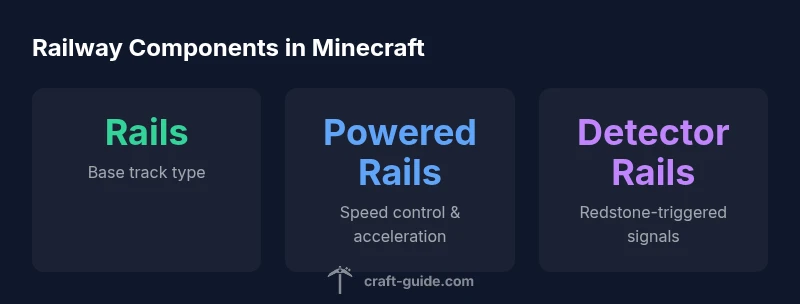
- Rails: The standard track that guides minecarts along straight paths and gentle curves. They form the backbone of any railway.
- Powered Rails: These provide acceleration and speed maintenance; they require a redstone-powered source to stay active.
- Detector Rails: These rails sense a cart passing over them and emit a redstone signal, enabling automation such as gates, switches, or stations. Understanding how to layer these rails lets you build responsive, repeatable systems rather than a one-off track.
In practice, most networks blend all three types to balance efficiency and reliability. Rails handle the routing, powered rails keep carts moving on long stretches, and detector rails automate stopping mechanisms and signals at stations.
Crafting rails and expanding into a railway system
Crafting rails, powered rails, and detector rails follows familiar patterns in Minecraft and benefits from a clear design plan. Rails are typically created to form a continuous path in the crafting grid, using iron-related components and sticks. Powered rails add redstone and, depending on the edition, gold ingots; detector rails incorporate a sensor-like element such as a pressure-sensitive component and redstone. While exact in-game recipes can vary by edition and version, the overarching principle remains the same: start with a simple rail, then add power and sensing to introduce automation. A practical route is to lay out a short test section: a straight line with rails, then insert a powered rail after a climb or long run, and finally place a detector rail near a small station to exercise the automation loop. Craft Guide emphasizes testing each stage in a controlled world to confirm behavior before scaling to longer networks.
Designing a practical railway network
A well-designed railway network begins with careful planning. Start with a main spine that connects key hubs (base, mine, village, docks). Use straight segments for long distances and curved sections to follow terrain, ensuring curves meet safe radii to prevent derailments. Place stations at logical intervals with clear entry and exit paths, and design access to storage or unloading areas. If your world includes height changes, plan gentle gradients and places to pause for loading or unloading. Modular segments should be built to mirror a template—so you can copy and adapt as your map grows. Finally, consider in-game weather and lighting; well-lit stations reduce mob spawns and improve safety at night.
Redstone integration: powering, detectors, and automation
Redstone integration is what turns a track into a smart railway. Powered rails require an active redstone power source to accelerate carts, so plan power lines or lamp blocks to activate them reliably. Detector rails respond when a minecart passes, triggering a redstone signal that can control gates, signal lamps, or automated loading bays. Intersections and junctions should include signals to prevent cart collisions, and station layouts should enable easy boarding and unloading. Keep wiring organized in separate layers or use vertical designs to minimize interference with the rails themselves. In multiplayer worlds, agree on a common redstone convention to avoid conflicts and ensure predictable behavior across players.
Common pitfalls and optimization tips
Common mistakes include under-powering long straightaways, neglecting curves that are too tight, and placing detector rails too far from stations to trigger reliably. Another pitfall is hiding redstone wiring, which makes debugging difficult. To optimize performance, map out your network using modular blocks, verify block updates, and test the full loop with multiple carts circulating. Keep storage near stations and consider spawn protection or safe zones to prevent accidental cart losses. Craft Guide recommends a phased build approach: implement a core spine first, then expand with additional branches as you master the mechanics. Finally, always back up your world before large overhauls.
Testing and iteration: from prototype to production
Build a small prototype with one straight section, a basic station, and a couple of curves. Run repeated minecarts to test speed, braking, and responsiveness of detector rails. Iterate by adding powered rails at critical choke points and adjusting detector rail placement for reliable signals. When you’re satisfied, scale by duplicating modules along a longer corridor, ensuring consistency in rail type, spacing, and redstone logic. Regular testing sessions prevent small misalignments from becoming large reliability issues in your final build.
Basic rail types and high-level crafting concepts
| Item | Materials (high level) | Crafting Pattern (concept) |
|---|---|---|
| Rails | Iron ingots, sticks | 3x3 grid with rails pattern (varies by edition) |
| Powered Rails | Iron ingots, gold ingots, redstone | 3x3 grid with redstone and gold placement |
| Detector Rails | Rails, stone pressure plate, redstone | 3x3 grid with detector components |
People Also Ask
What is included in the railway minecraft recipe?
The railway minecraft recipe covers three rail types: Rails, Powered Rails, and Detector Rails. The core materials are iron ingots, sticks, redstone, and, for powered rails, gold ingots. These components together enable a functional rail network.
The railway recipe includes rails, powered rails, and detector rails to create a complete track system.
Can detector rails power signals automatically?
Yes. Detector rails sense a minecart passing over them and emit a redstone signal, which can trigger gates, switches, or other automation in your railway system.
Detector rails trigger a redstone signal when carts pass over them.
How do I plan a long railway efficiently?
Start with a central spine connecting major hubs, add straight sections for speed, and integrate gentle curves. Place powered rails at intervals where speed needs a boost, and use detector rails at stations for automation.
Plan with straight runs and curves, power rails where you need speed, and place detectors at stations.
Are there edition differences I should know?
Yes. Crafting recipes and redstone behavior can vary between Java and Bedrock editions. Check version-specific guides and in-game recipes to avoid surprises when upgrading worlds.
Recipes differ between Java and Bedrock; verify your version beforehand.
How do I build a simple minecart station?
A basic station uses detector rails to sense carts and trigger signals, with powered rails to control movement. Include a loading area, safe boarding, and a clear exit path to prevent jams.
Detector rails trigger signals; powered rails manage speed at stations.
“Railway design in Minecraft rewards careful planning and modular construction. A well-structured rail network saves time and makes large builds feel cohesive.”
The Essentials
- Plan your route before laying rails
- Use powered rails to maintain speed
- Detector rails enable automation
- Test networks in a safe world