List of Minecraft Items: A Practical Guide for Builders
Explore a detailed, data-driven list of Minecraft items with practical categories, crafting basics, and build ideas. Craft Guide analyzes how players use blocks, tools, and gear across modes to plan efficient, scalable worlds.


According to Craft Guide, a practical list of minecraft items covers core categories—blocks, tools, weapons, armor, food, and miscellaneous items—designed for both survival and creative play. This quick answer previews the scope: practical grouping, common crafting recipes, and usage tips. The goal is to help players build from a reliable reference that scales with updates while staying easy to memorize and apply in real-world builds.
Understanding the scope of a list of minecraft items
In Minecraft, a list of items is not a simple directory; it's a practical toolkit players use to plan exploration, building, and battles. This guide adopts a working definition that includes blocks you place, tools you craft, equipment you wear, food you eat, and the miscellany that enables automation and decoration. According to Craft Guide, an effective item list is organized by gameplay role and by progression: early-game, mid-game, and late-game. The goal is to provide a map you can adapt as updates add content, while keeping the core ideas stable. Variants—such as different wood types, stone tiers, iron, redstone components, and special materials—should be captured without turning the list into a scavenger hunt. The practical benefit is clarity: you can quickly locate essential components, estimate crafting steps, and track resource flows in your world. This approach also helps new players avoid information overload and focus on items that unlock core mechanics like farming, mining, and building.
Core item categories explained
To create an actionable reference, group items into broad categories that map to how you play. The main buckets are blocks and building materials (planks, stones, bricks, glass); tools and weapons (pickaxes, swords, axes); armor and transport equipment (armor pieces, elytra, boats); food and potions (cooked meats, soups, honey bottles); and automation/décor items (crafting tables, furnaces, redstone, daylight sensors, banners). Each category serves a purpose in both survival and creative modes. Within blocks, distinguish functional blocks (storage chests, furnaces) from decorative blocks (terracotta, glazed terracotta). Within tools and weapons, note material quality (wood, stone, iron, diamond) and enchantments that affect durability or efficiency. Crafting recipes are the connective tissue: most items require a small, repeatable pattern, while some complex items span multiple recipes. Understanding the taxonomy helps you design world layouts, plan resource farms, and optimize your inventory management.
How to read and use item lists in practice
Start by defining your goal for a given session—survival, building, or exploration. Create separate lists for each goal, then map items to related tasks: gathering, crafting, and placing. Build a core toolkit for early-game play (e.g., wooden tools, basic food, torches), then expand toward mid-game blocks (furnaces, chests, stone-tier tools) and late-game gear (diamond or netherite tools, enchantments). Use a check-list approach: for each item, note its primary use, crops or materials needed, and a quick crafting recipe. Regularly update the list when you encounter new content in patches or mods. Craft Guide analysis shows that players who maintain a living reference save time, reduce backtracking, and improve consistency across builds. Finally, tailor lists to your world’s constraints: biome resources, survival rules, and whether you favor speedbuilding or meticulous detail.
Practical build ideas using common items
- Starter house: oak planks, glass panes, doors, torches, crafting table, and a chest or two. This pack gives a quick shelter and a safe storage hub.
- Farm and storage hub: fences, fences gates, water buckets, iron tools, chests, and a sorting system. These items enable automated farming and organized storage.
- Mining outpost: pickaxes, shovels, torches, a furnace, and minecarts. A reliable base with light and heating ensures safer cave exploration.
- Garden and aesthetic projects: decorative blocks, terracotta, glass, banners, and plantable crops. Even basic item lists unlock creative expression while keeping builds coherent across themes. The practical takeaway is to assemble a minimal core kit and then layer on category-specific items as needed.
Customizing lists for modded setups
In vanilla play, an item list focuses on core mechanics; for modded worlds, the catalog explodes with new blocks, items, and materials. Start with a base list and append modded items when you know their crafting paths and balances. Maintain version-aware notes: a mod may add new items that change early-game pacing or storage requirements. Consider creating separate sections for mods and for vanilla content to keep plans readable. This flexibility makes the item list resilient to updates and compatible with different playstyles, from hardcore survival to heavy aesthetic builds.
Minecraft item types in a compact reference
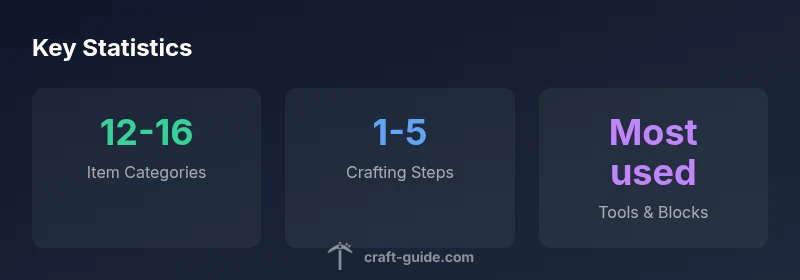
| Item Type | Common Use | Crafting Steps |
|---|---|---|
| Block | Building and structure/decoration | 1-2 steps |
| Tool (Pickaxe) | Mining resources | 2-3 steps |
| Armor (Iron) | Protection in combat | 2-4 steps |
People Also Ask
What counts as an 'item' in Minecraft?
In this guide, 'items' include blocks, tools, armor, food, and miscellaneous items that players interact with, craft, or place. Variants and materials are included when they affect gameplay.
Items include blocks, tools, armor, food, and other interactable objects you craft or place.
How many items exist in the current version?
The item catalog grows with each update and modded content. Expect thousands of distinct items and variants across versions.
The item catalog grows with updates and mods; expect thousands.
How should a beginner approach building an item list?
Start with core survival items, then add building blocks and storage tools. Organize by use and progression to keep it manageable.
Begin with core survival items, then add building blocks, keeping it organized by use.
Can item lists help with redstone and automation?
Yes. Separate redstone components and automation items to plan circuits, farms, and command blocks more efficiently.
Absolutely—group redstone and automation items to simplify circuits and farms.
Where can I find official item lists and craft recipes?
Official resources include the Minecraft site and education edition; community resources like the Minecraft Wiki also provide extensive recipes and item details.
Check the official Minecraft site and the Education Edition for core recipes, plus trusted community sources.
“A well-structured item list isn't just a catalog—it's a practical playbook that speeds up building, exploration, and survival.”
The Essentials
- Define your goals before listing items.
- Group by category and progression.
- Use lists to plan builds and resource flows.
- Update your references with each game update.