Fence Recipe in Minecraft: Quick Craft Guide for Builders
Learn how to craft fences in Minecraft using any wood type. This guide covers materials, the crafting pattern, tips, and common mistakes to help you build secure enclosures.


Craft fences in Minecraft by combining 4 wooden planks and 2 sticks to yield multiple fence blocks. Any wood type works, so you can match builds with oak, spruce, birch, or other varieties. For practical setups, pair fences with a fence gate to allow easy passage. Start small and expand as your base grows.
The Fence: Why It Matters in Your Minecraft Builds
Fences are a fundamental building block for creating safe, navigable spaces in Minecraft. They define property boundaries, protect crops, and help you control access without fully closing an area. A well-placed fence line can turn a simple hut into a functional base, making it easier to manage livestock, farms, and pathways. According to Craft Guide, fences help define safe spaces and control access in bases, which is why many builders start with a short fence perimeter before expanding. This practical approach lets you test layouts and adjust as your project grows while maintaining the Minecraft aesthetic you’re aiming for.
Materials: Wood Types and Alternatives
Fences in Minecraft are built from wooden planks that come in a variety of wood types. The choice of wood determines the fence’s color and appearance, so you can tailor your build to match an oak forest, a dark spruce hideaway, or a tropical jungle outpost. The core requirement remains four planks and two sticks, but you can use any wood variant to achieve the look you want. Crafting with multiple wood types can also help distinguish compounds and sections of a larger base. To maximize efficiency, you might stockpile a stack of planks from your preferred wood and keep a separate supply of sticks in a nearby chest.
The Crafting Recipe: Understanding the Pattern
In the crafting table, fences require a standard pattern that uses four planks and two sticks. The exact arrangement works in any order within the 3x3 grid, and the result will be two fence blocks per craft. Any wood type is acceptable, so you can build a fence line that matches the rest of your project. Mastery comes from consistent layouts, which makes future repairs and expansions faster. The Craft Guide team notes that consistency in wood choice improves both aesthetics and organization for larger builds.
Crafting Efficiency: Bulk Fences and Storage
If you expect to fence a large area, plan to craft in bulk. Prepare a stack of planks for your preferred wood type and a bin of sticks. The crafting process is quick, and you can produce many fence blocks in a single session. An efficient approach is to pre‑layout patterns in the crafting grid and keep a dedicated crafting area close to your workshop. Remember to keep extra fences handy in a chest near your build site so you don’t have to run to storage every time you need a segment.
Using Fences in Builds: Enclosures, Farms, and Decor
Fences shine when used to protect crops, pens, and base perimeters. They’re tall enough to deter many ground mobs and can be extended with how you connect sections for continuous barriers. For aesthetic appeal, combine fences with gate entries, decorative corners, or varying wood colors to create a distinctive style. Consider integrating fences into terraced landscapes or stair-like designs to guide players naturally around your base.
Fence Gates and Mobility: Practical Tips
A fence by itself blocks passage, but a fence gate provides controlled access without breaking the barrier visual. Craft a guard gate to pair with the fence line so you can pass through while your livestock remain contained. Place gates at logical access points such as near a pathway, gatehouse, or stable entrance. Ensure you have levers or doors nearby if you want easy one-click access from your base.
Common Mistakes and How to Fix Them
Common mistakes include underestimating fence length, mixing wood colors without a plan, and neglecting to craft matching gates. To fix these issues, draft a simple layout before you start, gather a uniform wood type, and craft a few extra gates for patrol routes. Another frequent slip is placing fences too close to water or terrain where mobs can jump or bypass the barrier. Reassess your perimeter and add vertical or diagonal sections to close gaps.
Bedrock vs Java: Version Considerations
Fences operate similarly across Java and Bedrock editions, with minor interface tweaks and inventory differences that do not affect core functionality. When planning builds, keep in mind that updates can tweak crafting or block behavior. For the most up-to-date guidance, consult the Minecraft community wiki and official resources to confirm any version-specific changes that might affect your fence design.
Extending Your Fence: Connectivity and Design Tricks
Connect fence lines to create larger courtyards and multi‑tier enclosures. Use corner blocks to align fences with walls or terrain, and experiment with partial fences to create gates that blend into natural layouts. Building practices like this help you maintain clean sightlines and efficient movement around your base. Patch gaps and ridges by smoothing the terrain so your fence runs are straight and cohesive.
Quick Reference: Output and Materials at a Glance
Keeping a simple reference near your workbench saves time. Remember the core recipe uses four wooden planks plus two sticks to produce two fence blocks per craft. Wood type influences color, so decide on a primary wood early in your planning phase. Pair fences with gates to ensure smooth access; this small decision improves both function and aesthetics in the final build.
Tools & Materials
- Crafting Table(Needed to access the 3x3 crafting grid)
- Wooden Planks (any wood type)(4 planks total; matches your build color)
- Sticks(2 sticks)
Steps
Estimated time: 15-25 minutes
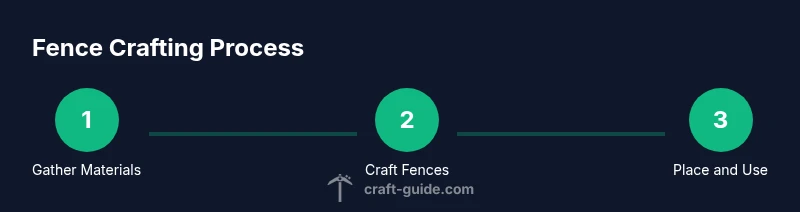
- 1
Gather materials
Collect 4 planks of your chosen wood type and 2 sticks. If you’re building a large fence, consider stocking up so you can craft multiple blocks in one session.
Tip: Organize your resources in a nearby chest before you start. - 2
Open crafting table
Right-click (PC) or use the appropriate action to open the 3x3 crafting grid. A clear workspace prevents misplacements and mistakes.
Tip: Ensure you have enough space around the crafting area for movement. - 3
Place planks in the grid
Place four planks in the pattern required for fences (the exact arrangement is the standard fence recipe). Any wood type will work for color consistency.
Tip: Keep the planks organized by type to avoid color mismatches. - 4
Add sticks to complete the recipe
Place two sticks in the grid according to the fence recipe so you receive fence blocks as the output.
Tip: Double-check you have the correct number of planks and sticks. - 5
Retrieve fence blocks
Drag the produced fence blocks into your inventory. Each craft yields two fence blocks.
Tip: Craft in batches to maximize your building speed. - 6
Craft fence gates (optional)
If you need controlled access, craft a fence gate using the same wood type to match your fences.
Tip: Gates are essential for animal pens and human‑accessible paths. - 7
Place fences
Lay down fence blocks along your planned perimeter. Maintain straight lines for a clean look and easier counting.
Tip: Use a ruler-like measurement to keep spacing consistent. - 8
Install gates and test
Place gates at entry points and test the enclosure by walking through. Make sure it remains secure and easy to navigate.
Tip: Place the gate on high-traffic sides for convenience.
People Also Ask
Can I use any wood type to craft a fence in Minecraft?
Yes, fences can be crafted from any wood type; the color matches the wood you choose.
Yes—any wood type works, and the fence color matches the wood you pick.
How many fence blocks do you get per craft?
Crafting fences using the standard recipe yields two fence blocks.
Crafting yields two fence blocks.
Do I need a fence gate to pass through fences?
Yes, you typically use a fence gate to create an entry/exit point, preserving the barrier.
Use a fence gate to pass through.
Are fences the same in Java and Bedrock editions?
Fences operate similarly across Java and Bedrock editions, with minor interface tweaks.
Fences work the same in both editions.
Can fences be dyed or colored separately?
Fences' color comes from the wood type; there is no separate dyeing option.
Fences follow wood color; no separate dyeing.
Where can I learn more about Minecraft building basics?
Check official Minecraft resources and reputable building guides for more tips.
See official resources for more tips.
Watch Video
The Essentials
- Choose a wood type for color consistency
- Remember the 4 planks + 2 sticks recipe
- Fences yield two blocks per craft
- Pair fences with gates for easy access