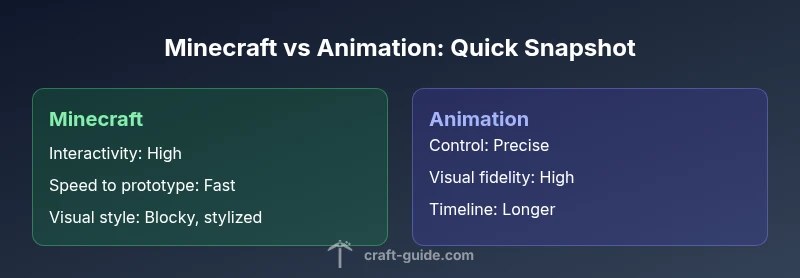
Minecraft vs Animation: A Practical Side-by-Side Comparison
Explore the key differences between Minecraft and traditional animation, including workflows, storytelling approaches, and engagement strategies. This Craft Guide comparison helps players and creators choose the best path for their projects.


The Minecraft versus animation landscape offers two distinct paths for storytelling and learning. This quick comparison highlights how interactivity, tooling, and audience engagement differ between the two approaches, helping you decide which route suits your project, budget, and timeline. Read on for deeper analysis, practical examples, and scenarios where each excels.
minecraft versus animation: Defining the Landscape
minecraft versus animation is more than a phrase. It signals two storytelling ecosystems with complementary strengths. The term captures the contrast between an interactive, voxel-based world you build in real time and a linear, frame-by-frame or simulated motion medium that presents scenes as fixed sequences. For players and creators, understanding these differences helps calibrate goals, tools, and expectations. According to Craft Guide, the most successful projects often blend elements from both worlds, using Minecraft for prototyping ideas and animation for polished storytelling. This hybrid mindset can unlock interactive narratives that still achieve cinematic or educational depth, depending on your audience and resources.
Interactivity vs Control: What Each Medium Delivers
Interactivity in Minecraft invites players to shape scenes, experiment with physics-style mechanics, and iterate on designs with immediate feedback. In contrast, animation prioritizes curated control over pacing, camera work, lighting, and character performance. The result is a more predictable, repeatable production flow that yields consistent cinematic quality. Craft Guide analysis shows that projects leaning into interactivity tend to excel in engagement metrics and user-generated content, while those prioritizing animation shine in clarity of storytelling and emotional impact. For educators, Minecraft can serve as a dynamic classroom tool, whereas animation offers refined demonstration of concepts when accuracy and pacing matter.
Visual Styles and Aesthetic Choices
Visual style often defines the boundary between Minecraft and animation. Minecraft embraces a distinctive blocky aesthetic, procedural lighting, and shader options that can produce charmingly retro or surprisingly photoreal effects depending on resource packs. Animation, meanwhile, leverages fine-grained texture work, motion curves, and lighting rigs to convey mood and realism. The choice isn’t simply about fidelity; it’s about audience expectations and narrative intent. A well-executed Minecraft project can feel cohesive and immersive through thoughtful camera work and texture tweaks, while animation can deliver advanced expressions and subtleties that a block-based world cannot easily mimic. Each path has its own set of technical decisions that influence production time and creative freedom.
Tools, Workflows, and Learning Curves
Working in Minecraft often relies on in-game editors, command blocks, redstone systems, and external tools like resource packs and world editors for faster setup. Animation requires a suite of software for modeling, rigging, texturing, lighting, and compositing, plus a robust pipeline for render, edit, and review cycles. The learning curve is typically steeper for animation due to concepts like rigging, keyframes, and rendering, but Minecraft offers a gentle entry point for beginners who want to prototype ideas quickly. Craft Guide notes that learners who begin with Minecraft can transfer foundational skills to animation later, smoothing progression over time and opening more intricate storytelling possibilities.
Storytelling and Narrative Techniques
Narrative technique diverges in a fundamental way. Minecraft storytelling thrives on interactivity, world-building, and emergent narratives driven by player choices and community content. In animation, storytelling centers on controlled pacing, character performance, voiceover integration, and cinematic structure. Both approaches can convey complex ideas—Minecraft through interactive quests and environmental design, animation through structured arcs and character-driven scenes. A practical strategy is to storyboard key scenes in animation, then build playable prototypes in Minecraft to test pacing, player agency, and structural flow before finalizing the cinematic.
Educational and Pedagogical Uses
Educators frequently use Minecraft as a hands-on classroom tool to teach geometry, collaboration, and problem-solving through exploration and experimentation. Animation complements these goals by illustrating concepts with precise visuals, demonstrations, and explainers. In a blended lesson, students might design a Minecraft world that models a scientific concept, then produce short animated clips to explain the underlying theory. Craft Guide’s approach emphasizes aligning learning objectives with medium strengths, sequencing activities to reduce cognitive load, and providing clear assessment criteria that map to both interactivity and narrative clarity.
Production Time and Resource Considerations
Production time scales with scope and medium. A compact Minecraft project may require hours to days for a simple build and an in-game narrative, while animations can demand weeks to months for cinematic sequences with rigging and multi-pass lighting. Resource considerations include hardware capabilities (GPU power for rendering), software licenses, asset creation time, and team coordination. A practical rule is to estimate iterations: rapid prototyping in Minecraft helps refine concepts early, then allocate more time for animation when polish and timing matter. This approach minimizes risk and keeps projects on schedule.
Collaboration and Community Involvement
Both Minecraft and animation benefit from collaborative effort. In Minecraft projects, communities contribute builds, skins, and mods, enabling diverse perspectives and rapid expansion of content. Animation projects often rely on collaboration among modelers, riggers, voice actors, and editors to produce cohesive results. An effective workflow combines community feedback with structured reviews, clarifies ownership rights, and uses version control for assets. Craft Guide highlights that transparent roles and clear milestones help teams stay aligned, reduce rework, and sustain momentum over long production cycles.
Realism, Scale, and Worldbuilding Constraints
Realism in Minecraft is bounded by voxel mechanics and engine limitations, which can dictate scale and the level of detail achievable in a scene. Animation offers greater flexibility to scale environments, craft nuanced lighting, and simulate intricate physics. However, higher fidelity comes with steeper production costs and longer timelines. The key is to model constraints early: decide how realistic you want visuals to be, what performance targets you must meet, and which scenes will be best served by Minecraft’s immediate interactivity versus animation’s cinematic control. This mindful approach prevents scope creep and keeps the project focused.
Bridging the Gap: Hybrid Approaches
Hybrid workflows are increasingly common. A typical pattern is to prototype a scene or game mechanic in Minecraft, capture gameplay footage, and then enhance it with animation techniques for transitions, cutscenes, or overlays. Some creators use animation to explain gameplay mechanics while letting players experience the core concept inside Minecraft. Toolchains that combine screen captures, motion tracking, and compositing can yield results that leverage the strengths of both mediums. The Craft Guide team recommends planning hybrid elements from the outset, establishing a shared visual language, and ensuring accessibility so audiences can follow along regardless of their familiarity with either medium.
Practical Guidelines for Creators: Getting Started
For beginners, start with a small, tangible project. Build a simple world in Minecraft that demonstrates a concept, then plan a short animated explainer video to accompany it. Develop a checklist: define objectives, map scenes, assign roles, and set milestones. Use community resources, such as tutorials and asset libraries, to accelerate learning. Maintain a clear export strategy for Minecraft footage and a render plan for animation, so you can iterate efficiently. Craft Guide emphasizes documenting decisions and preserving source files, which makes it easier to scale the project later or reuse assets.
Common Pitfalls and Troubleshooting
Common issues include scope creep, underestimating animation complexity, and mismatched pacing between gameplay and cinematic sequences. Another pitfall is neglecting accessibility, such as color contrast or subtitle availability. To mitigate problems, establish a minimal viable product early, test with diverse audiences, and schedule regular reviews that focus on narrative clarity and player experience. Keep backups of assets, maintain consistent naming conventions, and share progress updates to maintain team alignment. When technical glitches arise, adopt a modular approach to asset management and keep render pipelines flexible so adjustments can be made without redoing large portions of work.
Comparison
| Feature | Minecraft | Animation |
|---|---|---|
| Interactivity / Control | High in-world interactivity and player-driven outcomes | Predetermined sequences with controlled pacing |
| Visual Fidelity | Blocky, stylized realism; real-time lighting possible via shaders | High-fidelity textures, advanced lighting, and motion |
| Tools & Workflow | In-game editors, resource packs, command blocks | 3D modeling, rigging, texturing, rendering, compositing |
| Production Time | Variable; quick iterations for small ideas | Typically longer due to modeling, lighting, and rendering |
| Learning Curve | Accessible entry; growing community resources | Steeper; requires familiarity with multiple software stages |
| Educational Value | Hands-on exploration, collaboration, problem solving | Clear demonstrations of concepts through visuals |
| Cost & Accessibility | Low upfront cost (game is often free or inexpensive) | Software licenses and hardware requirements may apply |
| Best For | Rapid prototyping, interactive storytelling, classroom demos | Cinematic storytelling, character animation, polished trailers |
Benefits
- Encourages creative exploration and rapid iteration
- Low barrier to entry for beginners with Minecraft
- Fosters community collaboration and sharing
- Flexible for education and interactive storytelling
- Cross-platform accessibility and ease of distribution
Negatives
- Limited realism and cinematic control compared to animation
- Animation workflows can be time-intensive and costly
- Dependency on game updates or engine changes for Minecraft features
- Hybrid workflows may introduce coordination complexity
Minecraft is best for interactive storytelling and rapid iteration; animation excels for cinematic polish and controlled visuals
Choose Minecraft when you want player agency and quick prototypes. Choose animation when precision and cinematic quality matter. For many projects, a hybrid approach offers the strongest overall outcome.
People Also Ask
What is the core difference between Minecraft and traditional animation?
The core difference lies in interactivity: Minecraft enables player-driven exploration and live iteration, while traditional animation delivers curated, cinematic sequences with precise control over pacing, lighting, and motion. Both can tell compelling stories, but they engage audiences differently. Craft Guide highlights that understanding these contrasts guides better project planning.
Minecraft lets players shape the story in real time, while animation fixes the story and visuals in advance. Both have unique strengths for storytelling.
Can Minecraft be used to teach animation concepts?
Yes. You can use Minecraft to illustrate timing, scene composition, and narrative structure by building interactive scenes and recording or exporting gameplay. Then, you can supplement with animation software to demonstrate polished movement and camera work. This blended approach makes concepts tangible for learners.
Minecraft can show basic concepts, and animation can deepen the technique.
Which is easier for beginners to start with?
For absolute beginners, starting with Minecraft often feels more approachable because you can see results quickly without mastering complex software. As skills grow, moving into animation becomes more feasible. The key is starting small and building a repeatable practice routine.
Minecraft is usually easier to begin with; animation builds up with practice.
How long does a typical project take in each medium?
Minecraft projects can range from hours for a small scene to days for larger interactive experiences. Animation projects often span weeks or months depending on model, rigging, lighting, and render complexity. Planning milestones early helps manage timelines in both paths.
Expect shorter runtimes for Minecraft; longer for animation depending on scope.
Are hybrid approaches worth it for educational goals?
Hybrid approaches combine interactive prototypes with cinematic explanations, offering the best of both worlds. They support engagement and clarity, helping students grasp concepts through experimentation and visual storytelling. A well-planned hybrid can maximize learning outcomes.
Yes, hybrid methods often yield the most engaging learning experiences.
What are common pitfalls when comparing these mediums?
Common pitfalls include scope creep, overreliance on a single medium, and misaligned expectations about production time. Setting clear goals, defining success criteria, and choosing a hybrid approach when appropriate can mitigate these risks.
Define goals clearly to avoid overreaching projects.
The Essentials
- Start with clear objectives before choosing a medium
- Prototype ideas quickly in Minecraft to test interactivity
- Plan animation workstreams for scenes that need cinematic control
- Consider hybrid approaches to blend strengths
- Educators should align tasks with learning goals and accessibility