Minecraft or Stardew Valley: A Practical Comparison for Builders and Farmers
Explore minecraft or stardew valley in a rigorous, objective comparison. This guide weighs gameplay loops, progression, and community to help you decide which sandbox fits your pace and goals.


minecraft or stardew valley represent two iconic sandbox experiences, each delivering a different kind of progression and playstyle. Minecraft centers on open-ended building, exploration, and crafting in a limitless world, while Stardew Valley blends farming, relationships, and town life with structured goals. This comparison highlights core gameplay loops, accessibility, and long-term engagement to help you choose.
Context and Core Differences
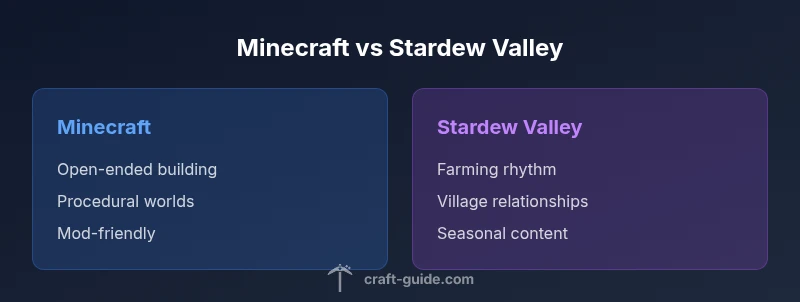
When players compare minecraft or stardew valley, they are weighing two different design visions for sandbox play. Minecraft offers a nearly infinite canvas: procedurally generated worlds, block-based building, and survival mechanics that scale with the player's ambition. Stardew Valley presents a tightly scoped, character-driven farm sim with seasonal cycles, relationships, and a sense of village progress. For many players, the choice comes down to whether you want to experiment with geometry and machinery or cultivate crops, friendships, and a small-town economy. According to Craft Guide, the appeal lies in how players narrate their own goals: in Minecraft, the story is what you build; in Stardew Valley, the story unfolds through daily routines, events, and character interactions. Both games reward experimentation, but they do so through different levers: creative freedom versus meaningful routine. The result is two distinct play sessions that can scratch different creative or relaxing impulses. This framing helps beginners and veterans think about what kind of play session they are craving in any given week.
Gameplay Loops and Core Activities
The sandbox thesis behind minecraft or stardew valley hinges on two distinct loop ecosystems. In Minecraft, the core loop emphasizes gathering resources, crafting tools, and building structures, with risk management (monsters, hunger) shaping your decisions. Players can escalate complexity by creating farms, automation with redstone, or massive megastructures that redefine how a world feels. Stardew Valley, by contrast, centers on farming cycles, crop planning, mining, and cultivating relationships with villagers. Seasons, festivals, and marriage add narrative hooks that keep you returning day after day. The cadence is deliberate: tend crops, tend neighbors, upgrade tools, and unlock new areas. Craft Guide Analysis, 2026 notes that the best sandboxes sustain long-term engagement by balancing open-ended exploration with achievable, recurring milestones. In both games, the most satisfying results arrive when you align a personal goal with in-game feedback.
Progression Systems and Endgame Goals
Progression in Minecraft is a mosaic of milestones rather than a single finish line. You advance by expanding your base, obtaining rare resources, defeating bosses like the Ender Dragon, and engineering complex mechanisms. Each success expands your creative options, enabling bigger builds and more ambitious projects. Stardew Valley charts progression through relationships, farm upgrades, and town development. You start with modest plots and limited tools, then unlock new crops, farmhands, and community events. The endgame feels like a living calendar rather than a traditional closing chapter: you chase completed bundles, maximize profit streams, and unlock the town’s deeper lore. The Craft Guide lens emphasizes how players structure time: in Minecraft, time is a resource for creation; in Stardew Valley, time is a narrative device that deepens community ties.
Visual Style, Mood, and Accessibility
Minecraft leans into a blocky, colorful aesthetic that invites customization—from texture packs to shader mods—making it accessible on a wide range of devices. Stardew Valley uses a pixel-art charm with a warmer, cozy mood, which many players find more inviting for long sessions in front of a screen. Accessibility considerations differ: Minecraft’s control complexity (especially with mods and redstone) can be intimidating, but the game remains approachable at the basics. Stardew Valley’s gentle pacing and explicit daily routines reduce decision fatigue for new players. Both games require a low-to-moderate learning curve to begin, but Stardew Valley scales more gradually into its deeper systems, while Minecraft presents an expansive horizon of possibilities that can feel overwhelming at first. Craft Guide’s experience with players shows that mood and aesthetic alignment often drive early engagement more than mechanical depth.
Modding, Community, and Longevity
The modding ecosystems around minecraft or stardew valley differ in scope and impact. Minecraft has a vast modding scene, offering everything from biome tweaks to automation frameworks and new dimensions. This ecosystem can dramatically alter gameplay and extend the title’s longevity well beyond its initial release. Stardew Valley has a dedicated modding community too, but the scope is narrower and more focused on quality-of-life enhancements, relationship tweaks, and farm customization. Player communities shape many experiences: servers, mod packs, community-run events, and fan-made guides create a sense of ongoing conversation. Craft Guide Analysis highlights that long-term satisfaction often correlates with how the community supports ongoing play, whether through new content or reliable, well-documented mods. In both games, longevity hinges on active communities and flexible tools rather than a single-game arc.
Social Play: Multiplayer and Co-op
Both titles support social play, but the takeaways differ. Minecraft’s multiplayer can be expansive: large servers, minigames, and cooperative builds offer nearly limitless collaboration opportunities. Stardew Valley provides co-op farming and town life with a more intimate, shared progression: players work together on a farm, share resources, and compare farm layouts. The social dynamics shift: Minecraft emphasizes collective creativity and project management; Stardew Valley cultivates relational storytelling and joint decision-making about the village’s future. On PCs and consoles, cross‑play varies by platform and edition, so check compatibility before committing. Craft Guide emphasizes that your social goals—epic collaborative builds versus shared daily routines—will largely determine which game your group enjoys together.
Economy, Crafting, and Resource Management
In Minecraft, resource collection fuels both practical builds and aesthetic exploration. Crafting recipes scale with your ambitions, from simple tools to intricate automation and redstone contraptions. Resource management is a constant game of planning, hoarding, and improvisation. Stardew Valley frames economy within a village ecosystem: you grow crops, raise livestock, mine for ore, and sell goods to neighbors and the traveling merchant. The joy comes from optimizing profit, balancing crops with livestock, and using money to unlock farm upgrades and new content. Muddying the line between resource strategy and relationship management, Stardew Valley adds social value to every resource you acquire. The Craft Guide perspective notes that success in either game comes from turning scarce resources into meaningful end results, whether it’s a towering wheat farm or a gleaming redstone farm.
Beginners Guide: Getting Started
Getting started with minecraft or stardew valley means different onboarding paths. In Minecraft, begin with a simple shelter and basic crafting table. Add basic mining, resource gathering, and a few early builds to gain confidence before you approach redstone or large-scale projects. Stardew Valley starts with a farm and a handful of tools; focus on planting a few crops, completing a couple of quests, and building relationships with a few villagers to unlock more content quickly. Both games reward small, consistent daily progress. Craft Guide suggests creating a simple plan for the first two in-game weeks, then adjusting based on how much you enjoy farming, exploration, or social interaction. In either case, start with a clear goal and a comfortable pace to avoid early burnout.
Performance, Platforms, and Hardware Considerations
Performance is a practical concern for both games, especially on older hardware. Minecraft’s performance hinges on world complexity and mods; lower-end devices can still enjoy the base game with fewer resource-heavy modifications. Stardew Valley is comparatively light on resources, but large farms with lots of crops and villagers can push performance on some systems. Both titles are available on PC and major consoles, with mobile versions offering lighter experiences. When evaluating hardware needs, prioritize stable frame rates and smooth world loading: a capped frame rate with reasonable texture settings can improve immersion and reduce fatigue during long play sessions. Craft Guide emphasizes that performance considerations often remake the user experience more than any single feature change, so tailor settings to your preferred play style.
Time Investment and Learning Curve
Time investment in these sandbox experiences can vary widely. Minecraft offers near unlimited time horizons; you can approach it as a daily creative retreat or as a milestone-driven engineering challenge. Stardew Valley rewards steady, daily routines with seasonal and town-wide outcomes, but it scales its complexity gradually as you unlock new crops, crafts, and relationships. The learning curve for Minecraft’s deepest systems—like redstone or command blocks—can be steep; Stardew Valley’s earliest content is accessible, with deeper systems opening as you invest more time. Both games encourage long-term play, though the pacing differs: one prioritizes endless creation; the other, a retuned life sim with evolving content. Craft Guide’s observation is that the time you invest should align with your desired balance of creativity, social interaction, and daily rituals.
Decision Framework: Which Is Right for You?
Choosing between minecraft or stardew valley comes down to your personal goals. If you crave architectural freedom, scalable automation, and expansive discovery, Minecraft offers a vast sandbox with a growing ecosystem. If you want a comforting, character-driven life sim with farming, relationships, and seasonal milestones, Stardew Valley provides a more guided, slower-burn experience with satisfying social layers. Many players enjoy both in different seasons or moods, using each game to fulfill complementary needs: Minecraft for ambitious build projects and experimentation, Stardew Valley for community life and farming progress. Craft Guide recommends matching your play style to the core loop you find most rewarding, then exploring the other game as a seasonal change of pace.
The Future of Sandbox Games: Why Both Matter
Looking ahead, minecraft or stardew valley illustrate two enduring paradigms in sandbox gaming. One emphasizes open-ended creation and technical mastery; the other emphasizes relational storytelling and life simulation within a cozy aesthetic. Both approaches keep players coming back because they satisfy different creative impulses and social needs. The craft of sandbox design lies in balancing freedom with meaningful constraints, ensuring players feel both agency and progress. Craft Guide believes the future of sandbox games hinges on flexible tools, strong communities, and ongoing content that respects both playstyles. Ultimately, both Minecraft and Stardew Valley matter for the broader gaming landscape as anchors for exploration, creativity, and collaborative play.
Comparison
| Feature | Minecraft | Stardew Valley |
|---|---|---|
| Gameplay Focus | Open-ended building, exploration, and automation | Farming, relationships, and town life with seasonal cycles |
| Progression Systems | Infinite progression through builds, tech, and exploration | Narrative-driven progression through farms, relationships, and town upgrades |
| Time Scale | Flexible; day/night cycles with persistent worlds | Daily and seasonal rhythm with festivals and events |
| Multiplayer/Co-op | Large server ecosystems, PvP/creative modes possible | Co-op farming and shared town progress |
| Modding Support | Vast modding ecosystem; redstone, tech packs, dimensions | Modding exists but is less central; quality-focused tweaks |
| Visual Style | Blocky, highly customizable via texture packs | Pixel-art charm with cozy, warm tones |
| Accessibility/On-ramp | Low entry barrier; immediate building and exploration | Approachable farming, relationships, and quests |
| Platform Availability | PC, consoles, mobile; strong cross-platform communities | PC and consoles; mobile port with simplified UI |
Benefits
- Extreme creative freedom with limitless building and automation
- Strong, active modding communities that extend playtime
- Cross-platform availability and broad device support
- Ongoing updates, new content, and community-driven innovations
- Highly adaptable to diverse playstyles (creative, survival, tech)
Negatives
- Time sink risk due to endless objectives and builds
- Steep learning curve for advanced systems (e.g., Minecraft redstone)
- Stardew Valley pacing can feel slow for players seeking instant gratification
- Mod compatibility can introduce instability or maintenance overhead
Both games excel as sandbox experiences; choose Minecraft for limitless building and experimentation, Stardew Valley for cozy farming and social play.
If you want vast, open-ended creativity and engineering, pick Minecraft. If you crave farming, relationships, and seasonal progression, Stardew Valley is the better fit. Craft Guide's verdict is to align your choice with your preferred pace and social play style.
People Also Ask
Which game is easier for beginners?
Stardew Valley tends to be more approachable for newcomers due to guided quests, simple farming, and a clear progression path. Minecraft offers a gentle start but introduces complex systems like redstone and modding deeper down the road. Start with Stardew to learn comfort with in-game routines, then explore Minecraft for broader creative freedom.
Stardew Valley is generally easier to pick up. If you want simple farming and social goals first, start there; then try Minecraft when you’re ready for more building and tech depth.
Can I play across platforms?
Both games are available on multiple platforms, but cross-play compatibility depends on edition and platform. PC players have broad options, while some console combinations may restrict cross-play. Check your specific platform store page for current cross-play support before buying.
Yes, but cross-play support varies by platform and edition. Check your version details before purchase.
Is modding essential?
Modding is not essential for either game. Minecraft’s mods can significantly extend features and playtime, while Stardew Valley’s mods mainly enhance QoL and content tweaks. Both communities support optional enhancements, but you can enjoy the base game without mods.
Mods aren’t required. They’re optional boosts for Minecraft’s depth or Stardew Valley’s customization.
How long does it take to 'finish' each game?
Both titles are sandbox experiences without a traditional finish line. Stardew Valley offers end-to-final goals through marriage, farm upgrades, and community achievements; Minecraft has no fixed end but can reach an awe-inspiring built world or a completed redstone factory. Your personal milestones guide your sense of completion.
There isn’t a fixed end in either game. Finish lines are personal milestones you set yourself.
Which is best for builders?
Minecraft is the premier builder-focused game, thanks to limitless blocks, redstone automation, and endless customization. Stardew Valley centers on farming and village life, not large-scale architectural projects. If your primary interest is building, Minecraft is the stronger fit.
If you want expansive building and automation, pick Minecraft.
Are official guides available?
Both communities publish tutorials, wikis, and guides, with high-quality content from fans and enthusiasts. Official strategy or walkthroughs exist, but the strongest guidance often comes from dedicated community resources and in-game experimentation. Craft Guide provides impartial, practical tips to navigate both experiences.
You’ll find plenty of guides; community resources are usually the most helpful, with Craft Guide offering practical tips.
The Essentials
- Define your preferred pace before you pick.
- Minecraft rewards invention; Stardew Valley rewards routine.
- Consider modding appetite and community size.
- Balance solo play with cooperative experiences.
- Both games reward long-term commitment and personal goals.