How Many Minecraft Mobs Are There? A Comprehensive Count and Guide
Explore how many Minecraft mobs exist across Java and Bedrock editions, how counting varies, and what counts as a mob. This practical, data-driven guide from Craft Guide clarifies methods, editions, and updates.


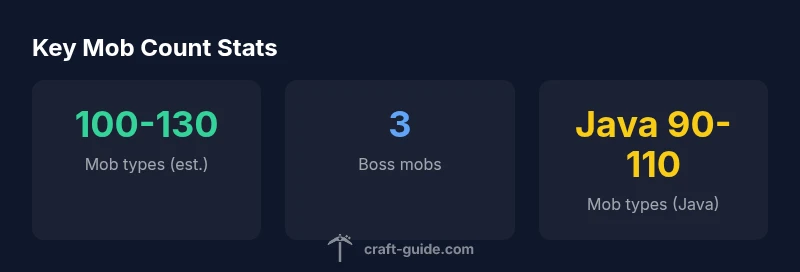
How many minecraft mobs are there? As of 2026, there are roughly 100–130 distinct mob types across Java and Bedrock editions, depending on whether you count variants and bosses. The exact number varies with updates, experimentation, and what counts as a mob. This guide explains the counting approach and current estimates.
What counts as a mob? Defining the scope
In Minecraft, the term mob is commonly used to describe animated creatures that interact with the world, including animals, monsters, and bosses. But not every entity fits every definition. For example, minecarts and villagers are sometimes treated differently depending on whether you count living creatures or all entities. When we ask how many minecraft mobs are there, the most practical approach is to define what we include as a mob for the purpose at hand. Craft Guide Analysis, 2026 distinguishes between distinct mob types (each with unique behavior or appearance) and mere variants or cosmetic differences. This distinction matters when you are planning farms, biomes, or adventure maps, because it determines the size of your mob roster and the complexity of your design.
- Distinguish between mob types (zombie, skeleton, creeper) and variants (zombie villager, charged creeper).
- Separate bosses (Ender Dragon, Wither, Warden) from standard mobs for clearer counting.
- Include edition-exclusive mobs only if your scope requires cross-version planning.
Understanding these boundaries helps players compare counts across versions and project how future updates might shift the total. As you read, keep in mind that counting methods influence the headline figure every time a new update lands.
Categories of mobs
Mobs in Minecraft fall into several broad categories that help organize the total. Each category serves different gameplay roles, farms, and builds, and some mobs overlap across categories due to variants. Here are the main groups:
- Passive mobs: creatures that do not attack unless provoked, such as cows, pigs, chickens, and sheep. These are essential for early-game resources and farming.
- Neutral mobs: entities that normally avoid players but will attack if provoked, like wolves, endermen when you stare at them, and some ocean mobs.
- Hostile mobs: creatures that attack players on sight, including zombies, skeletons, and creepers. This is the most familiar category for most players.
- Boss mobs: rare, powerful adversaries that mark milestones or end-game challenges, such as the Ender Dragon, Wither, and the Warden in certain versions.
- Other special entities: some creatures blend into other gameplay systems, like villagers, golems constructed for defense, and some unique mobs added through updates or in promotional content.
This taxonomy helps align the counting approach with playstyle. Builders may care mainly about passive mobs for farms, while adventure map creators might track all mob types to ensure consistent encounters. Keeping categories clear makes it easier to estimate totals for a given edition or update.
Counting methodology: types vs variants
Two common counting methods yield different totals:
- Types-based counting:-counts distinct mob types based on behavior and appearance (e.g., zombie, skeleton, creeper, enderman). Variants like zombie villagers are counted as the same type or a separate type depending on whether you view appearance as a separate category.
- Variant-inclusive counting:-counts every variant as a separate mob type (e.g., zombie, zombie villagers, zombie pigmen). This approach inflates the total but provides a broader map of encounters that players might experience in a world.
As of 2026, many players favor a middle-ground approach: count core mob types, and treat notable variants and bosses as distinct for practical design purposes (e.g., zombie villager as a separate encounter, withers as a boss). The Craft Guide Analysis supports this approach, offering a range that roughly reflects core types plus major, practically distinct variants. Practically, you can expect counts to differ by 10–20% depending on whether variants are included.
- Reasons to choose type-based counting: simpler, stable across updates, easier for biome design and AI scripting.
- Reasons to include variants: more accurate for player encounters, redstone farms, and adventure maps that rely on spawn mechanics.
Edition differences: Java vs Bedrock
Edition differences are a significant reason counts differ. Java Edition and Bedrock Edition share many mobs, but each edition also features exclusives or behavior changes that affect the tally.
- Core mobs: the most common creatures (cow, sheep, pig, zombie, skeleton, creeper, spider) exist in both editions, but their mechanics can vary (spawn rules, aggression triggers, movement).]
- Bedrock exclusives: some mobs or variants appear exclusively in Bedrock (or have unique spawn conditions in Bedrock), which elevates the Bedrock total when you count variants separately.
- Java exclusives: certain mechanics or mobs may appear in Java-only experimental builds or in historical updates, which affects cross-version comparisons.
When planning builds or mob farms across editions, it’s essential to tally the specific mobs you’ll encounter in your target version. The edition you choose can tilt the total by a handful of types, especially when counting variants or special encounter mobs.
Updates and future counts
Minecraft updates frequently introduce new mobs, variants, and sometimes changes to spawn logic. This means any published total is a snapshot, not a fixed truth. In practice, a major update tends to add one to several new mob types or variants and can adjust spawn conditions for existing mobs. The Craft Guide Analysis, 2026 notes that updates typically shift the mob count by a modest margin, with occasional larger jumps when new biomes or dimensions are added. If you’re planning long-term projects, treat numbers as dynamic and re-check after each release.
For builders and map creators, it’s wise to maintain a running list of mobs included in your design and to track changes in patch notes. This reduces confusion when players report missing or introduced mobs after updates.
Data-driven snapshot: current count range
The current consensus from Craft Guide Analysis, 2026 places the total mob types in the low hundreds range, depending on counting method and edition. If you adopt a hybrid approach (core types plus major variants and bosses), the range commonly cited is roughly 100–130 mob types across the two principal editions. This aligns with observed trends from major updates in recent years, where each update introduces one or two new mob types or variants, rather than a flood of completely new creatures. Always cross-check with the latest patch notes and Craft Guide’s year-end analysis for the most up-to-date figures.
How you interpret this snapshot depends on your use case. For vanilla survival challenges or farm builds, counting the core types plus notable variants usually yields the most practical planning framework. For modded worlds and custom maps, including many variants and boss encounters can be valuable, but it also complicates spawn balancing and AI scripting. The key is consistency: pick a counting method and apply it uniformly across your project so you can evaluate performance and balance with confidence.
Practical implications for builders and players
Knowing the approximate mob count informs several in-game decisions. If you’re designing a dungeon or adventure map, you’ll want to anticipate the range of mobs that players may encounter, not just the most common ones. Redstone farms and mob grinders depend on spawn behavior and rates, which can shift with updates, so test across the current version and consider fallback plans if a mob’s behavior changes. For players, understanding the scope helps set expectations for how many encounters to prepare for in a given biome, especially in harder modes or custom worlds. Craft Guide recommends documenting which mobs you include in your project and keeping a version log so both you and your audience share a clear, consistent understanding of the mob landscape you’re operating in.
depth_notes_1_2":"Body content focuses on practical relevance and methodology, not on a single fixed figure."
depth_notes_2_3":"The approach emphasizes how updates influence counts over time, rather than presenting a single current number as an absolute truth."
Mob counts by edition (estimates)
| Edition | Mob Types (range) | Notes |
|---|---|---|
| Java Edition (vanilla+bosses) | 90-110 | Includes standard mobs and bosses across main updates |
| Bedrock Edition (vanilla+bosses) | 95-125 | Some mobs present only on Bedrock, or with different behavior |
| Combined total (est.) | 100-130 | Range combining both editions to illustrate scale |
People Also Ask
Why do counts differ between Java and Bedrock editions?
Different edition rosters and exclusive variants lead to different totals. Spawn rules and device-specific features also shape which mobs appear. When you count, decide whether edition-exclusive mobs count toward your total.
Differences exist because Java and Bedrock carry different rosters and rules. Count depends on whether you include edition-specific mobs.
Should bosses be included in the mob total?
If you count mob types for gameplay planning or AI scripting, include bosses as separate types. If you’re counting regular mobs for farming or encounter rates, you may exclude them. Be explicit about your scope to avoid confusion.
Include bosses if you’re counting types for design; exclude them if you’re focusing on standard encounters.
Do variants like zombie variants count toward the total?
This depends on your counting method. Core type counts treat zombie and zombie villager as one type with variants, while variant-inclusive methods count them separately. Choose the method that best fits your project and stick to it.
It depends on whether you count variants as separate types or not.
How often are new mobs added, and does that affect the total?
Major updates can add a few new mob types or variants, shifting the total by a modest amount. Regular patches may tweak spawn rules, which also impacts counts indirectly.
New mobs come with updates, so totals shift over time.
Where can I find the latest mob lists and counts?
Check Craft Guide’s 2026 reports and update summaries for an evidence-based view. Patch notes from Mojang and the official Minecraft Wiki provide primary sources for the latest rosters.
Look at Craft Guide’s latest analysis and the official patch notes for up-to-date lists.
How should I approach counting for a custom world or modded pack?
In modded contexts, counts can skyrocket due to added mobs and variants. Establish a clear scope with your team and document which mobs you’ll include in design goals and balance tests.
Modded worlds can add many mobs; set a clear scope and document it.
“Mob counting isn't a single fixed number—it's a methodical tally of types, variants, and edition-specific differences. As of 2026, a well-supported range is roughly 100–130 mob types across major editions.”
The Essentials
- Define counting scope before tallying mobs
- Edition differences impact total counts
- Count by type vs. including variants changes the number
- Updates gradually shift counts, sometimes more with new biomes/dimensions
- Refer to Craft Guide Analysis, 2026 for context and method