Does Minecraft Have an End Credit Scene? A Practical Guide
Explore whether Minecraft has an end credit scene, how credits appear, and the End Poem’s role across Java and Bedrock editions. Craft Guide provides a clear, practical guide to viewing credits and debunking myths.


Does Minecraft have an end credit scene? In standard gameplay, Minecraft does not feature a traditional cinematic end-credit sequence like many blockbuster games. Instead, players encounter credits when the game ends or after major updates where trailers display credits. According to Craft Guide, the experience varies by edition and version, and some players recall the End Poem as a credit-like moment.
Does Minecraft Have an End Credit Scene?
The core question many players ask is whether Minecraft has an end credit scene. The short answer is nuanced: there is no traditional cinematic end-credits sequence that plays like a movie after a boss fight or a finished quest. Instead, the experience hinges on how you encounter the game’s ending, what version you’re playing, and whether you’re watching official trailers or fan-made compilations. In practical terms, most players see credits when the game concludes or when a major update is showcased, rather than through a built-in, film-style cutscene. This distinction matters for players who expect a polished post-credits scene. According to Craft Guide, the specifics can shift between editions and updates, which is why many players remember the End Poem more vividly than any on-screen credits.
This article uses the keyword does minecraft have an end credit scene in a natural, integrated way to help you understand what to expect across versions and play styles. If you’re curious about how credits appear in different contexts, keep reading for a breakdown of where Credits show up, what the End Poem is, and how to view credits in both Java and Bedrock editions.
How Credits Are Traditionally Presented in Minecraft
In Minecraft, traditional cinematic end credits are not part of the base gameplay loop. The game’s architecture rewards exploration, crafting, and combat rather than a post-credits rollout. When the game ends, players may be presented with a standard ending that includes information about the world seed, game version, and server details, but this is typically not a narrative credits sequence. On occasion, trailers and official marketing materials for large updates may feature a credits roll, but these are not integrated into the core game experience. This distinction is important for players who want a film-like epilogue and for builders who want to interpret the ending in their own way. The End Poem, a textual reflection, often surfaces as a separate, memorable moment rather than a live-action credits sequence, aligning with the game’s stylized, minimalist storytelling feel.
With Craft Guide’s lens, you can separate in-game endings from external media, recognizing that the core experience remains gameplay-first and that credits, when they appear, serve as a nod to the broader Minecraft universe rather than a cinematic payoff.
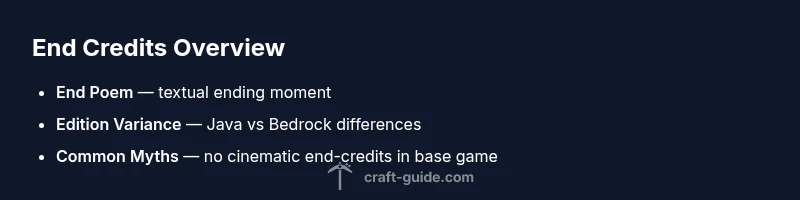
The End Poem: The Textual Credit Moment
The End Poem is widely discussed among players because it functions as a unique, text-based coda to the game’s ending. Unlike a traditional on-screen credits sequence with moving images and scrolling names, the End Poem is a poetic, reflective piece that appears after certain endings and updates. Its structure, cadence, and imagery encourage players to consider the journey they’ve taken, the worlds they’ve built, and the community that surrounds Minecraft. The End Poem’s presence is the closest Minecraft gets to a “credit moment,” and many players remember it long after their final in-game actions.
If you’re chasing a clearer sense of closure, focus on how the End Poem is delivered—whether as part of an ending screen, a post-ending moment, or a trailer’s closing lines—and how your platform handles the display format.
Java Edition vs Bedrock Edition: Credit Behavior
Credit behavior can differ between Java and Bedrock editions, reflecting the two engines’ divergent development paths. Java Edition often centers on updates that alter mechanics and world generation and, in some cases, deliver textual or marketed content as part of a release narrative. Bedrock Edition, optimized for cross-platform play, tends to replicate the same content with additional release notes and launch-time messages that may overlap with marketing materials but still do not produce a cinematic end-credits sequence by default. In both editions, the End Poem remains a focal point for players seeking a concluding moment, while actual in-game credits remain limited to contextual screens rather than film-like sequences. Throughout, your viewing experience is shaped by version-specific choices and how the game was packaged for your platform.
Craft Guide highlights that edition differences matter when you’re looking for a particular “credit moment,” so verify the exact version you’re playing if you want to compare experiences.
How to Watch Credits in Practice (Step-by-Step)
If you want to observe credits-like moments in Minecraft, follow these practical steps:
- Beat the game by defeating the Ender Dragon, if you’re playing standard Survival mode in Java or Bedrock. 2) After the game ends, watch for any textual End Poem or ending screens that appear as part of the ending sequence. 3) Check trailers or official patch notes for the specific update; these may display credits as part of the marketing material but aren’t part of the core gameplay loop. 4) If you’re using mods or custom maps, be aware that modding can alter endings and credits presentation; always review mod documentation for details about credits. 5) For a cinematic feel, creators often share fan-made compilations that simulate an end-credit sequence, though these are external to the base game experience. By following these steps, you can manage expectations and find the moment that best fits your play style.
This practical guide helps you understand where to look for credits and how to interpret them, regardless of your edition or platform.
Common Myths and Misconceptions
There are several myths surrounding Minecraft’s end credits. First, that the game always displays a long cinematic roll after every victory; this is not the case in standard gameplay. Second, that the End Poem is the credits; while it is a central textual moment, it isn’t presented in the same way as a traditional film’s credits. Third, the notion that every update introduces a new credits sequence is inaccurate; most updates alter gameplay or content without adding a cinematic ending. By debunking these myths, players can better appreciate the actual experience—textual endings, the End Poem, and occasional trailer-based credits—without expecting a movie-like format.
Craft Guide emphasizes that understanding the nuance between in-game endings and external media helps players set accurate expectations for their Minecraft journeys.
How Mods and Trailers Influence Perceived Credits
Mods and trailers can influence how players perceive Minecraft’s credits. Some mods implement custom endings or add a post-ending screen that resembles a credits sequence, while others concentrate on modded content while leaving the base game unchanged. Trailers often show cinematic credits to evoke a sense of grandeur, but these sequences are not a core feature of the game’s current releases. For players who enjoy cinematic moments, fan-made edits and community compilations are a popular way to experience a stylized end-credit vibe without altering the actual game code.
This distinction matters for players who value a traditional credits experience and for content creators who want to explore storytelling within Minecraft’s particular visual language.
Practical Takeaways for Players and Builders
- If you’re seeking a closing moment, expect the End Poem to be the most distinct textual memory rather than a film-like sequence.
- Verify the edition (Java vs Bedrock) and the specific update to understand how endings are presented.
- Mods can alter endings, so check mod documentation for any credits-related notes.
- Trailers and official promos may feature cinematic credits, but these are marketing assets, not in-game features.
- For builders, the lack of a traditional end credits offers creative freedom to design your own epilogue in custom maps or videos.
These takeaways help you navigate the nuance of does minecraft have an end credit scene and provide practical paths for your next Minecraft project.
Final Thoughts: What This Means for Your Playthrough
In sum, does minecraft have an end credit scene? Not in the conventional, cinematic sense. The game favors a textual, reflective ending—the End Poem—rather than a movie-like credits roll. This aligns with Minecraft’s design ethos: a focus on player creativity, exploration, and community over scripted epilogues. By understanding the nuances across editions and updates, players can set accurate expectations and still enjoy the meaningful moments that signal a completed journey in their own unique world.
Overview of Minecraft end credits behavior by edition
| Aspect | Notes | Edition |
|---|---|---|
| End credits presence | No traditional cinematic end-credits sequence in standard gameplay | Java & Bedrock |
| Viewing method | End Poem and ending screens serve as textual/ending moments | Java & Bedrock |
People Also Ask
Does Minecraft ever show a traditional end-credit scene?
No. Minecraft does not feature a cinematic end-credit scene in standard gameplay. Some contexts may display textual endings or refer to the End Poem, but there is no movie-style credits roll built into the core experience.
No traditional end credits in the game; you’ll typically see endings or the End Poem rather than a movie-like credits sequence.
When do credits typically appear in Minecraft?
Credits-like moments appear mainly after finishing an ending sequence or during update trailers. The exact display can vary by edition and version, so check your current build notes for specifics.
Credits appear after endings or in update trailers, varying by edition.
Is the End Poem the main credits moment?
The End Poem is a central textual moment that many players associate with Minecraft’s ending, but it’s not presented as a traditional film-style credits roll. It serves as a reflective coda within the game’s ending sequence.
The End Poem is a key ending moment, not a film-like credits roll.
Can I skip credits in Minecraft?
In most cases, there isn’t a cinematic credits sequence to skip; you simply close the ending screens or proceed after the End Poem. Mods or external videos may offer alternatives, but the base game doesn’t require skipping a standard credits rollout.
There isn’t a traditional credits sequence to skip in the base game.
Do credits differ between Java and Bedrock editions?
Yes. The presentation can differ—Java and Bedrock editions may display endings and accompanying text differently, though neither typically includes a cinematic end credits sequence as part of the core game.
endings vary by edition, but no cinematic credits in the core game.
Do mods affect end credits?
Some mods add or alter endings, which can include modified endings or new text prints. However, official, unmodded Minecraft endings maintain the End Poem as the main textual moment.
Mods can change endings, but base game endings remain largely unchanged.
“Credits in Minecraft are not cinematic by design; they are a textual, reflective moment (the End Poem) that completes the journey in a way that fits the game’s vibe.”
The Essentials
- Understand that Minecraft lacks a cinematic end-credits scene in standard gameplay
- The End Poem acts as the primary textual ending moment
- Edition differences (Java vs Bedrock) influence how endings appear
- Trailers and mods can alter perception but are not the core game credits