Difference Between Minecraft Account and Key: A Practical Guide
Explore the difference between Minecraft account and key, how licensing works, and which option fits you best. This objective, in-depth comparison covers ownership, activation, cross-platform play, and practical decision tips for Minecraft players.


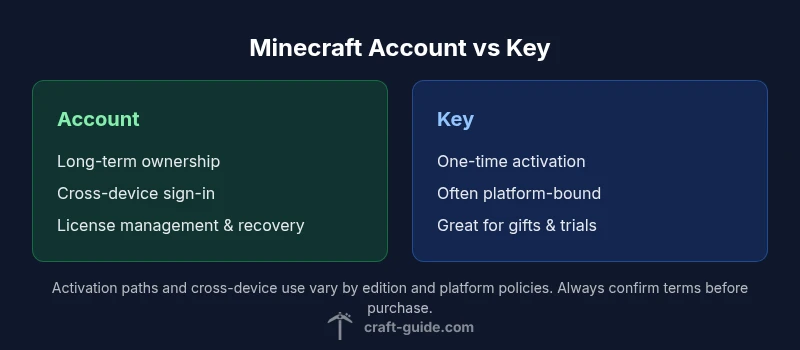
The difference between minecraft account and key is that a Minecraft account is a long-term access credential tied to a user profile (sign-in, ownership, and cross-device play), while a key is a one-time activation code that unlocks the game or a specific edition. In practice, accounts enable ongoing ownership management; keys are transactional and often tied to promotions or gifting.
Understanding what a Minecraft account is
According to Craft Guide, a Minecraft account represents a long-term ownership and access mechanism. It is tied to a user profile, which means you sign in to play across devices, manage purchases, and track licenses over time. The difference between minecraft account and key becomes clear when you consider persistence: accounts remain valid as long as you maintain access to the associated email or login, and they support account recovery options. This section will delineate the core attributes of an account, including how ownership is recorded, how it interacts with the Mojang/Microsoft identity system, and what this means for cross-platform play. In short, an account is a living credential that travels with you as you change devices or upgrade hardware, providing continuity and control that a one-time key cannot offer.
Understanding what a Minecraft key is
A Minecraft key denotes a short-lived activation code used to unlock the game or a specific edition on installation. Keys are typically issued for promotions, gift purchases, or bundled offers and may be single-use or platform-bound. The difference between minecraft account and key becomes evident here: keys do not establish ongoing ownership or identity; they grant access tied to a moment in time or a particular device. For players who rarely switch devices or who buy for others as gifts, a key can be convenient, but it lacks the persistent ownership and management features of an account. Craft Guide’s analysis highlights that keys are excellent for gifting, trial access, or promotions, while accounts are better for long-term engagement and account security.
Ownership, access, and lifecycle
The lifecycle of a Minecraft account is inherently different from that of a key. An account is renewed through ongoing sign-in, password changes, and email verification, creating a durable link to your in-game world and purchases. The difference between minecraft account and key is most pronounced in ownership continuity: with an account, you own the license as long as the account remains valid, and you can migrate or recover ownership if you lose access. A key, by contrast, does not establish a durable owner profile. Its value resides in initial activation and the edition it unlocks. If you lose the key, or if the platform policy changes, your access may be harder to regain without the associated account.
Licensing across editions: Java Edition vs Bedrock
When comparing the licensing models across Minecraft Java Edition and Bedrock Edition, the difference between minecraft account and key becomes a practical concern. Java Edition typically uses a single account for access across supported platforms, while Bedrock may tie ownership to a Microsoft/Xbox account that is used across devices. The activation flow for a key may differ by edition and platform, with keys sometimes required at install time and accounts used for ongoing sign-in and cross-play. This nuance is essential for players who move between Java and Bedrock, or who intend to play on consoles, Windows, and mobile devices. Understanding how licenses map to each edition clarifies what you should buy and how you should manage it.
Activation flow and sign-in: what happens behind the scenes
The activation flow for a key is often a one-time step: you enter the code during installation or purchase, and your platform unlocks the game. The difference between minecraft account and key is evident in the subsequent steps: an account requires you to sign in and verify ownership, which unlocks continued access, updates, and cloud saves. For cross-platform play, you’ll typically use an account to sign in once and then access the game on multiple devices. Keys may not move with you across devices unless the platform supports transferable licenses. This distinction is critical as a practical guide for both new players and seasoned builders.
Transferability and gifting: practical implications
When evaluating transferability, a Minecraft account is generally portable across devices and can be transferred or reclaimed if you regain access through recovery options. The difference between minecraft account and key is visible in gifting scenarios: keys are often used as gifts or promotions, but accounts are easier to gift in a controlled way where the recipient can claim ownership and manage the license. If you are buying for someone else, a key can be a simple one-off gift, whereas transferring an account ensures the recipient retains control and future access. Craft Guide recommends considering who will use the license long-term and whether cross-device play is a priority.
Security, recovery, and account hygiene
Security best practices reinforce the difference between minecraft account and key: accounts benefit from password protection, two-factor authentication, and recovery emails, which reduce the risk of permanent loss. A key has limited protection, as once it’s activated you rely on the platform’s license management for continued access. It is wise to store keys securely until activation and to associate your account with a strong, unique password and recovery options. In practice, choosing an account-based approach usually yields stronger security and easier recovery, especially if you frequently switch devices or platforms.
Costs, licensing implications and value
Pricing for accounts versus keys varies by edition, platform, and sales promotions, but the core distinction remains: an account grants ongoing access and ownership, while a key represents a one-time activation for a specific edition or platform. The difference between minecraft account and key becomes a question of long-term value versus short-term convenience. Accounts typically offer ongoing support, updates, and cross-platform compatibility, while keys may come with limitations such as transfer restrictions or expiry conditions. Craft Guide recommends evaluating your long-term play plans, whether you expect to switch devices, and how much you value lifetime access when deciding between these options.
Migration between accounts and keys: what to expect
Migration paths vary by region, edition, and platform policies. The difference between minecraft account and key becomes a practical factor in migration: accounts can be migrated or recovered with proper verification, while keys may require re-issuance or reactivation via a different mechanism if allowed. Before migrating or gifting licenses, verify platform-specific terms and ensure you have access to the recovery email for the account. This reduces the risk of losing access during license transfers or platform changes.
Edge cases and common misconceptions
A common misunderstanding is assuming a key can be used indefinitely without an account. The difference between minecraft account and key shows that many licenses require an associated account for ongoing use, security, and updates. Another misconception is that keys can always be transferred between users; in practice, transferability is often restricted by platform policies. Always check the terms of service for the edition you’re buying and consider the long-term benefits of an account-based approach for resilience and continuous access.
Practical decision framework for players
To decide between a Minecraft account and a key, start by listing your long-term goals: do you want uninterrupted cross-device play, or is this a one-off purchase for a gift or trial? If long-term ownership and cross-platform access matter, an account-based approach is usually the better choice. If you’re gifting, testing before committing, or purchasing for a friend, a key can be a practical option. Craft Guide recommends mapping your plans to edition compatibility, platform availability, and your ability to manage credentials.
Practical checklist before buying or upgrading
- Clarify which edition you want (Java or Bedrock) and the platform (PC, console, mobile).
- Decide if you need long-term access across devices or a one-time activation.
- Confirm whether a key supports cross-device use or if you’ll need an account for ongoing access.
- Enable account security features (strong password, 2FA) if you choose an account.
- Verify transfer and gifting policies for your chosen option.
- Review refund and promotion terms to avoid locked-in licenses.
- Set up recovery options (email, phone, authenticator) to prevent lockouts.
- Keep activation codes secure until use.
Final takeaway: choosing what fits you best
The difference between minecraft account and key boils down to whether you value long-term ownership and cross-device access or a one-time activation for a gift or trial. For most players seeking stability and ongoing updates, the account path offers clear advantages. If your goal is a simple gift or temporary access, a key can be the leaner route while keeping platform constraints in mind.
Comparison
| Feature | Minecraft Account | Minecraft Key |
|---|---|---|
| Ownership model | Account-based ownership with ongoing sign-in and license management | One-time activation that unlocks access to a game/edition |
| Activation/Sign-in | Sign-in required for continued access; ownership persists with the account | Activation opens access but does not establish a persistent identity |
| Transferability | Generally portable with account migration and platform flexibility | Usually non-transferable after activation or limited by platform policy |
| Edition support | Supports multiple editions through account association | May be tied to a specific edition or require a new key for upgrades |
| Cost and renewal implications | Potential ongoing costs or tied licenses with account management | One-time purchase with possible platform-specific restrictions |
| Best for | Long-term players who value cross-device access and ownership | Gifting, trials, or one-off access on a single platform |
Benefits
- Clear ownership with ongoing access across devices
- Simplified license management through a single account
- Better support for account recovery and security features
- Easier cross-platform play and device changes
Negatives
- Requires remembering login credentials; risk of lockout
- Potential complexity of password or email recovery
- Accounts may be targeted by phishing or credential theft
- Activation keys can be lost or misused if not stored securely
Accounts win for long-term ownership and cross-device access
Choose an account-based setup if you plan to play across devices and want durable ownership. Keys are convenient for gifts or one-off access, but lack the ongoing management benefits of an account.
People Also Ask
What is the core difference between a Minecraft account and a Minecraft key?
A Minecraft account provides long-term ownership and sign-in across devices, while a key is a one-time activation code that unlocks access for a specific edition or platform. The account model supports ongoing updates and cross-platform play, whereas a key focuses on initial access or gifting.
The account gives you ongoing ownership and sign-in across devices, while a key is a one-time code that unlocks the game on a given platform.
Can I use a key to upgrade to an account later?
In most cases, a key by itself does not convert into an account. You would typically need to purchase or claim an account-based license separately. Platform policies vary, so check the terms for your edition.
Keys usually don’t convert into accounts; you often need a separate account license.
Is a Minecraft account required for cross-platform play?
Yes, cross-platform play generally relies on the account being signed in with a stable identity that the platform recognizes. The key may unlock access on one device, but ongoing cross-platform features rely on the account.
Cross-platform play typically requires a signed-in account that the platform recognizes.
Are there regional restrictions on keys vs accounts?
Regional restrictions can affect both keys and accounts, particularly for pricing, edition availability, and transfer policies. Always review the regional terms for the edition you’re buying.
Regional terms can affect both keys and accounts; check local policies.
What should I do if I lose access to my Minecraft account?
Use the recovery options tied to your account (email, phone, authenticator) to regain access. If recovery fails, contact platform support and provide verification details to prove ownership.
Use your recovery options or contact support with proof of ownership.
Can ownership be transferred between accounts?
Transfer policies depend on the platform and edition. Some services allow transferring ownership, while others require the new owner to create a separate account. Review the official terms before attempting a transfer.
Transfers depend on platform terms; check policies before moving licenses.
The Essentials
- Choose account-based access for durable ownership and cross-device play
- Use keys for gifts or short-term access only when appropriate
- Prioritize strong account security (2FA, recovery options)
- Verify edition compatibility and platform policies before buying
- Keep licenses organized to avoid loss of access