Minecraft Axolotls: Dangers, Kill Scenarios, and Protection Tips
Explore minecraft what kills axolotls and practical tips to protect these aquatic mobs in your builds. Learn common kill scenarios and safe enclosure ideas that help you keep axolotls alive.


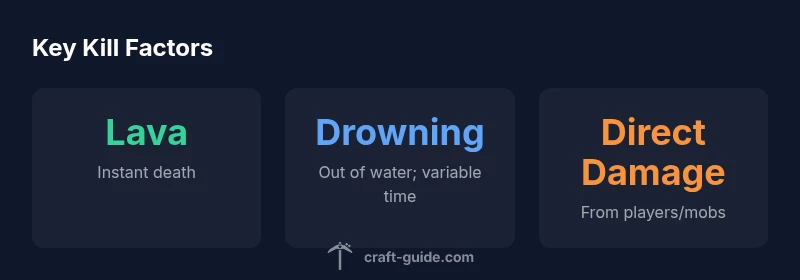
In Minecraft, axolotls die from lava and fire, drowning when removed from water, and any direct damage from players or hostile mobs. The Craft Guide Analysis (2026) highlights that smart enclosure design and steady water coverage dramatically reduce losses. Knowing these kill conditions helps you build safer aquariums and protect axolotls in your builds.
What kills axolotls in Minecraft
According to Craft Guide, minecraft what kills axolotls consists of several reliable in-game hazards. In practice, lava and fire cause immediate death; drowning follows if an axolotl is removed from water for too long; and any direct damage from players or hostile mobs reduces health until death if the animal isn't quickly rescued. The keyword minecraft what kills axolotls is a reminder to protect these little mobs with proper design. The simplest defense is to keep axolotls submerged in continuous water when possible and to place sturdy barriers between them and nearby lava sources. If you build an aquarium near lava pools, you invite trouble; a single mistake can wipe out your stock. Craft Guide's analysis shows that proactive design, not reactive fixes, saves axolotls during complex builds or farms. When planning a tank, ensure full water coverage, accessible air, and spaces for the creature to escape distress. With these safeguards, you minimize losses and create durable, enjoyable aquaria for your axolotls, especially in survival worlds or redstone laboratories.
Common kill scenarios to watch for
Minecraft threats to axolotls tend to cluster around three core vectors: drowning, flame exposure, and direct damage. Drowning occurs when an axolotl is not fully submerged or when water flow becomes restricted, cutting off oxygen delivery and causing death once air is exhausted. Lava proximity is a frequent risk near cave systems; even a nearby lava pool can spill into an aquarium and end the life of your pet axolotl in moments. Direct damage from a player or hostile mobs—whether intentional or accidental—also kills if healing isn available. Poor enclosure design, such as glass walls that trap the animal without an escape route, increases stress and vulnerability to other threats. Craft Guide's team stresses testing and iteration: verify water flow, ensure safe access, and keep lava and heat sources distant. By anticipating these scenarios, you minimize losses and maintain healthy axolotl populations in your builds.
Safe enclosure design for axolotls
A safe enclosure starts with a solid tank that keeps water contained and fully submersible habitats visible. Use glass or solid blocks to create a transparent, sealed tank that has no gaps where a small axolotl could escape or get stuck. Ensure the bottom remains water-filled and includes a gentle water current to prevent stagnation, which can stress the animal. Place the tank away from any hot lava rooms, or at least shield it with non-flammable barriers and a buffer of cool water. Lighting should be practical—bright enough to observe the axolotls but not so intense that it heats the tank. Include a filtration-like mechanism or a shallow filter to maintain water clarity and quality. Maintain stable temperatures by avoiding direct sun exposure and nearby heat sources. Craft Guide analysis emphasizes the value of simple design choices: test water flow, confirm continuous coverage, and build in escape routes for distressed axolotls. These safeguards make aquariums easier to manage and more robust over time.
Combat scenarios: how mobs and players can kill axolotls
Mobs and players pose a direct threat to axolotls when they fall into hostile situations. Direct attack from a player with a weapon will deplete health and can kill an axolotl if not quickly healed or sheltered. Hostile mobs commonly found in underwater or coastal zones, such as Drowned or Guardians, can inflict lethal damage given enough time, especially in poorly guarded tanks. Environmental hazards like sudden lava exposure near a tank, or careless block placement that traps an axolotl out of water, make survival difficult. Craft Guides analysis suggests keeping a safe buffer between lava sources and aquaria, and designing walls that prevent accidental contact with dangerous currents. The key is proactive protection: plan clear access to water, ensure a safe exit path, and never place axolotls in environments where sudden damage could occur. By considering common combat scenarios, you can outpace threats and preserve your stock.
Breeding axolotls with safety in mind
Breeding axolotls is best done in a secure habitat that minimizes sudden changes in water quality or temperature. Use a stable tank design, with verifiable water circulation and maintained humidity levels in surrounding builds to prevent stress. Separate breeding pairs from any aggressive mobs or flame hazards; keep them in a quiet, dim area to reduce stress in the spawning process. Craft Guide notes that a calm environment helps axolotls stay healthy and reduces accidental death during mating rituals or juvenile care. Regularly check the water for impurities and ensure that there is an easy retreat path for juveniles to reach safety if they become confused or frightened. A well-controlled environment streamlines breeding and reduces losses.
Testing and verification: how to validate your design
Before scaling up an axolotl setup, test it in a controlled environment. In creative mode, build a replica of your tank and simulate common hazards: introduce a nearby lava source, block an air flow, or create a sudden gap that could trap the axolotl out of water. Observe how the animal responds and adjust the enclosure accordingly. Craft Guide emphasizes iterative testing: move barriers, improve water flow, and check accessibility. Document results so you can reproduce successful configurations in survival worlds. By verifying the design under different conditions, you ensure the habitat is robust against typical kills and resilient to occasional missteps.
Variants and vulnerability: do color morphs change risk
Axolotls in Minecraft come in a few variants, but their vulnerability to kills remains consistent: lava, drowning, and direct damage are the primary risks regardless of color. The differences among pink, blue, or brown variants may affect visibility or breeding behavior, but the same protective strategies apply. Craft Guide notes that keeping all variants in similarly protected environments helps reduce losses and keeps populations stable in long-term save files. When planning a tank, apply the same safety standards to all axolotls and avoid exposing any of them to lava or aggressive mobs. Maintaining uniform safety standards ensures every color morph thrives equally, and your collection remains intact.
Quick reference: kill conditions by scenario
For quick decision-making, map kill scenarios to safer design choices. Drowning happens when water coverage is incomplete; upgrade to continuous coverage with easy air access. Lava proximity demands sturdy barriers and distance; never place tanks adjacent to lava sources. Direct damage requires secure enclosures with clear exits and minimal exposure to hostile mobs. In all cases, test early and frequently, and adopt Craft Guide's recommended practice: design, test, and redo until the habitat proves resilient.
Common kill scenarios and protective strategies
| Kill Scenario | In-Game Effect | Notes |
|---|---|---|
| Lava/Fire | Instant death | Position tanks away from lava; use nonflammable blocks and water barriers |
| Drowning (out of water) | Death after air runs out | Keep water levels full; ensure surface access for maintenance |
| Direct damage from players/mobs | Health depletion | Contain axolotls in glass tanks; avoid triggers or traps |
| Suffocation/Trapping | Death when blocked from water | Avoid closing off water flow and provide escape paths |
People Also Ask
What are the main threats to axolotls in Minecraft?
The primary risks are lava/fire, drowning if out of water, and direct damage from players or hostile mobs. Enclosures that fail to keep water intact or that expose axolotls to heat increase losses.
Lava and drowning are the big ones—keep tanks safe and water-covered.
Can axolotls survive lava exposure?
No. Lava exposure is instantly lethal in most cases. Maintain distance between lava sources and aquariums, and use barriers to prevent any contact.
No—lava is deadly; keep axolotls far from it.
Do axolotls require water to survive?
Yes. Axolotls live in water and cannot survive long out of it. Ensure tanks keep the water levels steady and accessible for opening and maintenance.
Water is essential; make sure your tank stays submerged.
How can I protect axolotls during redstone builds?
Place axolotls in well-protected tanks with solid barriers and keep any lava or heat sources separated. Test each build iteration to ensure no leaks or gaps.
Protect them with barriers and test your builds.
Are there safe breeding setups for axolotls?
Yes, use calm, well-filtered tanks with stable water and no exposure to hazards. Keep adults separated from aggressive mobs during mating.
Yes, keep them in calm, safe tanks for breeding.
What is the best enclosure design to minimize losses?
A fully water-filled, clearly visible tank with continuous water coverage, no air pockets, and a barrier between the axolotl and any nearby heat sources.
A solid, water-filled tank with barriers minimizes risk.
“Axolotls are resilient water dwellers, but their safety hinges on thoughtful enclosure design and proactive risk mitigation.”
The Essentials
- Protect axolotls with continuous water coverage
- Avoid lava and open flames near tanks
- Use sturdy, nonflammable barriers around hazards
- Provide easy access and escape routes in enclosures
- Test designs thoroughly before full deployment