Is Minecraft Harder Now? A Thorough Comparison of Version Difficulty
Is Minecraft harder now? This analysis examines how recent updates affect survival, combat, and resource gathering, with practical tips for players from beginner to expert. It explores combat changes, world-gen shifts, and progression pacing to help you plan your playstyle and goals in current Minecraft.


Is Minecraft harder now? In short, newer updates have added layers of complexity to combat, exploration, and progression that can feel tougher for newcomers while offering more tools for seasoned players. This quick comparison outlines where the difficulty has shifted, what to watch for in current versions, and how to approach mastering the game without getting overwhelmed.
is minecraft harder now: framing the debate
The question is as much about perception as it is about mechanics. When players ask is minecraft harder now, they are really asking whether recent patches have increased the effort required to survive, progress, and build. This section sets the stage by defining what we mean by 'harder'—not just a higher death rate, but greater demand on resource gathering, planning, and adaptation. For many, the answer depends on playstyle: vanilla survival, hardcore, or a modded setup can each experience different pressures. In crafting this analysis, we also consider how learning curves shift as new features arrive and as players become more adept at using the game's tools. According to Craft Guide, perceptions of difficulty evolve with experience and with how a player leverages new mechanics rather than simply with patch numbers.
is minecraft harder now: the essential axes of difficulty
To compare versions fairly, we must agree on the axes that define difficulty: combat complexity, exploration risk, resource pacing, and learning curves. Combat in recent releases emphasizes timing, spacing, shields, and weapon handling, which can elevate the bar for new players but reward skilled veterans. Exploration now often involves denser biomes and deeper cave networks, raising hazards and travel costs. Resource pacing has grown more nuanced, with early game pressure balancing late-game momentum. Finally, the learning curve has become more about mastering systems—enchants, blocks, and mechanics—rather than memorizing a few tricks. This section clarifies how these axes shift from older builds to the current landscape.
Combat evolution and its impact on difficulty
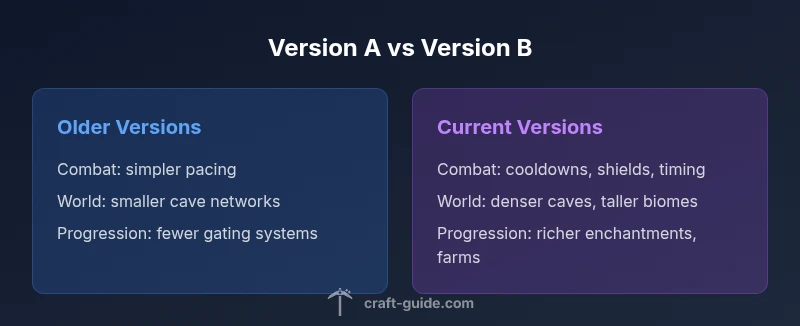
The combat system has evolved across updates, moving away from a purely instant-hit paradigm toward a more deliberate timing model. The introduction of cooldown mechanics, shields, and weapon endurance changes how players approach fights. Enemies have gained more diverse abilities and attack patterns, requiring situational awareness and planning. For new players, this can feel like a steeper learning curve, while experienced players gain deeper opportunities for strategy and defense. The practical effect is that skill, rather than brute haste, becomes a more reliable path to success in combat encounters.
World generation changes and exploration risk
World generation has also shifted in meaningful ways. Taller mountains, expansive caves, and an expanded vertical range make exploration riskier and more rewarding in equal measure. The density and variety of biomes affect travel routes, base placement, and resource discovery. While the expansion creates richer exploration, it also increases the likelihood of dangerous encounters, navigation challenges, and hunger for longer expeditions. Players who plan meticulously—carrying maps, torches, and escape routes—tend to handle these changes more effectively than those who sprint into unknown terrain.
Resource pacing and early-game pressure
Resource pacing in current versions rewards careful planning. Early-game gathering can be slower due to higher risk in hostile environments and more complex mob behavior. As players progress, new materials, enchanting options, and equipment upgrades create more meaningful milestones. The shift in pacing also affects base-building; more advanced farms, automation, and defense strategies demand time and organization. Conceptually, this means early survival is more about safe enclosure and resource efficiency, while late-game progression requires orchestration of multi-step workflows and planning.
Hardcore mode and permadeath: extreme scenarios
Hardcore mode remains a separate, unforgiving path where permadeath heightens every decision. In modern updates, the emotional weight of mistakes increases because players have fewer opportunities to recover from catastrophic losses. This mode exposes the true test of skill and preparation, compelling players to master safety nets like respawn anchors, secure bases, and emergency escape plans. The presence of hardcore options alongside evolving vanilla mechanics helps illuminate how difficulty is experienced differently depending on chosen rules and risk tolerance.
New players: learning curve in modern Minecraft
For newcomers, the modern Minecraft landscape can feel overwhelming due to the breadth of systems and options. The best approach is a structured learning path: start with a contained, safe base, focus on core mechanics (mining, farming, and lighting), and gradually add complexity (enchantments, potions, and redstone basics). Tutorial-friendly resources, starter challenges, and incremental goals reduce intimidation. Consistency matters: regular practice with simple tasks builds confidence and reduces the fear of dying or failing a build.
Mods, data packs, and the long tail of difficulty
Mods and data packs offer a way to tailor difficulty, either by dialing up challenge with hardcore-like tweaks or by smoothing the learning curve with quality-of-life improvements. The choice to mod reflects player preference and server rules. For many players, mods can temporarily increase difficulty through harder mobs or more complex recipes, while data packs can simplify mechanics or adjust resource gating. The result is a customizable spectrum rather than a fixed bar for difficulty.
Settings, seeds, and world options you control
A critical factor in perceived difficulty is player-selected settings and world seeds. Difficulty sliders, game rules (like mobGriefing, mob spawning limits), and seed-generated terrain influence how safe or risky a world feels. Understanding seed behavior and default game rules helps you tune the challenge to your preference. Savvy players experiment with seeds that yield different biomes and cave structures, then adapt strategies to the opportunities and hazards those seeds present.
Practical strategies: surviving current versions
- Establish a secure base with lighting and farms to reduce random mob spawns and food stress. 2) Prioritize early armor and weapon upgrades, then plan a clear mining route to access essential ores. 3) Use maps and markers to prevent wandering into dangerous biomes without a plan. 4) Practice combat timing against common mobs, and reserve shields for heavy hits. 5) If exploring new biomes, go with a buddy or set a safe return beacon. 6) Consider mods or data packs if you want to balance challenge with accessibility. These strategies reflect practical, real-world advice for navigating modern Minecraft’s difficulty landscape.
Summary of key changes across major updates
Across major updates, the game has moved toward more complex combat, richer world-gen, and deeper progression systems. Players consistently report that mastery comes from combining planning, resource management, and tactical combat rather than pure reaction speed. This section recaps how updates influence the core activities—exploration, farming, building, and combat—without prescribing a single path to success. The aim is to help players tailor their approach to their preferred playstyle and goals.
Craft Guide’s verdict and practical takeaways
The Craft Guide Team endorses a nuanced view: Minecraft’s current difficulty landscape rewards deliberate practice and thoughtful planning. While some updates raise the baseline challenge, they also expand the toolkit available to players for managing risk, optimizing resources, and automating tasks. The key takeaway is to identify your playstyle, set achievable goals, and adjust settings or mods to balance challenge with enjoyment. Craft Guide’s verdict is that informed preparation and flexible strategies make today’s Minecraft accessible to beginners while still offering meaningful challenge for veterans.
Comparison
| Feature | Older Minecraft versions | Current Minecraft versions |
|---|---|---|
| Combat mechanics | Instant, timing-agnostic melee, simple defenses | Cooldown-based combat with shields, timing, and advanced weapon behaviors |
| World height and terrain | Limited vertical range, simpler cave systems | Expanded vertical range, denser, more complex caves and biomes |
| Mob balance and AI | Basic mob behavior, fewer variants | Richer mob repertoire, smarter AI, more varied encounters |
| Resource pacing | Faster resource flow early, simpler progression | More nuanced pacing with multi-step upgrades |
| Exploration risk | Lower risk in early exploration | Higher risk but richer rewards in exploration |
| Hardcore/Death penalties | No hardcore mode by default | Hardcore mode with permadeath as a distinct option |
| Modding and customization | Limited official customization | Wide-ranging mods and data packs for difficulty tuning |
Benefits
- Provides a structured, version-aware view of difficulty
- Helps players set goals and tailor playstyle
- Highlights practical strategies for both new and veteran players
- Supports decision-making for vanilla vs. modded play
Negatives
- Subjective, depends on playstyle and world generation
- Can generalize across patches and ignore seed-specific differences
- Requires up-to-date patch knowledge to stay accurate
- May overwhelm beginners with terminology and systems
Current Minecraft is not uniformly harder; it is more complex and variable by playstyle
New updates introduce deeper systems and richer challenges, especially in combat and exploration. Players who adapt with planning, practice, and the right settings can still enjoy a manageable experience. Craft Guide’s take is that awareness of this complexity, plus goal-focused play, helps players thrive.
People Also Ask
Has Minecraft become harder recently?
Updates have intensified certain aspects like combat pacing, exploration risk, and progression pacing. The degree of difficulty depends on playstyle, seeds, and whether you enable hardcore rules. New players may feel steeper learning curves, while seasoned players can leverage deeper systems for efficiency.
Updates have increased some challenges, especially in combat and exploration, but you can adjust by choosing a suitable playstyle.
Which updates increased difficulty the most?
Major updates that rebalanced combat, expanded world generation, and added new mobs tend to raise the baseline difficulty, particularly for new players and in hardcore mode. The exact impact varies by seed and game settings.
Combat rebalancing and new world features tend to push difficulty up, especially for newcomers.
Is survival harder than hardcore in modern Minecraft?
In survival, you have respawns and more forgiving rules, while hardcore imposes permanent death. Modern updates often make hardcore feel meaningfully harder due to risk and fewer chances to recover from mistakes.
Hardcore is consistently tougher due to permadeath, but survival can be challenging depending on world setup.
Do mods make the game easier or harder?
Mods and data packs can either raise or lower difficulty. They can automate tasks, adjust enemy behavior, or simplify mechanics, so choose mods that match your preferred challenge level.
Mods let you tailor difficulty to your taste, from easier gameplay to stricter survival rules.
What are practical tips for new players today?
Start with a small, safe base, learn mining basics, and upgrade armor early. Use maps, lighting, and farming to reduce risk, and don't overextend exploration until you’re confident.
Begin with a simple base and steady goals to build confidence quickly.
Does platform or seed affect difficulty?
Difficulty is influenced by the world seed and game rules rather than platform. Seeds can create more or fewer hazards, while platform differences are generally minor if you play vanilla. Adjust settings to fit your comfort level.
Seed choice can change how hard the world feels, but platform differences are usually small in vanilla.
The Essentials
- Define what 'harder' means in your playstyle
- New updates add complexity to combat and exploration
- Hardcore mode remains the ultimate test of skill
- Mods and data packs can tune difficulty to taste
- Plan, practice, and adjust settings for success