How to Breed Villagers in Minecraft: A Step-by-Step Guide
Learn practical, step-by-step methods to breed villagers in Minecraft, from prerequisites to scalable village growth in 2026. Craft Guide explains safe setups, foods, and trading opportunities.


Breeding villagers in Minecraft requires two willing adults, access to beds, and a food supply to trigger willingness. Set up a safe enclosure with enough beds, feed villagers with bread or vegetables to trigger willing hearts, and monitor for a baby villager. Repeat steps to grow your village safely over time.
Understanding Villager Breeding in Minecraft
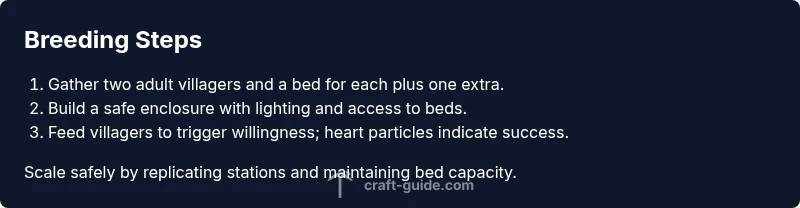
If you want to know how to breed villagers on minecraft, start with the basics: two adult villagers, beds for every villager plus at least one extra, and a steady supply of food to trigger willingness. According to Craft Guide, breeding success hinges on providing safe space and predictable food rewards so villagers will seek each other's company. When two adults are willing and have access to beds, they will produce a baby villager and begin a chain reaction that can grow your village. This guide explains core mechanics, signals like heart particles, and how to manage expectations while you troubleshoot common issues such as insufficient beds or overcrowding. By mastering these fundamentals, you can grow a thriving settlement in 2026 and beyond.
Prerequisites: Beds, Villagers, and Food
Before you start breeding, gather two adult villagers and ensure there are enough beds for all villagers, including future babies. Provide a steady food supply such as bread or carrots to make villagers willing, and prepare a safe enclosure that mobs cannot reach. Optional job blocks can keep villagers busy, but they aren’t required for breeding. Ensure you have a clear plan for expansion, including space for new beds and safe growth, so you can scale your village gradually as you play through 2026.
Setting Up a Safe Breeding Enclosure
Create a dedicated breeding area that is secure from mobs and easy to navigate. Use fences and gates to control access, and place beds in an accessible pattern so both villagers can reach sleeping spots. Lighting with torches or lanterns prevents hostile mobs from spawning nearby, and a short perimeter wall helps reduce wandering. The layout should allow two adults to reach both beds and each other without obstruction, while leaving room for babies to grow without overcrowding.
Feeding and Willingness: Triggering Breeding
To trigger breeding, supply food that makes villagers willing. Bread and vegetable items like carrots, potatoes, or beetroots work, with the game recognizing multiple consumptions over time. Feed each adult villager to raise their willingness meter and encourage them to pair up; Heart particles indicate success, and the pair will begin the process of producing a baby villager once conditions are met. Keep a calm pace—overcrowding or lack of beds can block breeding, so adjust your enclosure and food stock as needed.
Handling the Newborn: Beds, Growth, and Housing
When a baby villager spawns, ensure there is a dedicated bed for the child and a smooth path to access the adult area as the baby grows. Babies require time to mature into adults, during which you should maintain adequate lighting, food, and protection from mobs. It’s helpful to zone off the baby area to avoid accidental escapes or injuries, and to plan for future expansions by preparing additional beds and space nearby.
Scaling Up: Multiple Breeding Stations
Once your first breeding setup works reliably, replicate the system in multiple stations to increase population growth. Each station should have its own beds and food supply, with spacing that prevents babies from wandering into other groups. Use consistent design language across stations to simplify management, monitor bed occupancy, and prevent overcrowding. As you scale, consider trading halls to turn new villagers into valuable asset pools for emerald farming and better gear.
Common Pitfalls and How to Avoid Them
Common issues include insufficient beds, overcrowding, and mobs invading the breeding area. Verify there are enough beds for the current population plus potential babies before starting, and ensure the enclosure is fully protected with adequate lighting. Avoid closing off access or creating bottlenecks where villagers can’t reach beds or each other. Regularly patrol the area to prevent zombies from harming or converting villagers, especially at night.
Breeding for Trades: Jobs and Villager Roles
Villager breeding is most effective when tied to practical trading outcomes. After babies mature, workers assigned to job blocks can offer a range of trades—protecting your population while expanding your resource options. If you want more specialized traders, set up separate rooms with respective job blocks and ensure villagers have access to both beds and workstations. Balanced growth plus smart trading moves can make your village sustainable in survival playthroughs.
Quick Troubleshooting Checklist
If breeding stalls, recheck bed availability and ensure villagers are adults with access to beds and food. Inspect for lighting issues or nearby mobs that may disrupt growth. If heart particles aren’t appearing, refeed the villagers and verify they are not in love mode previously or blocked by another villager. When a newborn appears, ensure it has a bed and a clear path to grow into an adult.
Tools & Materials
- Beds(At least one bed per adult villager plus one extra for the baby; beds must be claimable by villagers.)
- Bread(Primary food to trigger willingness; you can also use carrots, potatoes, or beetroots.)
- Carrots(Alternative food to move villagers toward breeding; store in bulk.)
- Fencing and Gates(Build a secure enclosure to keep villagers safe from mobs.)
- Building Blocks(Solid blocks to construct walls, beds, and safe platforms.)
- Torches(Ensure proper lighting to prevent hostile mobs from spawning nearby.)
Steps
Estimated time: 15-30 minutes
- 1
Identify two adult villagers
Locate two adult villagers that are not currently babies or pathing to workstations. Confirm they are adults by their behavior, not by any events from other villagers. This step ensures you have a ready pair to begin breeding.
Tip: Look for villagers who aren’t stuck on workstations and who show stable paths toward each other. - 2
Set up a safe breeding area
Design a compact, sheltered zone with clear access to beds and a safe route for villagers. Add torches for light and a door or gate for easy entry and exit. A well-planned enclosure reduces mob threats while breeding happens.
Tip: Place beds in a symmetrical layout to minimize pathfinding confusion. - 3
Place beds and ensure accessibility
Install beds with free space around them for villagers to reach and use. Confirm that there are more beds than the current population to accommodate babies. Accessibility is key for breeding to continue smoothly.
Tip: Avoid placing beds behind barriers that villagers cannot pass through. - 4
Feed villagers to trigger willingness
Offer bread or vegetables to each adult villager to raise their willingness meter. Watch for heart particles that indicate they are ready to breed. Keep the feeding consistent until two villagers start showing compatibility.
Tip: Feed in small, repeated batches to avoid wasting resources. - 5
Wait for breeding to occur
If conditions are right, the villagers will move toward each other and produce a baby villager. If heart particles don’t appear, reassess bed access and feeding levels. Patience is part of successful breeding.
Tip: Ensure there is no single mob that disrupts the mating area during the process. - 6
Care for the newborn
Give the baby villager a bed and ensure a safe path to the adult area when it grows. Keep the baby area protected and well-lit to prevent wandering into danger. You can move babies later if you need more space for ongoing breeding.
Tip: Separate the baby once grown to adulthood to manage population growth. - 7
Scale your operation
Replicate the setup to multiple breeding stations to increase population growth. Maintain consistent bed count, food supply, and protection across stations to keep breeding efficient.
Tip: Use identical layouts for each station to simplify management. - 8
Maintain safety and order
Regularly patrol breeding areas for mobs and ensure lighting remains strong at night. Update fences and gates as you expand. A stable, safe environment reduces loss and keeps villagers productive.
Tip: Set automated lighting checks to ensure no dark spots.
People Also Ask
What do I need to start breeding villagers?
You need two adult villagers, beds, and a food supply to trigger willingness. Build a safe enclosure to keep them secure.
You need two adult villagers, beds, and food to trigger breeding. Build a safe space to keep them safe.
Do beds matter for breeding in all versions?
Yes, beds are required to spawn babies; each breeding pair must have access to beds for the process to complete.
Beds are essential for breeding in all main versions.
One bed enough to start breeding?
No. You need enough beds for all adults and the newborn, otherwise breeding will stall.
One bed isn't enough; you need beds for everyone plus space for a baby.
How long does a baby villager take to grow up?
Babies mature over in-game time. Growth occurs gradually, and adults will take longer to appear depending on game progression and conditions.
Babies grow up over time in the game; you’ll see them become adults eventually.
Can I breed villagers on Peaceful difficulty?
Yes, breeding can occur on Peaceful, but you still need beds and a food supply while managing safe housing.
Breeding can happen on Peaceful as long as beds and food are provided.
How can I optimize breeding for trading?
Breed to increase the number of villagers, then assign job blocks to diversify trades. A well-managed population yields better emerald farming.
Increase villagers, assign jobs, and trade smartly for growth.
Watch Video
The Essentials
- Prepare a bed-rich enclosure before breeding
- Feed villagers to trigger willingness
- Monitor bed count to accommodate babies
- Scale gradually to maintain resource balance
- Protect villagers from mobs and disasters