T Flip-Flop in Minecraft: A Practical Redstone Guide
Learn how to build a reliable t flip-flop in Minecraft using redstone. This educational guide covers wiring, timing, testing, and version considerations to create compact memory elements in your builds.


By the end, you will be able to build a functional t flip-flop in Minecraft using redstone, with a clear wiring diagram, required materials, and tested steps. The guide covers timing considerations, common pitfalls, and practical checks to ensure reliable memory behavior in most Minecraft editions. Follow the steps closely, and you can adapt the circuit for compact builds, clocks, and automations.
Why t flip flop matters in Minecraft
Memory elements are the backbone of automated redstone systems. A t flip-flop stores a single bit of state and toggles that bit each time it receives a pulse, enabling counters, clocks, doors, and multi-step automations to run without resetting manually. In compact bases, a well-made t flip-flop saves space and reduces the risk of glitches caused by uneven wire lengths or clock jitter. For players aiming to create repeatable puzzles, door guards, or item sorters, a reliable t flip-flop is a must-have building block. In this context, the term "t flip flop minecraft" is widely used, but the real skill lies in translating the concept into solid redstone wiring that works across editions and worlds. This section explains why a t flip-flop matters and how it fits into larger circuits. We cover the basic logic—input, latch, and output—and set the stage for practical construction, testing, and refinement. The goal is to help you recognize when a t flip-flop is the right tool and how to customize it for your own builds, from simple clocks to more complex state machines. According to Craft Guide, understanding toggle behavior and stable latch wiring is the difference between a flashy idea and a dependable mechanism, making this topic essential for any redstone enthusiast.
In most setups, a t flip-flop minecraft serves as a compact memory element that remembers a single state and toggles this state with each pulse. This capability is invaluable for automating doors, lighting sequences, or step-by-step puzzles. As you progress, you’ll learn how to adapt the design to your planet-sized base or a small dungeon corridor while keeping timing predictable, even if you switch between Java and Bedrock editions.
note”:null},
Tools & Materials
- solid building blocks(Assorted blocks for laying out the circuit; at least 20–40 blocks for the initial test layout)
- redstone dust(Plenty of dust to connect input, latch, and output; estimate 32 blocks)
- redstone torch(At least 2–4 torches for the latch network and input control)
- redstone repeater(1–2 repeaters to control timing and pulse width)
- input device (lever or button)(One input to toggle the state; keep it accessible)
- piston or sticky piston(Optional for extended designs or compact layouts)
- slabs or transparent blocks(Helpful for clean wiring and spacing)
Steps
Estimated time: 60-90 minutes
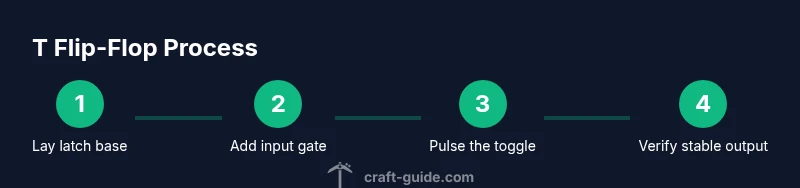
- 1
Lay out the latch framework
Place two solid blocks to hold the cross-coupled gates. Ensure space to route redstone from both sides without crossing awkwardly. This forms the basic RS-latch that will hold the memory state.
Tip: Use spacing gaps to prevent accidental short circuits when wiring the next gates. - 2
Build the cross-coupled gates
Create the latch with two inverters using redstone torches and blocks, arranged so each output feeds the other’s input. This cross-coupled arrangement stores the state and toggles when the input pulse arrives.
Tip: Double-check that outputs are feeding into the opposite side to avoid a stuck state. - 3
Add the T input and clock
Connect the input toggle to a clock-like pulse feed using redstone dust and a repeater. The clock should deliver a short, clean pulse to toggle the latch without creating long delays.
Tip: Keep the clock pulse brief to avoid multi-tap toggling. - 4
Wire the output
Run redstone from the latch output to your desired mechanism (door, light, piston, etc.). Add a clean, unbroken path so the output reads reliably across load conditions.
Tip: Test with multiple pulses to ensure consistent reads. - 5
Test the circuit with pulses
Activate the input several times in quick succession and observe the stored state toggling as expected. Confirm the output reflects the current state after each pulse.
Tip: Record a short pulse pattern to verify repeatability. - 6
Debug and refine
If the state sticks or toggles unexpectedly, check for stray dust, length mismatches, or missed cross-links. Adjust spacing or add another repeater to normalize timing.
Tip: Consistency beats speed; aim for predictable toggling rather than maximal clock speed.
People Also Ask
What is a t flip-flop in Minecraft?
A t flip-flop stores a single bit of state in Minecraft using redstone. It toggles its output on each input pulse, letting you build clocks, counters, and memory for automation. This design relies on a stable latch and careful timing to avoid glitches.
A t flip-flop stores one bit and toggles on each pulse, enabling memory in redstone projects.
Can I use a t flip-flop in Java Edition and Bedrock Edition?
Yes. The fundamental behavior is the same across editions, but timing and block behavior can differ slightly. Plan for version-specific testing and adjust repeater delays as needed.
Yes, but test and adjust delays for your edition.
How is a t flip-flop different from a basic RS latch?
An RS latch stores a state, while a t flip-flop toggles its state each time it receives a pulse. The t flip-flop adds the input-driven toggle behavior on top of the latch mechanism.
An RS latch holds a state; a t flip-flop toggles that state with a pulse.
What are common timing errors and how can I fix them?
Common issues include pulse lengths that are too long or too short, causing multiple toggles or no change. Fix by adjusting repeater delays and shortening the input pulse, ensuring clean, single toggles.
Mostly due to pulse length. Tweak the clock delays to get clean toggles.
What versions support this design well?
The concept works across major editions, but you may need to adapt the wiring slightly for different redstone mechanics. Start with a test build in your target version.
Works across editions with possible wiring tweaks; test first.
Do I need a clock to run a t flip-flop?
A short pulse input drives the toggle, which can be generated by a small clock or simply a momentary button press followed by a pulse-drawing circuit. A dedicated clock often gives more reliable timing.
A short input pulse is enough; a clock makes timing more reliable.
Watch Video
The Essentials
- Master a compact t flip-flop to add memory to redstone builds
- Use a clean latch plus a controlled input pulse for reliability
- Test pulses thoroughly to avoid state glitches
- Adapt timing to your Minecraft edition for consistent results
- Document your designs for future edits and sharing