Difference Between Minecraft and Block Party: A Practical Side-by-Side Guide
A detailed, objective comparison of Minecraft and Block Party, covering gameplay, scope, modding, and multiplayer dynamics to help players choose where to invest their time and effort.


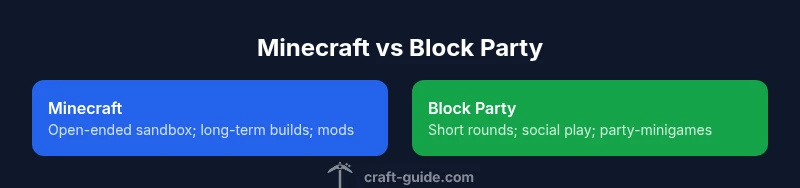
Minecraft is a broad sandbox with survival and creative modes that invites long-term world building, exploration, and farming. Block Party, by contrast, is a fast-paced multiplayer mini-game focused on jumping, rounds, and social competition on servers. Understanding the difference between minecraft and block party helps players decide where to invest time, especially for newcomers. This quick comparison highlights core concepts, accessibility, and social dynamics.
Context and Definitions
According to Craft Guide, the difference between minecraft and block party hinges on scope, pace, and intent. Minecraft is a broad, open-ended sandbox where players build, explore, and adapt to survival or creative rules. Block Party represents a class of party-style mini-games hosted on multiplayer servers, emphasizing short rounds, button presses, jumping puzzles, and rapid social interaction. In practice, many players experience both styles: they design sprawling worlds in Creative or Survival, then jump into Block Party sessions to enjoy quick, competitive moments with friends. This section clarifies terminology and sets expectations for the deeper analysis that follows. For newcomers, the core distinction is that Minecraft rewards long-term projects, while Block Party rewards fast decision-making and teamwork in repeated rounds.
Core Gameplay Differences
At the core, Minecraft offers an expansive canvas: you gather resources, craft tools, and shape environments over time. The game can be played solo or cooperatively with extended goals, such as building replicas, exploring biomes, or surviving hostile environments. Block Party reframes that canvas as a sequence of challenges: rounds test timing, problem-solving, and collaboration. Players race, jump, or compete in mini-games with immediate feedback and rewards. The contrast is not merely about pace; it’s about experience design. If Minecraft emphasizes enduring projects and world-building, Block Party foregrounds interaction, speed, and round-by-round accomplishment. For players who love both, the blend is common—creative builds punctuated by social, quick-play sessions.
Scope, Progression, and End Goals
Minecraft is designed for long horizons. Progression spans hours, days, or even months as you level up skills, acquire resources, and unlock new technologies. In contrast, Block Party operates on short cycles: you join a lobby, play a round, and receive immediate feedback such as a win, a loss, or a milestone on a leaderboard. The end goals differ accordingly: one favors accumulation and mastery across a world, the other prioritizes momentum, coordination, and social validation in compact sessions. This distinction matters for players who want supplementary learning experiences or want to manage time efficiently across several playstyles.
Modding and Customization
Minecraft shines in customization. The ecosystem includes mods, resource packs, and data-driven world alterations that can redefine physics, lighting, mobs, and even core systems. Modding enables players to create entirely new experiences within the same engine. Block Party’s customization lives mainly on the server side: maps, rules, and matchmaking define what rounds look like, while the underlying game remains the same. Some servers support plugins or custom minigames, but the scope is generally narrower than full-scale modding in Minecraft. For many players, this means richer creative output in Minecraft and richer social variety in Block Party—each platform leverages its strengths.
Multiplayer and Community Dynamics
Minecraft’s multiplayer audience is vast and diverse, spanning educational programs, roleplay communities, speedrunning, and modding circles. Block Party typically centers on social play on servers, with friend groups forming the core community and repeated sessions building social bonds. Craft Guide analysis shows that Minecraft’s ecosystem generates a wide range of resources—seed maps, skins, and tutorials—while Block Party communities tend to emphasize quick coordination, team strategies, and event-driven gameplay. Both ecosystems thrive on collaborative play, but they cultivate different social rhythms: patient collaboration on big builds versus dynamic, ephemeral rounds with friends.
Learning Curve and Accessibility
For beginners, Block Party can be easier to pick up: rounds are short, mechanics are straightforward, and success feels immediate. Minecraft’s breadth can feel overwhelming at first—crafting recipes, managing hunger, mining, and navigating biomes require time to learn. The learning curve thus splits: Minecraft rewards patience and experimentation; Block Party rewards quick learning, teamwork, and map familiarity. If your goal is to ramp up slowly, you might start with Creative or Survival in Minecraft, then blend in Block Party to build social game fluency. For families and classrooms, Block Party can offer an approachable entry point that still engages basic problem-solving and teamwork.
Visual Aesthetics and Performance
Visuals in Minecraft are iconic and modular: block-based aesthetics are their own design language, and performance depends on world complexity and the presence of mods. Block Party visuals vary only as much as the server’s maps and the round’s design allow; performance is often influenced by multiple shorter sessions rather than a single large world. This means players can experience crisp performance across a wider range of hardware in Block Party than in heavily modded Minecraft worlds. Conversely, Minecraft can become visually richer and more immersive when you leverage resource packs and shaders, at the cost of higher hardware requirements.
Use Cases and Player Personas
If you are a builder, redstone tinkerer, or educator who wants to create sprawling, persistent worlds, Minecraft is the natural fit. If your group wants casual, social gaming with friends—short rounds, chatting, and coordinated jumps—Block Party is ideal. Some players board both experiences: they use Minecraft for deep projects and Block Party for social breaks. The choice often comes down to time availability, social preferences, and whether you value long-term progression over episodic gameplay. In mixed-gaming households, a routine that alternates between the two can keep players engaged and motivated.
Potential Pitfalls and Misconceptions
One common misunderstanding is that Block Party is simply a minor variation of Minecraft rather than a distinct playstyle on top of the same engine. Another pitfall is assuming Block Party provides the same depth as a full Minecraft world; it’s superb for social sessions but lacks the ongoing, emergent storytelling that large Minecraft builds can deliver. Conversely, some players assume Minecraft cannot be fun in short bursts—yet many enjoy micro-sessions of creative troubleshooting, quick redstone challenges, or server mini-games between longer builds. Recognizing that both experiences serve different appetites helps you set expectations and avoid burnout.
Practical Pathways: How to Start Exploring Both
- Set up Minecraft in Creative or Survival mode to begin a one-to-one comparison with Block Party. Practice basic building, then gradually add resource packs or mods if you want enhanced visuals or new mechanics.
- Find 1-2 servers offering Block Party minigames and dedicate 20–30 minutes to each session. Observe how rounds flow, how teams coordinate, and how you respond to changing maps.
- Create a simple schedule that intertwines long-form builds with short, social rounds. Track what you enjoy most and adjust your playtime to balance creativity and social engagement.
- Use world seeds, starter maps, and community guides to get up to speed quickly in Minecraft while collecting quick tips for Block Party from bracketed communities.
Comparison
| Feature | Minecraft | Block Party |
|---|---|---|
| Gameplay Core | Open-ended sandbox with survival and creative modes | Short, rounds-based party minigames on multiplayer servers |
| Platform Availability | Cross-platform on PC, consoles, and mobile (Java/Bedrock) | Accessible on most server networks; varies by edition |
| Modding & Customization | Extensive modding and custom resource packs | Limited customization; relies on server maps and rules |
| Progression & Rewards | Long-term progression, crafting, and exploration | Short-term rounds, leaderboards, and immediate rewards |
| Learning Curve | Steep at first due to breadth of features | Lower entry barrier for new players, quick round familiarity |
| Community & Content | Massive ecosystem of guides, mods, seeds, and skins | Tighter, social communities around specific minigames |
| Performance & Hardware | Variable; world size and mods impact requirements | Generally light per round; depends on server hosting and map size |
| Best For | Players seeking limitless creativity and long projects | Players who want quick, social sessions with friends |
Benefits
- Massive creative potential and modding ecosystem
- Quick, social gameplay in short sessions
- Strong community resources and guides
- Cross-platform availability across editions
Negatives
- Steep learning curve for complex survival and modding
- Block Party's replay value depends on server rotation and matchmaking
- Performance can vary with large worlds or many mods
- Limited long-term progression in most party minigames
Minecraft offers deep, long-term creativity; Block Party delivers fast, social rounds.
For creators, Minecraft wins due to expansive building and modding options. For friends seeking quick, casual competition, Block Party shines. The Craft Guide team recommends trying both to match your goals, starting with Minecraft if you want lasting projects.
People Also Ask
What is the main difference between Minecraft and Block Party?
Minecraft is a broad sandbox focused on long-term builds, exploration, and modding. Block Party is a party-style mini-game focused on quick rounds, competition, and social play on servers. The difference lies in scope, pace, and intended gameplay experience.
Minecraft offers vast, ongoing projects, while Block Party delivers quick, social rounds.
Is Block Party official Minecraft?
Block Party is not an official standalone product from Mojang. It is a mini-game concept commonly found on multiplayer servers within the Minecraft ecosystem.
Block Party is a server-based mini-game, not an official Minecraft product.
Which one is easier for beginners?
Block Party tends to be easier to pick up due to short rounds and straightforward objectives. Minecraft has a steeper learning curve, but it becomes highly rewarding with time and exploration.
Block Party is usually easier to start; Minecraft offers deeper skills over time.
Can you play Block Party without mods?
Yes. Block Party rounds can be enjoyed without mods since it’s server-based. Mod usage is not a requirement for the core game.
Block Party doesn’t require mods to play; mods are optional enhancements for Minecraft.
How should I decide which to play?
If you crave long-term building and customization, choose Minecraft. If you want quick, social sessions with friends, start with Block Party and rotate as needed.
Think about your goals: creativity and growth vs. social, fast rounds.
The Essentials
- Start with Minecraft for expansive creativity and modding
- Sample Block Party for social, quick-play sessions
- Balance time between long-form builds and short rounds
- Utilize community resources to accelerate learning