What Minecraft Client Wemmbu Uses
Explore what wemmbu uses for their Minecraft client, how analysts assess public signals, and practical guidance for choosing a client that fits your setup. Learn about Forge, Fabric, Lunar Client, and vanilla configs with data-driven insights from Craft Guide.


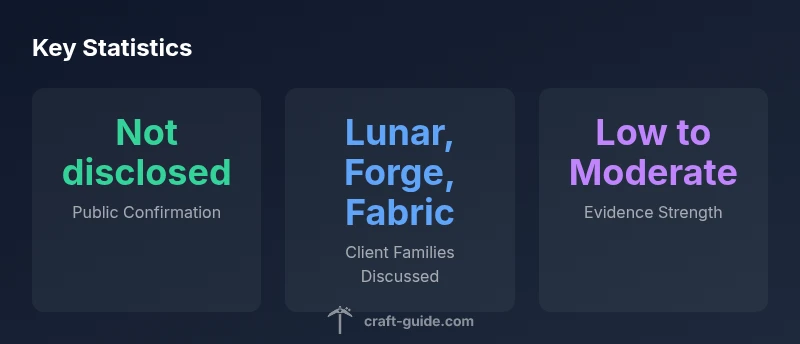
There is no confirmed public statement about Wemmbu's Minecraft client. According to Craft Guide analysis of public streams and videos, Wemmbu appears to run a modded client with performance tweaks, but no official disclosure is available. The most discussed possibilities include Lunar Client, Forge-based setups, and Fabric configurations. Keep in mind that creators often customize tools for streaming and recording, so the visible client may not reflect their full environment.
What the question means for Wemmbu's setup
In practice, the question what minecraft client does wemmbu use is tricky because creators rarely disclose exact client configurations. Public signals—such as on-stream overlays, chat commands, and mods lists shown in videos—offer clues but are easily misinterpreted. As with many Minecraft creators, Wemmbu may customize tools for streaming, recording, and plugin testing, which can look like a fixed setup but actually vary by session or project. Craft Guide's analysis, based on publicly available footage and metadata, finds no definitive disclosure from Wemmbu or their team. The absence of a formal announcement means any assertion should be treated as speculative rather than definitive. This section lays out the landscape and how to interpret visible indicators without overclaiming what is not proven. Readers should consider the broader ecosystem of client options and how popular choices align with performance, compatibility, and comfort.
Interpreting signals: what to look for and what to ignore
When evaluating whether a creator uses a particular client, look for concrete, repeatable signals rather than one-off appearances. Visible overlays, version numbers in video descriptions, and explicit mod loader names (for example, a launcher badge) are stronger indicators than casual comments. However, overlays and edits can be manipulated, and creators may test multiple configurations across projects. Treat any claim as a hypothesis to be tested against observable evidence, not a definitive truth. Cross-reference what you observe across several videos, streams, and behind-the-scenes notes to build a more balanced view. Craft Guide emphasizes caution: correlation is not causation, and many factors influence on-screen appearance beyond the chosen client.
The major Minecraft client families: Forge, Fabric, Lunar Client, and vanilla plus mods
Forge-based setups have long been a staple for extensive mod lists and compatibility testing. Fabric is leaner, with a focus on performance and rapid mod iteration. Lunar Client combines built-in optimizations, client-side mods, and a curated experience that some creators favor for consistency. Vanilla Minecraft, augmented with performance-oriented mods or resource packs, remains a baseline option for those prioritizing simplicity and stability. Each family offers distinct advantages and trade-offs in terms of compatibility, updates, mod availability, and performance. When you watch Wemmbu’s content, you can look for signs of these families—like bundled mod packs, launcher branding, or distinctive UI tweaks—to form a reasoned hypothesis without assuming certainty.
Security and safety considerations with modded clients
Modded clients introduce additional risk vectors, including potential malware, license restrictions, and unstable mod dependencies. It is crucial to source clients and mods from trusted channels, verify digital signatures, and maintain backups of your saves and configurations. Responsible creators disclose their setup to help their audience learn, but not every stream or video will provide complete security details. If you choose to explore similar configurations, start with well-known, reputable mod loaders, and keep your game and launcher updated to minimize vulnerability surfaces.
Performance implications and configuration tips
Performance is a primary driver behind choosing a client. Some setups optimize memory usage, chunk loading, and render distance differently, which can significantly affect FPS and latency. When evaluating options, consider your hardware profile, such as CPU, GPU, and available RAM, and test with representative world types. Document your test results: frame rate, load times, stutter episodes, and input latency. Compare these metrics across Forge, Fabric, Lunar Client, and vanilla with mods to identify the best fit for your playstyle and recording needs. Craft Guide recommends a structured test plan and consistent testing conditions to draw meaningful conclusions.
How to test your own setup and make an informed choice
Start with a baseline: vanilla Minecraft with your favorite performance tweaks. Add one client family at a time, run a fixed set of tasks (exploring, combat, farming), and measure FPS, stability, and load times. Use a reproducible test script: load a seed, perform a standard path, and log metrics. Keep a changelog to track mod versions, launcher updates, and performance shifts. If you notice improvements or regressions, revert or adjust specific mods to isolate the cause. This disciplined approach helps you determine which client best supports your hardware and preferred play style, rather than guessing based on others’ configurations. Craft Guide’s guidance is to prioritize your experience and safety while exploring options.
Ethical considerations and disclosure norms in creator content
Creators, including Wemmbu, balance transparency with workflow privacy. It’s common for public content to omit full technical detail to protect workflows, avoid misinterpretation, or preserve content pacing. When evaluating a creator’s client, rely on multiple data points and be mindful of potential bias or sponsored content. The goal is to learn practical techniques that you can adapt, not to copy someone else’s exact setup blindly. Ethical consumption means acknowledging uncertainty, testing for yourself, and sharing verifiable takeaways with your own audience.
Creator client indicators and public signals
| Aspect | Public Evidence | Notes |
|---|---|---|
| Client identity disclosure | Not publicly disclosed | No official statement or video shows exact client identity |
| Mods/Overlays visible | Some streams show mod usage | Overlays may indicate loaders, but not definitively prove the client |
| Consistency across content | No uniform client claim | Visibility changes across videos and sessions |
People Also Ask
Has Wemmbu publicly disclosed their Minecraft client?
No official statement has been posted by Wemmbu or their team confirming a specific client. Public content provides clues but not a definitive declaration. Do not rely on a single video for proof.
No official disclosure has been made; look for multiple, verifiable signals instead.
Why is it difficult to verify a creator's client choice?
Creators may test multiple configurations for different projects, and on-screen visuals can be edited. Therefore, even clear-looking cues may not reflect a fixed setup. Use corroborating sources and non-intrusive testing methods to form a hypothesis.
Signals can be misleading; verify with multiple sources before drawing conclusions.
What are the main Minecraft client families?
The major families include Forge-based mod setups, Fabric loaders, Lunar Client with built-in optimizations, and vanilla Minecraft with performance mods. Each has its own ecosystem, update cadence, and mod availability.
Forge, Fabric, Lunar, and vanilla with mods are the main families.
How can I decide which client is best for me?
Identify your goals: performance, mod access, or streaming stability. Test each option under realistic loads, compare FPS and latency, and choose the setup that best fits your hardware and play style.
Test options and pick what feels best for you.
Are there safety concerns with modded clients?
Yes. Use trusted sources, verify mod signatures, and back up data. Some mod configurations can introduce instability or security risks; keep software sources reputable.
Yes, safety first; verify sources and back up data.
“Public signals about a creator's Minecraft client are often inconclusive; testing your own setup yields real, measurable benefits.”
The Essentials
- Avoid assuming a creator's client without explicit confirmation
- Distinguish signals from noise in visual cues
- Know major client families and their signatures
- Test your own setup to optimize performance
- Respect safety and licensing when using modded clients