Minecraft or Finder: Which Tool Wins for Builders?
This data-driven comparison examines vanilla Minecraft against a hypothetical Finder tool for builders, detailing features, performance, costs, and practical scenarios to guide your choice.


Bottom line: vanilla Minecraft delivers broad access, stability, and a vast ecosystem, while a Finder-style tool promises faster resource location and streamlined builds. If your priority is reliability and learning, Minecraft wins; if speed and repeatable workflows matter, a Finder approach can win. Your decision should reflect your playstyle, budget, and willingness to experiment with mods.
minecraft or finder: framing the debate
In this comparative analysis of minecraft or finder approaches, we set aside hype and focus on practical outcomes for builders. According to Craft Guide, the decision frequently boils down to how you balance reliability with speed, and how much you value a thriving modding ecosystem versus built-in features. Minecraft, in its vanilla form, provides a stable baseline: predictable world generation, a massive knowledge base, and a long history of community-created tutorials. A Finder-inspired approach—whether literally via a tool or a hypothetical workflow—emphasizes rapid discovery, automation, and repeatable patterns that reduce repetitive tasks. For players who want a clear path toward specific resources, Finder-like methods can shave minutes off exploration, especially in survival play or large-scale build projects. The key is to define success metrics early: do you want the widest palette of options, or do you want to optimize your build process to move from concept to completion with minimal friction? Keep these questions in mind as you read on, because the right answer depends on your goals and constraints. The Craft Guide team also notes that real-world decisions should consider your comfort with technology and your willingness to adapt as new updates arrive.
The vanilla Minecraft baseline: features that define the experience
Vanilla Minecraft remains the baseline against which any Finder concept is measured. Core features like procedurally generated worlds, crafting progression, resource scarcity, and simple redstone mechanisms shape what builders can create without external tools. The Minecraft community maintains a vast knowledge base, from official guides to fan-made tutorials, which helps new players learn faster and experienced players optimize workflows. The absence of built-in automation means players frequently rely on data packs, resource packs, and community maps to unlock complex builds. For long-running projects, update compatibility and stable world generation rules become crucial, since a change can ripple across dozens of planned structures. If you value a wide pool of resources and a predictable upgrade path, vanilla Minecraft remains a strong foundation. It also serves as a clear benchmark for evaluating any Finder-like approach, because it defines what baseline capability looks like when automation or discovery tooling is not present. Craft Guide’s perspective emphasizes that a stable baseline encourages creative experimentation rather than rushed optimization.
The Finder concept: what it could optimize and how it might work
Imagine a Finder tool that analyzes your project goals and automatically locates suitable resources, blocks, and components across your world. In practice, this would reduce time spent wandering caves or shopping for materials, while improving reproducibility for large builds. Key areas Finder could optimize include resource mapping, inventory planning, and workflow automation—such as generating a calculated bill of materials, or suggesting efficient mining routes. However, to remain practical, Finder-like systems would need clear rules for reliability (do results reflect current world state?), transparency (why were certain blocks suggested?), and privacy (map ownership and data handling). The challenge is designing a tool that augments human creativity without removing the sense of discovery that defines Minecraft. From a builder’s perspective, the main question becomes: does Finder speed up the creative cycle without erasing the joy of exploration? Craft Guide notes the best options balance automation with hands-on learning, and that any Finder workflow should incorporate safeguards to preserve sense of achievement.
Performance, hardware, and platform considerations
Vanilla Minecraft performance depends on world size, render distance, and the number of entities, while a Finder-like tool—if implemented—could require additional processing to query and filter results, especially on large worlds. On PC, mid-range hardware typically handles big builds with stable frame rates; console and mobile versions introduce constraints in terms of input methods and mod support. A Finder approach would need to consider cross-platform compatibility, data persistence, and update synchronization with game patches. The core takeaway is that more automation often means more moving parts and a higher maintenance burden. If you’re aiming for performance consistency across sessions, vanilla Minecraft offers the safer base, whereas Finder-like workflows may demand additional testing, backups, and version checks to prevent drift after updates. Craft Guide’s experience suggests a careful balance: automate where it saves time, but retain manual verification to avoid costly surprises.
Content creation, modding, and ecosystem access
Mods, data packs, and resource packs dramatically extend what’s possible in Minecraft. A Finder-based workflow would ideally integrate with these ecosystems, guiding mod selection, dependency management, and version alignment. Minecraft’s modding communities have matured around Forge, Fabric, and data packs; these ecosystems provide thousands of ideas, from new crafting recipes to automated farms. Evaluating a Finder option means testing interoperability with existing mods, how it handles conflicting changes, and how it communicates updates. The upside is a more streamlined design-to-build pipeline; the downside is potential fragility if tooling lags behind game updates. Craft Guide’s analysis highlights that the most robust setups preserve a stable core experience while enabling optional automation, rather than replacing live exploration with scripted routines.
Cost, time investment, and long-term value
Vanilla Minecraft has a low upfront cost—primarily the game license—with free updates and predictable price lines. A Finder approach carries indirect costs: learning curves, potential subscription models for tooling, and ongoing maintenance. Time-to-value matters; with Minecraft, players can start building immediately and gradually expand with mods and resources. With Finder, the initial time investment to configure workflows may pay off in later projects by reducing repetitive actions, provided the tooling remains compatible. In long-term terms, consider how updates affect your investment: if tooling evolves too quickly, you risk churn or obsolescence that undermines long-term value. Craft Guide’s research shows that builders who prioritize resilience tend to favor a vanilla core augmented by optional automation rather than fully embracing a moving target.
Risk, stability, and support ecosystems
Relying on vanilla Minecraft yields a broad, well-documented support network, including official guidance, community forums, and tutorial videos. Finder-style workflows introduce dependencies on external tools or plugins, which may fail after major updates or across platforms, and can raise questions about data ownership and backups. The risk profile suggests a cautious approach: test tools in a dedicated test world, back up saves before major changes, and maintain a reliable fallback plan to preserve momentum. From Craft Guide’s perspective, the safest path is to separate core gameplay from automation decisions, ensuring that a failure in tooling does not derail your project.
Practical build workflows: step-by-step thought experiments
What would a typical build pipeline look like with a Finder approach? Step one, define scope: final structure, size, and block palette. Step two, map resources: quantities and locations for rapid collection. Step three, assemble a materials plan: generate a BOM and a layout strategy. Step four, automate repetitive tasks: mining routes, farm layouts, and inventory organization. Step five, review and iterate: test the build in a staging world and adjust as needed. In contrast, a purely vanilla workflow emphasizes exploration, manual resource gathering, and iterative testing. The middle ground—part vanilla, part automation—often yields the best balance between learning and efficiency. Craft Guide’s experience suggests starting with a gentle automation layer that proves its value on a small project before scaling up.
Decision framework: turning features into a choice
Begin with clear goals: speed, simplicity, exploration, or orchestrated large builds. Then weigh the investment against the payoff: initial learning time versus long-term relief from repetitive tasks. Finally, factor in your support network: are there robust communities and documentation for the chosen path? A practical decision frame might look like this: use vanilla Minecraft for ongoing learning and creative exploration; adopt a Finder-inspired workflow for repeatable, scalable projects where speed matters. The Craft Guide framework emphasizes testing both paths on a controlled project and quantitatively evaluating alignment with your playstyle.
Comparison
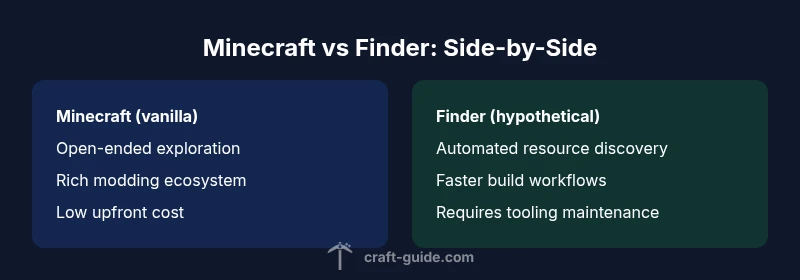
| Feature | Minecraft (vanilla) | Finder (hypothetical) |
|---|---|---|
| Resource discovery | Manual exploration and hand-scouted mining | Automated hints and guided discovery across the world |
| Modding ecosystem | Rich with data packs, mods, and plugins | Conceptual; potential tooling for automation |
| Upfront cost | Low to none (base game) | Variable (tooling and setup) |
| Learning curve | Steep for full mastery | Moderate to high depending on implementation |
| Maintenance after updates | High stability, community support | Depends on tooling maintenance |
| Best for | Long-term vanilla play and learning | Fast prototyping and automation-driven builds |
Benefits
- Low upfront cost and wide accessibility in vanilla Minecraft
- Extensive community resources and proven stability
- Rich modding and data-pack ecosystem that enables creativity
- Finder-like workflows can dramatically reduce repetitive tasks and speed up builds
Negatives
- Steeper learning curve for modded or Finder workflows
- Potential stability and compatibility risks with third-party tooling
- Reliance on external tooling can complicate updates and backups
Minecraft remains the default for most builders; Finder-inspired tooling is best for automation-focused projects.
Choose vanilla Minecraft if you value a stable base, broad community support, and long-term resilience. Opt for a Finder-inspired approach when speed, repeatability, and automated workflows are your priority, especially for large-scale builds.
People Also Ask
What is minecraft or finder in this article?
We compare vanilla Minecraft with a Finder-style workflow concept for resource discovery and automation. The goal is to help builders decide which approach fits their style and project goals.
We compare vanilla Minecraft with a Finder-style workflow concept for builders.
Is Finder a real product?
No real product called Finder exists in official Minecraft sources. Here, Finder refers to a hypothetical automation workflow or tool concept used for discussion.
Finder here is a hypothetical concept.
Which is better for beginners?
For beginners, vanilla Minecraft offers a gentle learning curve and abundant tutorials. Finder-like tooling may be too complex early on and is better tried after gaining basic familiarity with the core game.
For beginners, start with vanilla Minecraft.
How does modding affect the decision?
Mods expand possibilities but add potential instability. Finder workflows can help manage mods, but rely on tooling compatibility and ongoing maintenance.
Modding adds power but complexity.
Can Finder speed up building projects?
Finder-inspired workflows can speed up repetitive tasks but may reduce hands-on learning. A balanced approach often yields the best results.
Automation can speed things up, with balance.
What about performance and frame rates?
Performance depends on world size and tooling complexity. Vanilla Minecraft is typically smoother, while Finder workflows add processing and maintenance that can affect performance if not tuned.
Performance varies; vanilla is often smoother.
The Essentials
- Define goals before choosing between Minecraft and Finder workflows
- Vanilla Minecraft excels in stability and community-created content
- Finder-like tooling targets speed and repeatable processes
- A hybrid approach often balances learning with efficiency
- Always back up saves before adopting new tooling or automation