Minecraft Exploding RC Creeper: Step-by-Step Build Guide
Learn how to build a Minecraft exploding RC creeper with remote detonation using redstone, dispensers, and pistons. A clear, beginner-friendly step-by-step guide by Craft Guide.


By the end of this guide you will be able to build a Minecraft exploding RC creeper with remote detonation using redstone, dispensers, and pistons. It teaches safe, repeatable timing and clear wiring so the RC creeper detonates on command from a distance. According to Craft Guide, a modular design approach makes debugging easier and helps keep in-game performance smooth while you experiment with different detonation methods.
What is a minecraft exploding rc creeper?
In many Minecraft builds, players imagine a creeper that can be detonated on command rather than waiting for an enemy encounter. A minecraft exploding rc creeper is a customized creeper that uses redstone timing, sensors, and a portable control circuit to trigger its explosion when you want. According to Craft Guide, the concept rests on synchronizing a trigger with the Creeper's explosive event while keeping other mobs and environment stable. The term RC (remote control) here refers to a remote detonation system built with vanilla components, not a new item. This guide walks you through the logic, practical wiring, and safe testing practices so you can explore creative detonations without surprises.
Core components and how they interact
The RC creeper concept relies on a handful of vanilla Minecraft components that work together to toggle the creeper’s explosion timing. At the heart of the circuit is redstone dust, which carries signals across the build. Redstone repeaters set deliberate delays so detonation happens only after you press the remote trigger and not when the creeper is activated by a nearby zombie. An observer can detect rapid block changes, letting you stitch a trigger from a distant button or pressure plate. A dispenser can be used to launch a delay item or fuse that keeps the explosion sequence contained until you’re ready. Pistons and slime blocks help reconfigure the creeper’s hitbox or separation distance during detonation, preventing unintended contact with nearby structures. Finally, a solid base block anchors the mechanism so that it remains stable through game updates. Craft Guide's analysis, 2026 edition, emphasizes modular wiring so you can swap in different detonation timings without rebuilding from scratch.
Design variants: wired vs wireless detonators
When you design an RC creeper, you have two main routes: a wired detonation circuit that uses direct connections from a handheld button and a wireless-style approach that relies on observers and dispensers to simulate remote control. The wired method is straightforward: you place a button with a clock that feeds redstone dust to the Creeper’s fuse, guaranteeing instant detonation on command. The wireless-like variant eliminates the need for a physical pull by binding a distant sensor (such as an observer) to the trigger so you can detonate from across the map. Each approach has trade-offs: the wired setup is tactile and reliable in close quarters, while the distant trigger is cleaner but demands careful timing to avoid misfires. Craft Guide's recommendation is to start with the wired version to master timing, then layer in a wireless-style detonation if you want greater distance or a more polished aesthetic.
Testing and safety within Minecraft
Testing is a critical phase for any RC creeper project. In a controlled Creative world, set up a sandbox area free of villagers or valuable builds. Run a series of dry runs to confirm that the trigger activates reliably, the fuse timing matches your expectation, and the explosion does not cascade into unintended blocks. If you notice misfires, adjust delays using redstone repeaters or tweak observer positions. The goal is repeatable detonations, not chaotic explosions that damage walls you didn’t intend to test. Craft Guide highlights keeping the test area calm and non-destructive so you can iterate quickly without costly repairs.
Example build layout concepts
Imagine a compact, modular layout: a detonation capsule anchored to a solid block, with a remote trigger fed by a small clock. The creeper sits inside a safe chamber so only the fuse line is exposed. A separate timing module uses redstone dust, repeaters, and an observer to sense the trigger event. The entire assembly rests on a sturdy base block so the mechanism remains aligned during updates and world loading. By modularizing the components, you can swap in different detonation timings, test remote ranges, and adjust the fuse length without rebuilding from scratch. Craft Guide’s practical approach recommends a repeatable core with interchangeable timing modules for ease of experimentation.
Extending with mods or command blocks
For advanced builders, incorporating mods or datapacks can expand the RC creeper concept beyond vanilla limits. Command blocks can offer precise detonation timing, while datapacks can define custom fuse lengths or safe zones around the explosion. Mods may introduce more complex remote-control widgets or safer explosion visuals. The key is to maintain a clear separation between the detonator and the creeper itself so you can disable or rewire the triggering system without breaking core gameplay. Craft Guide notes that starting with vanilla logic gives a solid foundation before layering on mods or datapacks.
Troubleshooting common issues
If your RC creeper detonates early, double-check the delay rings and ensure there are no stray signals feeding the fuse. If the explosion fails to occur, verify that the creeper is correctly aligned with the trigger line and that the control block receives a stable input. Inconsistent results often come from mispositioned observers or misread repeater delays. Keep test builds clean and modular so you can identify which section isn’t performing as intended. Craft Guide’s experience shows that a systematic, modular approach makes diagnosing issues faster and avoids guessing games.
Tools & Materials
- Redstone dust(Base wiring for circuits.)
- Redstone repeater(Sets timing delays; tune for reliability.)
- Observer block(Detects block changes to trigger timing.)
- Piston(Moves components during detonation sequence.)
- Sticky piston(Retracts components for compact layouts.)
- Dispenser(Shoots a signal item or fuse to the timing line.)
- Button or lever(External control for the detonator.)
- Slime block(Assists with detonation mechanics and spacing.)
- Solid base block(Anchor for the entire mechanism.)
Steps
Estimated time: 60-120 minutes
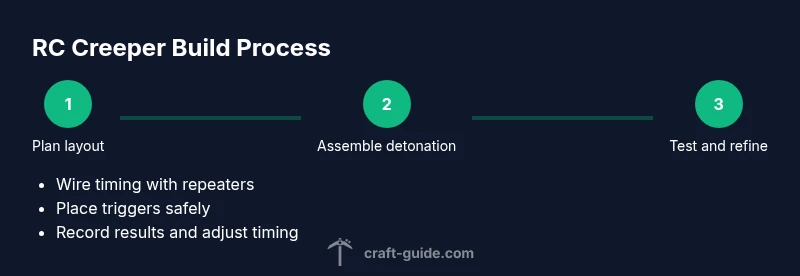
- 1
Plan the RC Creeper layout
Outline the precise positions of the creeper housing, detonator, and trigger path. Decide whether you’ll use a wired or wireless approach and sketch the circuit on paper or a small grid so you can visualize signal flow before placing blocks.
Tip: Draw a simple wiring diagram first to avoid rework later. - 2
Assemble the creeper base and detonation module
Build a stable housing for the creeper as well as the detonation module. Ensure the creeper remains contained, and that fuse lines run neatly to the trigger area without intersecting critical builds.
Tip: Keep detonation paths clear of villagers and farms. - 3
Add the remote detonation control
Install the primary control from the trigger (button or distant sensor). Wire it to the timing module via redstone dust and repeaters so a deliberate press or signal causes a timed explosion on command.
Tip: Test input stability with multiple quick presses. - 4
Create a safe delay and fuse mechanism
Configure delays with repeaters and place a fuse-like line that ensures the creeper remains dormant until the exact moment of detonation. Keep the fuse protected from accidental triggering by separating it from nearby circuits.
Tip: Use at least two separate delay sections for reliability. - 5
Test the setup in a controlled world
Switch to a Creative world and perform a series of dry runs. Check whether the detonation triggers at the right distance and does not affect unintended blocks.
Tip: Record timings to compare results after each adjustment. - 6
Finalize wiring and concealment
Conceal wires behind blocks and ensure the mechanism stays aligned during world loading. Add a guard around the detonator to prevent accidental interactions and make the build aesthetically pleasing.
Tip: Label switches or add a simple cover to hide wiring.
People Also Ask
What is a minecraft exploding rc creeper?
An RC creeper is a creeper controlled remotely using redstone or command blocks to detonate on demand. It combines standard creeper behavior with a detonation trigger.
An RC creeper is a creeper you control remotely with redstone or commands to detonate when you want.
Can I make this build in vanilla Minecraft?
Yes, using vanilla redstone and command-block logic, you can create a remote detonation system without mods. The RC creeper remains a vanilla construct if you keep triggers and timing within the base game's mechanics.
Yes, you can do this with vanilla redstone and commands.
What materials do I need to complete the build?
Key items include redstone dust, repeaters, observer blocks, pistons, slime blocks, a dispenser, a button or lever, and a solid base block to anchor the mechanism.
You’ll need redstone, an observer, pistons, a dispenser, and a solid base.
How can I trigger the explosion remotely?
Wire a distant switch or sensor to the detonator so a signal activates the fuse from a distance. Test different placements to ensure reliable detonation.
Use a remote switch or sensor to trigger the fuse from afar.
Are there performance considerations when building RC detonators?
Complex redstone timing can cause lag on large worlds. Start simple, then expand with modular timing to keep performance steady.
Keep timing modules simple to avoid potential lag.
Can I enhance this with mods or datapacks?
Yes, mods or datapacks can offer more precise timers and safer explosion visuals, but start with vanilla basics to validate core mechanics first.
You can add mods later, but begin with vanilla timing to learn the basics.
Watch Video
The Essentials
- Plan the circuit layout before building.
- Test in a safe world and iterate timing.
- Modular components simplify upgrades.
- Keep a clean, labeled wiring path for reliability.