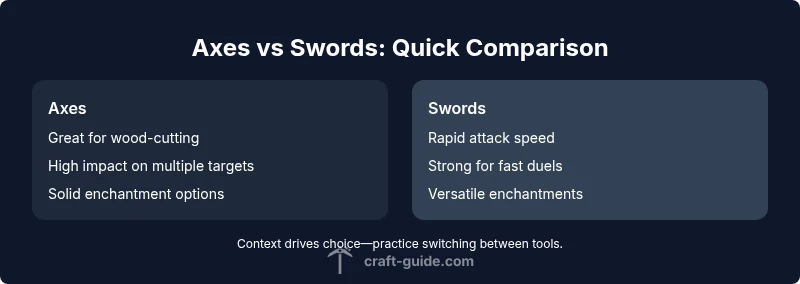
Axes vs Swords in Minecraft: A Practical Comparison
Explore when Minecraft axes outperform swords, focusing on combat dynamics, wood-cutting efficiency, and real-world build scenarios. This Craft Guide analysis breaks down context, enchantments, and loadouts for smarter decisions.


Axes vs swords in Minecraft boils down to context. If you ask why are minecraft axes better than swords, the short answer is that axes bring heavier per-hit impact and wood-cutting utility, while swords offer faster strikes and smoother single-target combos. Craft Guide analysis shows the best decision depends on your goals, terrain, and enchantment setup.
The practical question: axes vs swords in play
When you think about weapon choice in Minecraft, the question often boils down to a single trade-off: axes vs swords. The core question of why are minecraft axes better than swords is not universal; it depends on your objective and environment. In practical terms, axes typically deliver heavier per-hit impact and tend to support wood-related tasks or crowd control, while swords provide faster strikes and smoother single-target combos. According to Craft Guide, the best decision emerges from a mix of scenario, terrain, and enchantment setup, not a single stat. Understanding these nuances sets the stage for smarter loadouts across PvE, mining runs, and base-building.
This article reframes the comparison for builders and battlers alike, highlighting practical decisions you can apply in real play. You’ll see scenes where an axe pays off and others where a sword is the clear winner, along with ways to balance a kit so you’re never caught weaponless in a critical moment.
Core mechanics: attack speed, damage, and stance
The two tools diverge in how quickly you can strike and how hard each swing lands. In general, axes offer heftier hits per swing, which can translate to higher impact on crowded mobs and tougher targets. Swords, by contrast, enable rapid, fluid strikes that dominate in fast-paced fights and tight windows of vulnerability. Material quality matters a lot here: iron, diamond, and netherite variants shift the balance, but the overarching rule remains that axes trade speed for power while swords trade power for speed. This interaction shapes DPS in practical play, especially when you factor in critical hits, knockback, and enchantments that amplify either approach.
Beyond the blade itself, consider your stance and spacing. With axes you’ll often need to pause between swings to maximize a hit, while swords reward aggressive, quick sequences. The Craft Guide team emphasizes that mastery comes from practice with both tools and recognizing which scenarios favor one over the other. In dense environments like caverns or dense forests, axes can help you clear space, whereas open combat might favor swords for tempo.
Wood-cutting and tool utility
Wood-cutting utility is a pivotal factor in many survival runs. Axes have a distinct advantage when it comes to breaking wooden blocks quickly, which translates into faster shelter-building, fuel collection, and fence-line creation. This can be a meaningful time-saver during early-game phases where wood is abundant and huts or bridges are built rapidly. Swords, while not optimized for wood, remain valuable for defense and quick mobility in rugged terrain. For players focusing on resource collection and base expansion, carrying an axe as a primary tool for wood tasks while keeping a sword handy for defense is a sensible hybrid approach.
In terms of tool modality, both axes and swords share durability mechanics, so choosing one tool often reduces inventory clutter rather than increasing it. The best path for most players is to pre-plan a loadout that aligns with the day’s task—wood harvesting and base-building on one end, scouting and demolition on the other.
PvP vs PvE dynamics: where axes shine and where swords shine
PvE scenarios—fighting mobs in caves or during farming—often reward methods that balance area control with reliable damage. Axes can help when you’re facing groups of adversaries and need to land decisive blows to break lines quickly. PvP contexts, however, tend to reward speed, precise timing, and rapid weapon swaps, which favor swords. The choice hinges on how you engage enemies, whether you’re coordinating with allies, and how you manage threat levels in confined arenas.
The Craft Guide analysis suggests that successful players maintain flexibility—switching between weapon types as the fight and environment dictate. In practice, you’ll alternate between an axe to crater a cluster of enemies and a sword to chain quick hits when a single target presents an opening. Remember that enchantment setups can tilt the balance, often making swords more efficient in pure one-on-one duels and giving axes the edge in mixed combat.
Enchantments, durability, and progression
Enchantments add a strategic layer to any weapon choice. Both axes and swords can benefit from efficiency-enhancing enchantments, durability extensions, and combat bonuses. Sharpness or Smite-type enchantments boost damage against a range of targets, while Looting can improve drop yields from mobs—though availability and effectiveness can vary by version and material. At higher play levels, Mending and Unbreaking dramatically affect long-term viability, making the decision less about raw power and more about sustain during extended sessions.
Durability is a practical constraint. If you regularly engage in long expeditions or repeated mining runs, the durability of your weapon matters as much as its DPS. Players who value longevity often invest in Unbreaking and Mending, then decide whether the extra DPS of the other weapon justifies the extra enchantment setup. Craft Guide emphasizes balancing enchantments to suit your play frequency, resource access, and preferred combat tempo.
Practical loadouts for common playstyles
A typical base-building or exploration kit uses a primary tool for wood work and a secondary option for defense. For many players, an axe remains the go-to tool during base construction, enabling quicker frame-building and shelter maintenance. A sword in the off-hand or as a secondary weapon allows rapid responses to unplanned threats. In woodland biomes or heavily wooded areas, the axe becomes indispensable for clearing saplings and timber. In open or combat-focused zones, the sword’s quick strikes and mobility often outpace the axe in one-on-one skirmishes.
Loadouts should reflect the day’s goals. If you are gathering resources, lean on the axe for efficiency. If you’re exploring or raiding, carry a sword for expedient engagement. Enchantment plans should align with your playstyle—investing in durability and attack-enabling enchants on your primary tool while ensuring your backup weapon remains ready for sudden encounters.
Real-world strategies: swapping, resource awareness, and practice
Real-world practice matters more than theory. Practice weapon-swapping to reduce downtime between targets and to capitalize on each weapon’s strengths. Build muscle-memory for pacing your swings—avoiding spam and conserving stamina for critical moments. Resource-aware strategies include prioritizing wood-based environments and planning multiple trips so you’re never caught with a partial supply. The practical takeaway is simple: tailor each run to the tasks ahead and remember that there’s no single perfect weapon.
From a strategic viewpoint, players often find it beneficial to adopt a hybrid approach—carrying both an axe and a sword and swapping as needed, rather than committing to one tool. This flexibility is particularly valuable during multiplayer sessions where team roles influence loadouts as well as objectives. Craft Guide’s guidelines stress that skillful weapon management, not just weapon choice, determines success.
Common misconceptions and pitfalls
Many players assume axes are always superior when mobs cluster together, or that swords are universally best for combat. In reality, the environment and goals determine the best choice. A frequent pitfall is carrying only one weapon type and relying on it in all situations. Another misconception is ignoring enchantment synergy: even a less powerful tool can dominate in the right enchantment setup. Finally, players should avoid underestimating the importance of mobility and situational awareness when selecting any weapon loadout.
Improving your outcomes means testing scenarios, timing your hits, and learning when to switch tools. Craft Guide underscores that mastery comes from practical experimentation across PvE and base-building contexts, not from relying on a single stat line.
How to transition between axes and swords smoothly
Smooth transitions between axes and swords can dramatically improve combat efficiency. Develop a routine that uses the axe for crowd control and a quick shift to the sword for concentrated, high-speed hits. Practice swapping in response to mob positioning and environmental cues—this reduces wasted time and keeps you in control of the fight flow. A disciplined rotation minimizes downtime and maximizes damage output while keeping resource usage in check. Remember that the best players stay adaptable and practice switching under pressure, rather than sticking to a rigid plan.
Comparison
| Feature | Minecraft Axis | Minecraft Sword |
|---|---|---|
| Attack approach | Heavier hits, slower swings | Faster, lighter swings |
| Best use case | Crowd control and wood tasks | One-on-one combat and swift targeting |
| Block breaking utility | Excellent for wood-based blocks and crowded terrain | General-purpose tool for combat and quick tasks |
| Enchantment compatibility | Sharpness/Smite, Looting, Unbreaking, Mending | Sharpness, Looting, Unbreaking, Mending |
| Durability impact | Similar durability across materials | Similar durability across materials |
Benefits
- Better wood-cutting efficiency and crowd control in mixed tasks
- Strong raw impact in multi-target scenarios
- Versatile enchantment options on common materials
- Useful as a reliable fallback when exploring or building
Negatives
- Slower attack speed reduces DPS in pure PvP
- Not universally superior for all tasks depending on the context
- Carrying two weapons can add inventory management overhead
Axes are situationally advantageous for wood-centric tasks and crowd control, but swords remain superior for fast, precise PvP.
In mixed playstyles, an axis shines during base-building and mob crowds, while a sword dominates in quick, one-on-one combat. The best approach is to tailor your kit to the day’s objectives and practice swapping between tools for optimal efficiency.
People Also Ask
Are axes better than swords for PvE in Minecraft?
In PvE, axes can excel when facing groups or when wood-based tasks are common. They offer powerful hits that help create space and manage crowds, but may lag behind swords in pure fast-paced combat against single targets. Your success depends on the mob mix, terrain, and how you angle your swings.
Axes can help in PvE when you’re dealing with crowds; swords are faster for single targets. Your environment and strategy matter most.
Can axes be enchanted like swords?
Yes, axes can be enchanted with many of the same enchantments available to swords, such as Sharpness or Looting, depending on your version and material. Proper enchantment planning boosts durability and combat effectiveness across scenarios.
Axes can be enchanted similarly to swords; plan your enchantments to match your playstyle.
Do axes break wood blocks faster than swords?
Yes, axes are better suited for breaking wood blocks quickly, which is useful for shelter building and resource collection during early-game exploration. This makes them valuable for base-building tasks where time matters.
Axes cut wood faster, great for building and gathering materials quickly.
Should I carry both axes and swords?
For most players, carrying both tools provides flexibility: use the axe for wood tasks and crowd control, switch to the sword for quick, aggressive combat. This hybrid approach reduces downtime and adapts to changing threats.
Yes—both tools give you flexibility to handle different tasks.
Is swords’ speed always better for combat?
Swords offer faster attack speed, which is advantageous in quick duels and against nimble targets. However, the payoff depends on timing, enchantments, and the opponent’s defenses, so situational awareness matters more than raw speed alone.
Speed helps, but timing and strategy win fights, not speed alone.
How should I plan enchantments for axes vs swords?
Plan enchantments around durability and utility. Both tools benefit from Unbreaking and Mending, while Sharpness or Smite-type enchantments boost damage. Looting and Efficiency can also tilt the balance toward your chosen playstyle.
Enchantments should boost durability and combat effectiveness—tailor to your goals.
The Essentials
- Assess task first, choose tool by objective
- Use axes for wood work and crowd control during base builds
- Keep swords handy for fast, precise PvP moments
- Enchantments and durability management shape long-term viability
- Practice weapon-switching to maximize combat flow