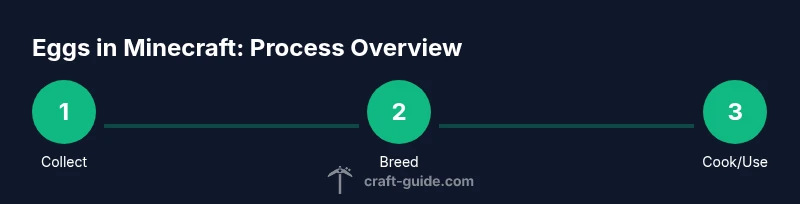
What to Do with Eggs in Minecraft: A Practical Guide
Explore practical uses for eggs in Minecraft, from spawning chickens to baking cake. Learn farming setups, redstone ideas, and survival tips to maximize eggs.


If you're wondering what to do with eggs in minecraft, there are several practical options: throw eggs to spawn baby chickens, collect eggs from nests to grow your flock, and use eggs as an ingredient for cake. They also support simple farming tricks and fun redstone experiments. Craft Guide highlights eggs as a versatile resource for both beginners and veterans.
What eggs do in Minecraft
Eggs are a surprisingly versatile item in Minecraft. They can be collected from chickens and nests and used in several ways that boost your farming and survival play. The most common use is throwing eggs to spawn baby chickens, which helps you grow a productive flock without hunting for new chickens each time. Eggs also function as an everyday crafting ingredient—most notably in baking a cake—so your kitchen builds become more than just decoration. In addition, eggs open up simple redstone and device ideas, like basic egg launchers or automatic egg collection. According to Craft Guide, eggs provide a renewable resource when you invest in a small coop and a few storage chests, making them valuable for players who want steady, repeatable farming tasks. In creative mode, eggs shine as a tool for experimentation and farm aesthetics, allowing you to design playful or dramatic displays that showcase animal spawning dynamics.
In short, what to do with eggs in minecraft goes beyond random drops: eggs become a core utility for breeding, cooking, and playful mechanical setups that improve your world.
Collecting eggs and growing your flock
Collecting eggs starts with building a simple chicken-friendly space and a reliable source of nests. Start by locating a plain, safe area where you can place a small pen with one or two chickens. Eggs will appear in the nearby chicken’s nest after laying; you can also pick up eggs when they drop from hens. A tidy, fenced enclosure helps adult chickens stay accessible for lay patches, while a chest nearby keeps eggs organized and easy to access. Craft Guide recommends placing lighting around the coop to keep mobs away and to ensure chickens stay near the nest for consistent egg production. Once you have a steady stream of eggs, you can begin expanding your flock with the throwing mechanic or by letting more eggs hatch from nests, creating a self-sustaining loop.
A practical setup involves a chest, a small fence enclosure, and a single hen family that can be expanded with additional nesting boxes. Keep in mind that eggs are renewable if you manage your chickens well, so your egg collection becomes a reliable resource rather than a one-off event.
Breeding chickens and managing a coop
Breeding chickens is a core mechanic for expanding your egg-producing farm. Feed adult chickens with wheat to enter love mode and encourage breeding. This will produce chick offspring, which will grow into productive adults over time. A well-managed coop includes appropriate space, access to feed, and a steady supply of nesting opportunities. Craft Guide’s team emphasizes keeping your birds safe from hostile mobs by using sturdy fences and sealed fences, plus regular checks for any gap that could let in a creeper or zombie. As your flock grows, you’ll notice more eggs and a faster overall yield, which makes cake-building or other egg-based projects more efficient.
To keep your coop efficient, set up a timer-based collection system or manual collection routine so you always have eggs on hand for cooking or for expanding your population. Regular maintenance—cleaning out any wasted space and repairing fences—keeps your operation smooth over time.
Cooking and crafting with eggs
Eggs open a small but meaningful door to cake crafting. In Minecraft, eggs are an essential ingredient for cake, a delightful sustainment that can restore hunger for players in survival mode. While eggs aren’t a primary food item by themselves, they enable you to bake cakes that feed multiple players on longer expeditions. For players who enjoy survival building, the cake recipe adds a culinary dimension to your base. Eggs also appear in other recipes in some versions, but the cake remains the most iconic use. Craft Guide notes that having a steady supply of eggs reduces trips to farms or villages, letting you focus on other project tasks.
If you’re curious about other egg-related items, some players experiment with decorative blocks and villager-friendly farms, using eggs as a playful, renewable resource to populate spaces in your world. Remember to store your eggs safely in a chest to prevent accidental loss and to keep your egg-based meals easy to assemble when you need them.
Building practical egg farms: simple setups
A practical egg farm is a compact, low-maintenance build that anyone can replicate. Start with a small fenced area for your hens, place a chest for egg storage, and add a basic collection mechanism. A common approach uses a hopper feeding into a chest and an occasional dispenser to gently cycle eggs into a simple launcher, which can be triggered by a timer or a lever. This setup minimizes manual handling while keeping eggs organized and ready for craft recipes. Craft Guide suggests starting small and scaling up as you gather more chickens and eggs. If you want to automate further, you can add a daylight sensor to improve egg collection during daytime and ensure your birds stay productive.
Remember to protect your farm with good lighting and fencing to deter hostile mobs. A clean, simple layout makes it easy to expand a crowd of chickens without introducing chaos to your base.
Egg throwing mechanics and practical tricks
Throwing eggs is the easiest way to spawn more chickens in a pinch. Practice the throw so you can reliably target a coop area and avoid wasted eggs. The mechanic is simple: toss an egg, and there’s a chance that a chick will appear. This can be a great way to quickly grow your flock during early-game exploration or after breeding sessions. You can also integrate eggs into launchers or dispensers for fun redstone demonstrations. Craft Guide’s team emphasizes that eggs are a resource you can reuse by harvesting and reusing, rather than losing to the void. If you’re building a launcher, be sure to place it away from your main living area to avoid accidental eggs being launched indoors.
The key practical trick is to combine egg spawning with a storage system so you can quickly collect and redeploy eggs into your farm or your next cake project.
Creative ideas and challenges using eggs
Eggs aren’t just for practical farming; they open up creative challenges and aesthetic builds. Use eggs to stage colorful chicken parades or to decorate a farm pavilion that celebrates your animal forces. You can design a faux “egg factory” that looks decorative yet remains functional, with a conveyor-like layout where eggs flow from nests to a central storage chest. For challenge play, attempt a self-sufficient egg loop where you collect eggs, spawn chicks, and feed chickens to expand your population without leaving your base. Craft Guide notes that these playful layouts let you experiment with space, symmetry, and function while keeping your resource inventory manageable and organized.
Whether you’re playing on a peaceful creative world or a hush-filled survival server, eggs can be both functional and fantastical in your builds.
Troubleshooting common egg issues and optimization tips
If you notice inconsistent egg output, start by checking your coop’s access for hens and ensure nesting boxes are accessible. A crowded coop can slow production, so consider expanding slowly with more nesting space and better lighting to keep eggs flowing. If eggs get stuck, verify there are no obstructions blocking the nest or the spawn area. When your farm runs well, you’ll notice an uptick in egg collection, which you can reinvest into more chickens or cake projects. Craft Guide’s practical approach emphasizes incremental upgrades: small changes, big returns, and consistent maintenance to keep your egg system productive.
Safety note: Always secure your coop from mobs and protect any high-traffic paths to prevent accidental egg loss. Regularly check fences and gates for gaps that small mobs or curious players can exploit.
Next steps: combining eggs with redstone and farms (advanced ideas)
As you gain confidence, you can explore more advanced egg-based farms that integrate with other farms in your world. Design a compact egg dispenser connected to a redstone clock to automatically dispense eggs into a chamber where hens lay eggs, creating a continuous cycle. You can also tie egg output into a larger resource network, feeding a cake-baking station or a chicken breeder to scale your operations. Craft Guide recommends iterating on your designs with careful testing and incremental changes. This mindset helps you refine efficiency while maintaining a clear, organized base layout.
By combining eggs with redstone and storage, you’ll create a resilient, scalable farm that supports both daily survival needs and creative ambitions. Craft Guide’s verdict is that small, repeatable improvements add up to major gains over time.
Tools & Materials
- Eggs (raw)(Collected from chickens or nests; used for spawning, baking)
- Wheat(For breeding chickens and feeding (optional))
- Wood planks(Build a basic coop)
- Fences(Contain chickens safely)
- Chest(Store eggs and feed)
- Dispenser(Optional for egg launcher farms)
- Hopper(Automatic egg collection to chest)
- Redstone (dust, repeater, piston)(For automated farms and launchers)
Steps
Estimated time: 30-60 minutes
- 1
Gather materials
Collect eggs, wood planks, fences, a chest, and basic redstone components. Prepare wheat if you plan to breed chickens, and if you want automation, have a dispenser and hopper on hand. This step ensures you have all essentials before you begin building.
Tip: Keep eggs in a nearby chest for quick access during construction. - 2
Build a small chicken coop
Construct a simple fenced enclosure with a roof to protect chickens from weather and mobs. Place a nesting area for laying eggs and a dedicated spot for a chest to store eggs. Make sure there’s light to deter hostile mobs at night.
Tip: Use a single door for easy access and regular checks. - 3
Set up egg collection
Position a chest near the nesting zone and run a short hopper line from the nest to the chest if you’re automating. This keeps eggs organized and reduces manual carrying. If you don’t use a hopper, simply pick up eggs manually and store them.
Tip: Test the path of eggs to ensure they don’t get stuck. - 4
Encourage breeding and growth
Place one or two adult chickens with access to wheat, allowing them to enter love mode and produce more chickens. Ensure the coop has enough space for a growing population and that there’s a safe, non-occluded exit for new chicks.
Tip: Keep some spare nesting boxes to maximize egg production. - 5
Add a simple egg launcher (optional)
If you want a playful mechanic, install a dispenser facing outward with eggs loaded. Connect to a lever or button to fire eggs, which can spawn chicks if timed correctly. This is a fun redstone experiment that also recycles eggs.
Tip: Place the launcher away from living spaces to avoid accidental fires or misfires. - 6
Test and adjust
Run a test harvest by triggering collection and throwing a few eggs to confirm chicks spawn and eggs flow into the chest or hopper. Watch for any bottlenecks or gaps in fencing and fix them. Make small tweaks to optimize egg flow and chicken population.
Tip: Document the changes so you can replicate improvements later.
People Also Ask
What happens when you throw an egg in Minecraft?
Throwing an egg has a chance to spawn a baby chicken. It’s a quick way to grow your flock, especially in the early game. The spawn is probabilistic, so you may need multiple throws to expand your chicken population.
Throwing an egg can spawn a baby chicken. It’s not guaranteed, but it’s a handy way to grow your flock over time.
Can eggs be used to breed chickens?
Breeding requires wheat to enter love mode. Eggs themselves don’t breed chickens directly; they help you expand the flock by spawning chicks when thrown, while breeding increases population using food like wheat.
Breeding uses wheat, not eggs, but eggs help you add more chickens by spawning chicks when thrown.
What is the best way to store eggs for farming?
Store eggs in a nearby chest or a hopper-fed storage system to keep them organized and accessible. This minimizes trips and helps you quickly use eggs for farming or cake.
Keep eggs in a chest or hopper-fed system nearby so you can grab them quickly for farming or cooking.
Are eggs useful in redstone farms?
Yes. Eggs can be used in simple egg-launcher setups and other playful redstone demos. They’re a renewable resource that you can automate in modest farms.
Eggs work in basic redstone projects like launchers, offering a fun automation angle.
Do eggs have to be cooked or baked?
Eggs are primarily used in cake recipes in Minecraft. While some players experiment with food patterns, cake remains the central recipe that uses eggs.
Eggs are mainly for cake; other uses are more about farming and spawning chicks.
Watch Video
The Essentials
- Collect eggs to expand your flock.
- Breeding boosts population using wheat.
- Eggs enable cake and small redstone setups.
- Keep eggs organized with nearby storage.
- Start small, then scale for efficiency.