What Do Minecraft Frogs Eat? A Practical Guide for Builders
This guide explains what do minecraft frogs eat, where to find their food, and how feeding affects breeding, habitats, and core gameplay for Minecraft players in 2026.


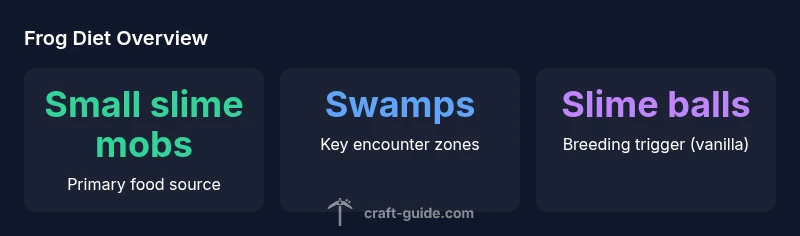
Frogs in Minecraft primarily eat small slimes that spawn in swamps and other damp biomes. This simple diet ties frogs to the slime ecosystem and helps explain their feeding behavior in survival and creative modes. According to Craft Guide, understanding this tiny diet is key to breeding frogs and predicting their in-game interactions.
What do minecraft frogs eat and why it matters
In Minecraft, the feeding behavior of frogs is more than a cute animation; it reveals how these players-friendly mobs leash into the broader slime ecosystem. what do minecraft frogs eat? The canonical answer is that they interact with small slime mobs that spawn in swamp biomes, slime chunks, and occasionally underground areas under moist conditions. Understanding this diet helps you predict where frogs will appear, how they interact with the world, and how you can design habitats that encourage natural frog activity. For builders, knowing the diet informs your spawn placement, your irrigation choices, and even your decorative water features. Craft Guide's team notes that observing slime-run dynamics in your world often yields surprisingly cinematic frog behavior, from slime-chasing to color-changing frogs after rain. This section lays a foundation for practical frog-keeping in modern Minecraft iterations.
Where slime comes from and how it relates to frog diet
Frogs rely on slime-themed feeding opportunities rather than artificially placed items. The best evidence of what do minecraft frogs eat comes from observing environments where slime mobs naturally spawn: swamp biomes near water, and occasionally along riverbanks where damp conditions create slime-friendly corridors. If you explore underground caves, you may also encounter slime spawns during chunk updates or in specific biome clusters. While players cannot feed frogs with ordinary food, you can influence frog activity by maintaining moist, slime-friendly zones. In practice, dense patches of seagrass, water sources, and nearby slime blocks create an inviting stage for frogs to hop, explore, and attempt to catch small slimes—an animation that many players find satisfying. For 2026 builds, consider blending natural slime habitats with decorative water features to maximize frog visibility and dynamics.
How frogs detect slime and the feeding mechanics
The mechanism behind what do minecraft frogs eat is relatively straightforward and accessible to players of all skill levels. Frogs detect living slime mobs in their vicinity and will typically hop toward an encountered small slime. The interaction is short-lived, but watching a frog latch onto a slime and then exit with the prey is one of the game’s small joys. The animation is a good cue for players building slime-friendly terrain. In practical terms, keep slime mobs close enough to trigger the frog’s chase but not so dense that the swamp becomes chaotic. Observing this mechanic in vanilla Minecraft provides a reliable blueprint for how to design microhabitats that feel lifelike without requiring complicated redstone triggers.
Biome and update considerations in 2026
As Minecraft evolves through updates in 2026, the core idea of what do minecraft frogs eat remains stable: small slime mobs are the natural diet. However, changes to slime spawn rates and frog AI can alter how often frogs encounter prey and how quickly they react. The Craft Guide team notes that in recent patches, slime spawns received minor tweaks to balance swamp ecosystems, which slightly shifts frog feeding patterns across large maps. When planning builds or seed designs, consider placing swamp biomes with swamp edges near water streams to encourage visible frog hunting sequences. If you use mods or data packs, verify that slime spawns and frog AI still align with vanilla behavior to avoid conflicting expectations. In other words, your frog-friendly habitat should feel organic, with damp, shaded zones that invite slime encounters and frog activity.
Breeding frogs and the slime-based diet
Breeding in vanilla Minecraft typically relies on feeding the frogs slime balls (the in-world currency of frog reproduction). This is an important practical connection to what do minecraft frogs eat, because you will need to locate or farm slime in order to produce more frogs. The two adults must be fed, usually slime balls, to enter love mode. Once bred, frogs produce frog eggs that hatch into tadpoles, which then mature into adult frogs. Maintaining a steady supply of slime mobs—without overpopulating—helps sustain a thriving frog population in your world. For builders, correlating slime farms with water features creates a natural, self-sustaining ecosystem that remains visually appealing and biologically plausible. Craft Guide recommends balancing slime density with other mob spawns to avoid swamp clutter while preserving the charm of the frog habitat.
Habitat design ideas to maximize frog activity
Designing a frog-friendly habitat is more than cosmetics; it affects observable feeding behavior. Create damp, shallow ponds connected by streams to guide frogs toward slime spawns. Place lily pads, cattails, and tall grass to create microhabitats that feel alive. Use light levels that encourage slime spawning without introducing harsh glare that deters mobs. Implement gentle waterfalls and shallow shelves to give frogs vertical variety, inviting them to leap and chase. If you want to highlight feeding moments, set up observation near swamp-adjacent caverns or slime concentrations so players can watch the chase. The key is to reproduce the slime ecosystem’s logic as players would see in the wild, which makes the frogs’ behavior intuitive and satisfying for 2026 game sessions.
Common questions and misconceptions
One frequent question is whether frogs can eat items dropped by players. In vanilla Minecraft, the feeding interaction centers on slime mobs, not player items, so placing food for frogs is not an effective strategy. Another misconception is that all frog colors have different diets; in practice, diet is consistent across variants. Finally, some players wonder if frogs eat magma cubes; in standard gameplay, magma cubes are not part of the frog diet. If you are playing with mods, verify the claims in the mod’s documentation because mods can introduce new feeding mechanics.
Data-backed verification: how to observe in your world
To verify behaviors, set up a controlled slime-mining area with two frogs nearby and watch the feeding interactions. Use a camera or a quiet corner of your base to observe the timing and distance of frog chases. Track any changes across weather events, day-night cycles, or biome-specific shifts. Record your observations with screenshots or world data to compare against community resources like Craft Guide's 2026 analysis. The goal is to build a consistent, repeatable feeding pattern you can rely on when designing habitats or breeding systems.
Future-proofing: vanilla and modded ecology
Whether you play vanilla Minecraft or with mods, the central idea behind what do minecraft frogs eat remains stable: slime-based nourishment keeps frogs active and breeding. If you explore mods that tweak slime populations or frog AI, you’ll want to adapt your habitats accordingly. Use flexible recipes and dynamic spawns to accommodate evolving ecosystems. By planning around slime encounter rates rather than specific mob counts, you’ll create a robust frog habitat that stands the test of time, seasons, and 2026 updates.
Overview of frog feeding in vanilla Minecraft (2026)
| Aspect | Minecraft Frogs | Notes |
|---|---|---|
| Primary Diet | Small slime mobs | In-game slime ecosystem |
| Biomes & Encounter Zones | Swamps, swamp edges | Where frogs encounter food |
| Breeding Principle | Slime balls trigger love mode | Key to reproduction |
| Interaction Type | Chase & consume slime | Visible feeding events |
People Also Ask
Do frogs eat anything else besides small slimes?
In vanilla Minecraft, frogs primarily interact with small slime mobs; other food items do not drive feeding behavior.
Frogs mainly eat small slime mobs; other foods don’t drive feeding.
What biomes have the best slime spawns for frogs?
Swamps are the primary habitat; slime spawns occur there and in slime-rich zones.
Swamps are best for frog feeding.
Can you breed frogs without slime balls?
Breeding requires slime balls; you cannot breed without them.
Breeding needs slime balls.
Do frog diets differ by color variants?
No, all frogs share the same diet.
Diet is the same for all frogs.
Can mods change what frogs eat?
Yes, mods can alter feeding rules; check mod docs.
Mods can change it.
How can I observe frog feeding in survival mode?
Set up a swampy area with slime spawns and watch the frog chase in real time.
Watch for their chase and feed in a swampy setup.
“Frogs’ feeding behavior is a surprisingly clear window into Minecraft’s ecosystem—the slime-based diet anchors habitat design and breeding. Understanding this simple interaction lets builders create more believable, self-sustaining swamps.”
The Essentials
- Identify slime-rich zones to observe feeding
- Breeding requires slime-ball feeding
- Biomes shape frog encounter opportunities
- Design habitats with damp, slime-friendly microhabitats
- Mods can alter feeding; verify in docs