Staircase Minecraft: A Practical Guide to Building Efficient Staircases
Learn to design and construct practical staircase minecraft solutions that save space, improve navigation, and look great in any Minecraft base. Step-by-step guidance, tips, and visuals for straight, switchback, and spiral stairs.


You will learn how to design and build an efficient staircase in Minecraft that saves space, improves movement between levels, and fits your base style. This quick answer covers the essential design choices (straight, switchback, spiral), material selection, and a basic build workflow to get you moving upward with confidence. By the end, you’ll be ready to tailor a staircase minecraft to any room.
Why Staircase Design Matters in Minecraft
A well-planned staircase minecraft isn’t just about moving from floor to floor. It affects navigation, mob safety, lighting, and overall aesthetics. Poorly spaced steps or random materials can make daily travel awkward or even dangerous in survival mode. Craft Guide’s approach emphasizes consistency, clear sightlines, and material harmony with your base. In practice, a thoughtful staircase reduces wasted space, speeds vertical movement, and enhances the sense of progression as you explore a base. When you build with intent, every ascent feels purposeful and satisfying, whether you’re entering an underground starter base or a sprawling fortress. This section explores why the staircase matters and how small choices compound for big gains in staircase minecraft design.
Types of Staircases in Minecraft: From Straight to Spiral
There isn’t a single “best” staircase minecraft style; each design serves different space constraints and aesthetics. A straight staircase is simplest and fastest to build, ideal for wide corridors and generous rooms. Switchback designs bend the ascent into tight corners, saving horizontal space but requiring careful planning for turns. Spiral stairs maximize compactness, perfect for towers or dense builds, but demand precise placement and lighting to avoid missteps. Materials influence not just looks but weight and texture in your world—stone brick conveys fortress vibes, while oak blends with rustic bases. Craft Guide analysis shows that most players benefit from starting with a straight ladder-like path and then iterating toward a switchback or spiral as space and confidence allow. Throughout, staircase minecraft usability hinges on consistent rise and run, even spacing, and clear lighting.
Material and Aesthetic Considerations for Staircase minecraft
Material choice matters for both function and style. Matching your stairs to surrounding blocks enhances cohesion, while high-contrast combinations improve visibility and navigation. Common options include oak stairs for a warm, classic look; stone brick for a sturdy, medieval feel; and quartz for a modern, clean aesthetic. In survival mode, durability and ease of sourcing are practical factors—wood is easy to gather, while stone blocks offer weathered appeal. Think about how your base’s lighting interacts with the stair design; a well-lit staircase reduces mob spawns and ensures safe travel at night. Craft Guide recommends iterating with different materials in a test area to compare how staircase minecraft feels under real gameplay conditions.
Designing for Small Spaces: Compact and Efficient Staircase minecraft Solutions
Not every base has the luxury of a wide corridor. For tight rooms, consider a two-wide straight staircase or a switchback with a shallow turn. Spiral staircases are especially effective in towers or vertical shafts, but they require careful dimensioning and rail-like edges to guide the player. If you’re building in a compact alcove, you can offset the stairs into a recessed wall or use see-through elements like fences or glass to maintain openness while saving space. In all cases, maintain a consistent rise per step and a comfortable rail height to ensure easy movement through your staircase minecraft.
Ergonomics and Movement: The Psychology of Vertical Travel
A staircase’s rhythm is almost musical: a steady cadence of steps that feels natural. Players should be able to ascend and descend without pausing or mis-steps, especially when carrying items. Establish a predictable rhythm by keeping the same number of blocks per rise and a uniform width. If you’re working with multi-level builds, plan landings between floors to break up long climbs and give players a moment to reorient. This ergonomic approach is a cornerstone of staircase minecraft that keeps exploration enjoyable.
Lighting, Safety, and Mob Considerations in Staircase minecraft
Lighting is more than atmosphere; it’s a practical tool to deter mobs and ensure visibility. Place torches or lanterns at regular intervals along the wall or under stair edges to minimize shadowy pockets. Avoid placing light sources directly on the stair treads, which can obscure steps and confuse movement. Where staircases pass close to enclosed spaces, consider rail-like barriers (fences, walls, or slabs) to prevent slips or accidental falls. A well-lit, clearly demarcated staircase minecraft improves safety for both players and any pets or mounts you may transport.
Step-by-Step Design Templates You Can Copy
If you’re aiming to copy a reliable template, start with a straight staircase that is two blocks wide. Once you’re comfortable, adapt to a switchback or spiral layout to save space. Use a test build area to verify alignment with walls, doors, and ceilings. You can adjust the material to match your base’s theme and still keep the cadence of movement consistent. This approach lets you experiment safely without committing to a single design before you’ve tested it in-world.
Common Pitfalls and Quick Fixes in Staircase minecraft
The most common mistakes are inconsistent risers, misaligned steps, and poor lighting. Fix a misaligned step by removing and re-placing the offending block with the correct height. If lighting is sparse, add a few more torches on walls or use lanterns hanging from ceilings. In small rooms, a staircase might feel claustrophobic; widen the corridor slightly or add a transparent rail to open up the space while preserving function. With practice, you’ll develop a sense for stable, comfortable staircase minecraft builds that fit your base’s personality.
Creative Ideas and Advanced Variations for Staircase minecraft
After you’ve mastered basics, push your creativity with slight asymmetry, half-block offsets, or decorative rails that mirror your base’s theme. A stairwell with integrated storage, a drop-down drop-off platform, or a hidden ladder leading to a maintenance tunnel can elevate your build. For vertical towers, a double-helix staircase minecraft design can be visually striking while remaining practical. The key is to test each variation in a controlled area and maintain consistent rise, run, and lighting. Craft Guide encourages experimentation, especially for ambitious bases.
Quick Reference: Design Checklist for Staircase minecraft
- Choose a primary material and ensure consistency across the build
- Decide on a straight, switchback, or spiral layout based on space
- Maintain a consistent rise and run for comfortable movement
- Place lighting to minimize mob spawns and illuminate steps
- Include guard rails or walls on exposed edges for safety
- Test travel in both directions with full inventory to gauge flow
- Adapt the design for multi-level structures with appropriate landings
References and Further Reading (Authority Sources)
For safety and ergonomics guidelines that influence stair design in Minecraft projects, see official guidance and research from recognized authorities. These sources provide general principles you can apply to your staircase minecraft projects: https://www.osha.gov, https://www.nist.gov, https://www.cdc.gov
Final Thoughts: Craft Guide’s Verdict on Staircase minecraft
A great staircase minecraft balances form and function. Plan with the surrounding space in mind, keep the cadence of steps consistent, and test changes in a safe build area. The Craft Guide team recommends starting with a simple straight design, then expanding to switchback or spiral configurations as you gain confidence. With deliberate planning and careful testing, your staircases will be both beautiful and practical.
Tools & Materials
- Stairs blocks (your chosen material)(Oak, spruce, stone brick, quartz, etc. Pick a material that fits your build.)
- Full blocks for risers/backing(Solid blocks to fill any gaps and provide strong wall support.)
- Lighting options (torches or lanterns)(Place along walls or under steps to prevent mobs spawning.)
- Scaffolding or ladders(Helpful for placing high sections or testing tall stairwells.)
- Crafting table(Useful if you’re crafting stairs on-site or changing materials mid-build.)
- Measuring blocks (temporary blocks for planning)(Useful for visualizing rise/run before placing permanent blocks.)
Steps
Estimated time: 20-40 minutes
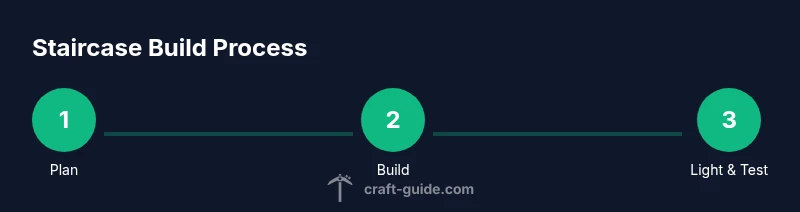
- 1
Plan your ascent path
Map the route of the staircase minecraft on paper or in a test area. Decide whether you’ll use a straight, switchback, or spiral approach and how many turns are feasible within your space. This planning phase prevents later rework and ensures comfortable movement.
Tip: Mark corners with temporary blocks to visualize geometry before committing. - 2
Choose your material
Select a material that harmonizes with your base’s theme and provides good contrast for visibility. If you’re in survival mode, consider materials that are easy to obtain while still looking intentional.
Tip: Aim for consistent texture and color to maintain visual cohesion. - 3
Set base and risers
Place the starting block and define each riser to maintain even height. Ensure the width stays consistent across all steps for a natural walking cadence.
Tip: Use a single width (commonly two blocks) for predictable movement. - 4
Place stairs and adjust
Layer stair blocks to build the ascent. Check that each step is reachable and that there are no hollow gaps that could cause missteps.
Tip: Test by climbing the stairs with a full inventory to simulate real use. - 5
Test and tweak
Walk the staircase minecraft in both directions. Confirm there are no awkward turns, and adjust the rise/run as needed to maintain comfort.
Tip: If space is tight, consider adding a landing between levels to improve flow. - 6
Lighting and safety
Install lighting to keep the path bright at night. Add guard rails or walls on exposed edges to help prevent accidental falls.
Tip: Edge lighting helps maintain visibility without creating glare on the steps.
People Also Ask
What is the best material for a staircase in Minecraft?
There is no single best material. Choose a material that matches your build and provides clear visibility. Use stairs blocks of your chosen wood or stone for a cohesive look.
There isn’t one best material; pick what matches your build and is easy to see.
How wide should a Minecraft staircase be?
Most classic staircases are two blocks wide to leave room for players and mobs. For tight spaces, a single-block-wide stair is possible but harder to use.
Two blocks wide is standard; single-block stairs work but are less comfortable.
Can I make a compact spiral staircase?
Yes. Use alternating turns and trapdoors to create a narrow spiral. Lighting is important to maintain visibility.
Yes, a compact spiral is doable with trapdoors and careful lighting.
Are ladders faster than stairs?
Ladders are slower for upward movement in most builds; stairs offer faster, more natural movement and safety.
Ladders are slower; stairs feel faster and safer.
How do I light stairs safely?
Place torches or lanterns along walls or under stair edges to minimize mob spawns while keeping path clear.
Light the path with torches to deter mobs and improve visibility.
What about multi-level staircases?
For multi-level, create landing platforms between floors and maintain consistent rise per level to avoid fatigue or confusion.
Add landing platforms and keep consistent rises between floors.
Watch Video
The Essentials
- Plan material to match surrounding builds
- Maintain consistent step height and width
- Test the staircase from multiple angles
- Light the path to deter mobs
- Consider space-saving spiral designs