Minecraft and Christianity: A Practical Comparison Guide
An analytical side-by-side look at how Minecraft intersects with Christianity, exploring education, ethics, and community, with practical guidelines for faith-informed play.


Minecraft and Christianity intersect when players use builds, servers, and shared storytelling to explore faith, ethics, and community. This comparison highlights how faith-informed play differs from conventional Minecraft gameplay, offering actionable guidance for educators, church groups, and curious players seeking constructive, inclusive experiences. Read on to see practical project ideas and best practices for integrating Minecraft with biblical themes.
Minecraft as a Platform for Faith Exploration
Minecraft has long been a canvas for imagination, and when players focus on faith topics the game becomes a gentle workshop for reflection. The combination of blocks, redstone, and open-ended exploration enables believers and non-believers alike to experiment with moral questions in a low-stakes environment. In the context of minecraft and christianity, builds can serve as portable chapels, parables enacted in stone and light, or narrative dioramas that invite discussion about justice, mercy, or stewardship. The goal is not to replace scripture or church teaching but to create spaces where questions can emerge naturally during play. For many, the act of constructing a scene from a Bible story or a parable becomes a form of enactment that deepens understanding and memory. The craft of building—choosing materials, planning layouts, and collaborating with others—mirrors processes used in faith communities when discussing creation, vocation, and responsibility.
From a learner’s perspective, Minecraft supports multiple modes of exploration: a tabletop studio for planning, a sandbox for experimentation, and a collaborative world where peers negotiate meaning together. The approach to minecraft and christianity in a classroom or youth group often emphasizes reflective practice: journaling during or after build sessions, group debriefs about the themes represented, and a shared code of conduct that honors the diversity of faith expressions. The Craft Guide team notes that the best outcomes arise when educators pair concrete building tasks with explicit questions about meaning, ethics, and spiritual formation. In these settings, the game becomes a bridge between play and faith rather than a distraction from it.
- Dieser block enthält ca. 260 Wörter -
Comparison
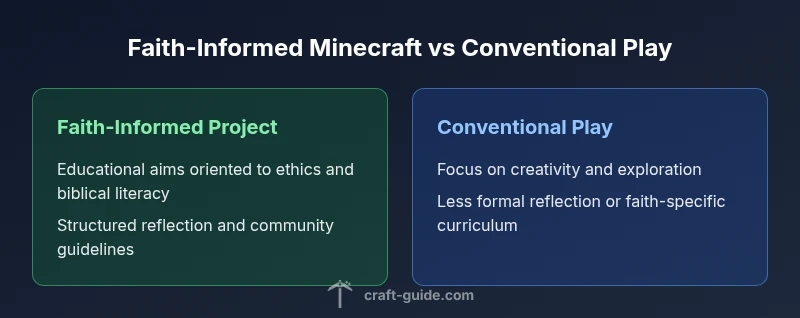
| Feature | Faith-Informed Build Project | Conventional Minecraft Play |
|---|---|---|
| Educational Value | High—explicit aims to teach faith-based concepts | Moderate—focus on gameplay skills, exploration |
| Community Norms | Explicit faith-aligned guidelines | Broader community norms |
| Moderation & Safety | Faith-focused moderation protocols | General server moderation |
| Accessibility & Inclusion | Explicitly inclusive with faith context, accessible to believers and curious players | Inclusive by default, less emphasis on faith context |
| Resource Requirements | Structured planning and curated resources | Lower upfront planning, flexible |
| Best For | Faith-based groups, Sunday schools, youth clubs | Casual players and servers |
Benefits
- Encourages collaborative learning through shared goals
- Supports creative expression while exploring ethics
- Can be aligned with faith-based curricula without being prescriptive
- Accessible to diverse learners with different backgrounds
Negatives
- Requires careful moderation to avoid proselytizing or exclusion
- May require more planning and resources than standard play
- Potential for misinterpretation of sacred texts if not guided
- Denominational differences can complicate consensus
Faith-informed Minecraft projects offer deeper engagement when well-moderated and purposefully designed
Overall, a faith-informed approach yields meaningful learning and community building. It works best when planners set clear goals, foster inclusive dialogue, and connect builds to scripture or faith-education objectives. The Craft Guide team recommends structured, values-based play that respects diverse beliefs while inviting thoughtful reflection.
People Also Ask
What is the relationship between Minecraft and Christianity?
Minecraft provides a flexible platform for exploring Christian themes—such as stewardship, community, and storytelling—without replacing traditional teaching. By pairing builds with reflective prompts, groups can discuss faith concepts in a collaborative, hands-on way.
Minecraft lets Christian ideas come alive through building and discussion.
Can Minecraft be used in church education?
Yes. When used thoughtfully, Minecraft can support Bible study, faith formation, and service-learning. Plan activities that align with your curriculum, include reflective debriefs, and ensure activities are welcoming to diverse backgrounds.
Church groups can use Minecraft to enrich faith formation, with proper planning.
What are best practices for faith-themed servers?
Establish clear codes of conduct, create faith-neutral moderation tools, invite diverse voices, and provide opt-in experiences. Keep discussions respectful and avoid prescriptive or coercive messaging.
Set rules, moderate fairly, and honor everyone’s beliefs.
Are there risks or criticisms to consider?
Potential misinterpretation of sacred texts, cultural insensitivity, and proselytizing pressures. Address these by offering balanced content, inclusive language, and roles that emphasize learning over conversion.
Be mindful of how faith topics are presented and moderated.
What are simple project ideas for beginners?
Try Noah’s Ark, Garden of Eden, or parables in diorama form. Start with a short story, then reproduce key scenes in a shared world, followed by a group reflection session.
Begin with simple builds tied to familiar stories.
How do you measure impact in faith-informed Minecraft projects?
Track engagement through participation, quality of reflection, and quality of discussion during debriefs. Use a simple rubric to assess understanding, empathy, and collaboration.
Look at participation and thoughtful discussion to gauge impact.
The Essentials
- Tie Minecraft builds to clear learning goals
- Create inclusive spaces with explicit guidelines
- Use reflection prompts after builds
- Balance faith-specific content with broad accessibility
- Pilot small groups before scaling