Is Minecraft Better or Free Fire? A Practical Comparison for Players
A practical, evidence-based comparison of Minecraft and Free Fire to help players decide which game fits their goals, from expansive creativity and long-term progression to fast-paced mobile battles.


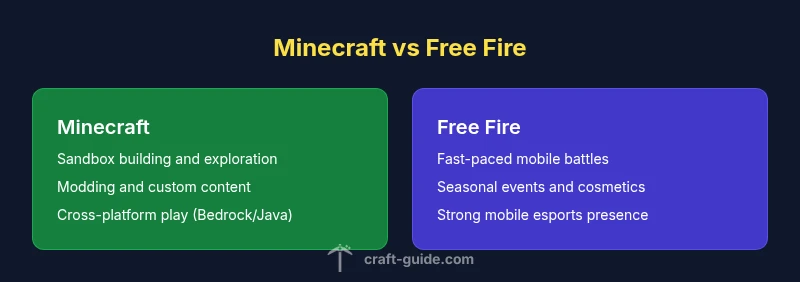
Is Minecraft better or Free Fire? The choice hinges on what you value: creativity and long-term progression favor Minecraft, while Free Fire delivers quick, competitive battles on mobile. If you seek a sandbox with endless building and modding options, Minecraft is the stronger pick. If you want fast matches, social play, and mobile accessibility, Free Fire is often the better option. Craft Guide analyzes player goals to guide your choice.
Core Gameplay Philosophies: Creativity vs Competitiveness
According to Craft Guide's framework, Minecraft centers on open-ended creativity, resource gathering, and experimentation. Players shape landscapes, build structures, and code with redstone or mods. The absence of a single winning condition means success is defined by personal milestones: a sprawling castle, a functional automation system, or a survival fortress. By contrast, Free Fire emphasizes fast, action-oriented combat in tightly timed matches. The goal is to outlast opponents in a shrinking map, with emphasis on reflexes, loadouts, and teamwork. These core differences shape how players approach progression, learning curves, and social play. In Minecraft, you can take days to plan a complex build, while Free Fire rewards quick decision-making and adaptive strategies within a 10- to 15-minute window. Both games reward repetition, but the motivations differ: mastery through creation in Minecraft, mastery through execution in Free Fire. Individual preference, device capability, and social circles often determine which path feels most satisfying. For younger players or education-focused play, Minecraft's creative mode can become a sandbox classroom; Free Fire's more straightforward shooter format can serve as a social gaming gateway. The Craft Guide team notes that neither game is inherently superior—each offers distinct, durable enjoyment depending on what you want to achieve.
Accessibility, Platforms, and On-the-Go Play
Minecraft supports multiple editions (including Bedrock and Java), enabling cross-platform play on consoles, PCs, and mobile devices. The Bedrock edition is especially friendly for cross-device experiences, while Java Edition remains popular among PC players who enjoy deeper modding and customization. Free Fire is designed primarily for mobile devices, with optimized performance on mid-range hardware and frequent updates that emphasize quick matchmaking and social features. Accessibility matters: Minecraft appeals to players who want long sessions, large-scale builds, and community-created mods; Free Fire appeals to players who want short, repeatable matches with friends, fast progression, and competitive leagues. Practically, players often choose based on their preferred gaming context—solo exploration and learning curves in Minecraft versus quick, social, mobile-first sessions in Free Fire. Craft Guide’s research suggests that device constraints and session length heavily influence choices. Both games support strong communities, but they cultivate different play rhythms and expectations for new players.
Progression, Endgame Goals, and Longevity
Minecraft offers a sense of endless progression through building, exploration, farming, and technical systems. There is no singular end state; players define milestones and challenges—whether it’s defeating a dragon in survival, automating farms with redstone, or completing massive architectural projects. Longevity comes from continual creativity and community-made content, which can be shared in servers, maps, and mods. Free Fire follows a structured progression path with clear endgame objectives: improve rank, unlock skins, and participate in time-limited events and tournaments. Matches are designed to be replayable in short bursts, which makes it easy to log many sessions in a single day. The ongoing updates keep the meta fresh, but the core loop remains a battle royale archetype: drop in, gather loot, outlast rivals, and repeat. Your long-term attachment may hinge on whether you value a crafted, evolving world (Minecraft) or a rapid, competitive grind with visible progression curves (Free Fire). Craft Guide’s analysis highlights how these distinct progression models impact motivation, learning curves, and social engagement.
Economic Models and Monetization Impact
Minecraft typically requires a one-time purchase for the base game, with optional add-ons like skins, texture packs, and mods that can be bought or downloaded for free, depending on platform policies. The modding ecosystem is a key driver of long-term engagement for many players, especially on PC. Free Fire follows a free-to-play model on mobile with monetization centered on cosmetic items, character skins, and passive power-ups accessed through in-game currency. The economic design influences how players invest time and money: Minecraft players often invest time in creation and discovery, while Free Fire players may invest more immediately in cosmetic customization and seasonal pass systems. In terms of value, Minecraft offers durable, user-generated longevity through mods and community content, while Free Fire emphasizes ongoing content drops and competitive ecosystems that sustain short- to mid-term engagement. Craft Guide analysis suggests both models support strong communities, but the perceived value depends on one’s willingness to pay for vanity items versus investing time in building or mastering a sandbox.
Community, Modding, and Content Creation
Minecraft has a robust, long-standing modding scene that enables everything from minor quality-of-life tweaks to total gameplay overhauls. Content creation thrives on tutorials, build showcases,
and adventure maps, with communities around servers and creative worlds. Free Fire’s community centers on mobile esports, fan art, and social media sharing of skins and highlights. Modding is far less central to Free Fire and is regularly limited by platform restrictions to preserve game balance. The contrast in user-generated content shapes the type of learning and collaboration you can expect: Minecraft fosters deep technical experimentation and collaborative builds; Free Fire emphasizes organized play, team tactics, and competitive storytelling in a shorter window. Craft Guide notes that neither community eclipses the other in importance; instead, each supports distinct ways to learn, share, and grow as a player.
Decision Scenarios: When to Pick Which Game
If you crave expansive creativity, long-term progression, and a sandbox with endless customization, Minecraft is the better pick. If you want quick, action-packed matches, social play, and strong mobile accessibility, Free Fire wins for most casual and mid-core players. For educators or learners, Minecraft’s sandbox can be used to teach planning, resource management, and collaboration, while Free Fire can teach split-second decision-making, teamwork, and reflex-based tactics. Consider your device, available time, and preferred playstyle. Craft Guide’s conclusion from analyzing player goals is that neither game is universally superior; the best choice is the one that aligns with your typical gaming sessions and social circle.
Comparison
| Feature | Minecraft | Free Fire |
|---|---|---|
| Core genre | Sandbox/creative | Battle Royale/shooter |
| Typical session length | Long-form builds and exploration | Short, action-packed rounds |
| Platform availability | Cross-platform on Bedrock/Java (PC, console, mobile) | Mobile-first with PC/emulator options |
| Monetization | One-time purchase plus optional add-ons/mods | Free-to-play with cosmetic microtransactions |
| Modding / content creation | Extensive modding, maps, shaders, and community content | Limited modding; content largely defined by the base game and updates |
| Learning curve | Varied; deep systems for builders and technologists | Steeper for new players due to mechanics but quick to pick up combat |
| Endgame/long-term goals | Endless, player-defined milestones | Ranked progression and seasonal events |
| Social play emphasis | Co-op builds, servers, and creative communities | Team-based matchmaking and livestreamable esports |
Benefits
- Offers deep, open-ended creativity and real sense of ownership
- Extensive community content and educational potential
- Strong modding and customization ecosystem
- Accessible in long play sessions and solo or group play
- Supports cross-platform play on Bedrock/Java
Negatives
- Can require significant time investment for meaningful progress
- Mod ecosystems can be chaotic or platform-restricted
- Free-to-play monetization in Free Fire may encourage cosmetic spending
Minecraft is the better long-term creative platform; Free Fire excels in quick, mobile, competitive play
Choose Minecraft for lasting projects and learning; choose Free Fire for fast, social matches and mobile accessibility. Your goal and device will determine the best fit.
People Also Ask
Which game is cheaper to start with?
Minecraft requires a purchase upfront, while Free Fire is free-to-play on mobile. Both offer optional in-game purchases, but the entry cost differs.
Minecraft costs upfront, Free Fire is free to start, with optional cosmetic purchases.
Which supports creative building more effectively?
Minecraft is designed for expansive building, world editing, and modding. Free Fire focuses on combat, with less emphasis on long-form construction.
If you want to build and create, Minecraft is the clear choice.
Can you play both on mobile and still have a good experience?
Minecraft runs on mobile via Bedrock Edition, with cross-platform play. Free Fire is mobile-first, with some PC/emulator options, but performance varies by device.
Both are playable on mobile, though Minecraft offers broader cross-platform options.
Which has a larger esports or competitive scene?
Free Fire has a strong mobile esports presence with frequent events. Minecraft's competitive play is community-driven, primarily through maps, servers, and mini-games.
Free Fire is more esports-focused on mobile; Minecraft competition is more community-built.
Is there skill transfer between the games?
Both games teach strategic thinking: Minecraft through planning and resource management; Free Fire through tactical movement, aiming, and team coordination.
Yes—planning helps in Minecraft, quick decisions help in Free Fire.
The Essentials
- Choose Minecraft for creativity and learning through building
- Choose Free Fire for fast-paced, mobile-focused action
- Platform and social circles should guide your choice
- Both games offer strong communities, but in different rhythms