How to Use Minecraft Pie Chart: Step-by-Step Guide
Learn practical, beginner-friendly steps to create and read pie charts in Minecraft, using maps and in-game blocks to visualize resources, mobs, and progress. This step-by-step guide from Craft Guide helps players visualize data clearly.


This guide shows you how to use a Minecraft pie chart to visualize data in-game, using maps and colored blocks to represent categories like resources, mobs, or progress. You’ll learn data preparation, color-coding, labeling, and layout basics so your chart is readable at a glance. By the end, you’ll have a working in-game chart you can reuse for future datasets.
What a Minecraft Pie Chart Is and Why It Matters
In Minecraft, a pie chart is a visual tool that translates a dataset into slices arranged around a circle, each slice representing a category with a distinct color. The concept is simple, but it makes comparison across categories immediate and intuitive. According to Craft Guide, pie charts in Minecraft help players manage complex data sets—like resource inventories, mob counts, farm outputs, or progress milestones—by turning numbers into a visual story that’s easy to interpret at a glance. The technique blends data visualization with creative in-game design, turning raw data into a memorable craft project. This section lays the groundwork for why you’d want a pie chart in your world and what you gain from transforming numbers into visuals. Read on to see how to choose a dataset and map it into a pie chart that teammates can understand quickly.
wordCount
Tools & Materials
- Minecraft world with a dataset prepared(Record counts for each category (e.g., ores, mobs, biomes) before starting)
- Colored maps or map items(One map per slice; ensure colors are distinct and consistently applied)
- Item frames (optional)(Use frames to display maps as a labeled, floating gallery)
- Dyes and basic building blocks(Color slices and labels; helps with quick identification)
- Notes or a small notebook (digital or paper)(Plan your labels and legend before placing slices)
Steps
Estimated time: 60-120 minutes
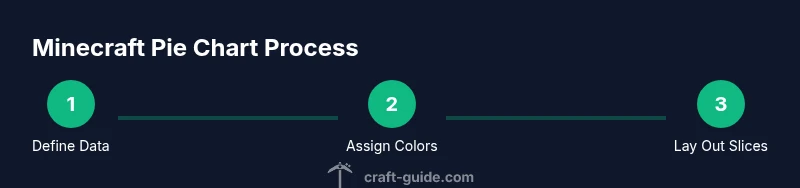
- 1
Define your dataset
Decide which categories you want to compare and gather reliable counts for each. Common choices include resource totals (gold, iron), mob populations, or progress milestones. Write down the exact numbers so you can translate them into proportional slices.
Tip: Keep categories mutually exclusive to avoid double-counting. - 2
Choose a visualization approach
Determine whether you will create a full circular pie chart or a semi-circle or donut style variation. Decide if you’ll map slices to maps in a circle around a center point or if you’ll place adjacent maps in a circular layout on a wall.
Tip: Consistency in slice ordering helps viewers compare charts across sessions. - 3
Assign colors to categories
Pick a color palette with 6–8 distinct, high-contrast colors. Assign each category a color and keep that mapping constant throughout your project. This reduces confusion as data changes over time.
Tip: Color contrast matters; avoid colors that blend with the in-game lighting. - 4
Create and label slices
Create individual maps for each category slice and color the map according to the assigned color. Attach a small legend nearby or on the chart itself to explain which color corresponds to which category.
Tip: Test readability from typical viewing distances in your world. - 5
Layout your pie chart in-world
Place maps in a circular arrangement around a central point to form a complete pie. Use a flat surface or a wall for alignment, ensuring equal spacing and consistent orientation so the chart reads like a single circle.
Tip: Mark compass directions to keep slices oriented correctly. - 6
Add labels and a legend
Add nearby signs or a legend block with color swatches showing which category each slice represents. Clear labeling removes guesswork and makes the chart usable for others.
Tip: Keep text concise; large labels can clutter the chart. - 7
Verify accuracy and readability
Review the chart with others if possible. Recheck counts, verify color associations, and confirm that the layout remains readable after lighting changes or other world events.
Tip: If the dataset changes, update the corresponding maps to reflect new slices. - 8
Document and reuse
Save the chart layout as a blueprint or a designed section of your world so you can reuse it with new data. This makes future datasets faster to visualize and share with teammates.
Tip: Create a blueprint note in your world file detailing how to update values.
People Also Ask
What data is best for a Minecraft pie chart?
Pie charts work well for comparing categories within a single dataset, such as resource counts, mob populations, or progress milestones. Choose data that sums to a meaningful whole so slices represent whole parts of the dataset.
Pie charts are ideal for comparing categories within a single dataset, like resources or mobs. Choose data that sums to a meaningful whole.
Can I build a pie chart entirely in-game without mods?
Yes. You can visualize data using maps, colored blocks, and item frames. This method relies on careful planning and planning of map colors, but you can achieve a functional chart without mods.
Yes, you can build a pie chart in-game using maps and colors without mods.
What if my data changes after I publish the chart?
Update the corresponding maps and, if needed, reorder slices to reflect the new totals. Keeping a simple update process in your blueprint helps maintain accuracy over time.
If data changes, update the maps and adjust the slices to keep the chart accurate.
Do I need external tools for prep?
External tools can help you tally data or test color schemes, but they are optional. Many builders prep data on paper or in a spreadsheet before translating it into the in-game visuals.
External prep is optional but helpful for complex datasets.
How can I include a legend without cluttering the chart?
Place a nearby legend on a sign or a dedicated legend tile, using color swatches and short category labels. Keep the legend compact and close to the chart for quick reference.
Use a compact nearby legend with color swatches to keep the chart clean.
Watch Video
The Essentials
- Define a clear dataset before building.
- Color-code slices and maintain consistent ordering.
- Place labels and a legend for clarity.
- Test readability in-world and update as data changes.
- Reuse chart layouts to save time on future datasets.